QUESTION IMAGE
Question
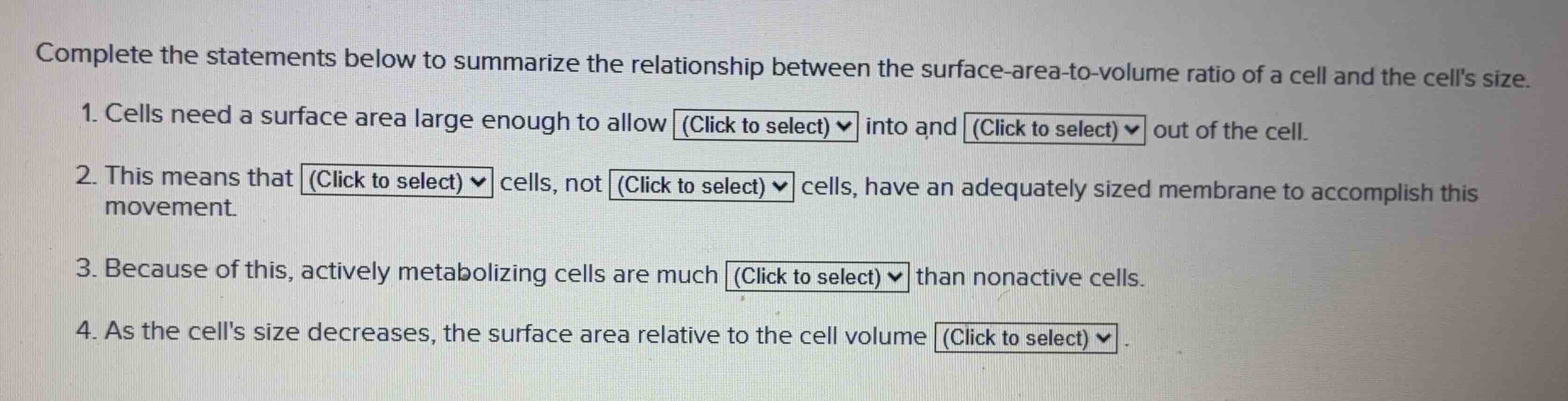
complete the statements below to summarize the relationship between the surface-area-to-volume ratio of a cell and the cells size.
- cells need a surface area large enough to allow click to select into and click to select out of the cell.
- this means that click to select cells, not click to select cells, have an adequately sized membrane to accomplish this movement.
- because of this, actively metabolizing cells are much click to select than nonactive cells.
- as the cells size decreases, the surface area relative to the cell volume click to select.
Analyze cell transport needs
Cells must exchange materials with their environment to survive. The plasma membrane serves as the gateway for this exchange. To maintain homeostasis, essential substances like nutrients and oxygen must move into the cell, while metabolic waste products must move out of the cell. Therefore, the surface area of the membrane must be large enough to accommodate the entry of nutrients and the exit of wastes.
Evaluate cell size constraints
As a cell grows larger, its volume increases much faster than its surface area (volume increases as a cubic function of radius, while surface area increases as a quadratic function). Consequently, smaller cells maintain a much higher surface-area-to-volume ratio than larger cells. This high ratio ensures that small cells, rather than large cells, have an adequately sized membrane relative to their volume to efficiently transport materials.
Determine metabolic activity effects
Cells that are actively metabolizing require a rapid exchange of nutrients and wastes to sustain their chemical reactions. Because smaller cells have a more favorable surface-area-to-volume ratio for rapid diffusion, actively metabolizing cells are typically much smaller than nonactive cells. This physical constraint prevents highly active cells from growing too large, as they would otherwise starve or accumulate toxic waste.
Relate size to ratio changes
Mathematically, the surface-area-to-volume ratio (\(SA/V\)) is inversely proportional to the characteristic linear dimension (size) of the cell. As the cell's size decreases, the denominator (volume) decreases much faster than the numerator (surface area). Thus, as cell size decreases, the surface area relative to the cell volume increases.

Snap & solve any problem in the app
Get step-by-step solutions on Sovi AI
Photo-based solutions with guided steps
Explore more problems and detailed explanations
Question 1
Cells need a surface area large enough to allow <blank>nutrients</blank> into and <blank>wastes</blank> out of the cell.
Question 2
This means that <blank>small</blank> cells, not <blank>large</blank> cells, have an adequately sized membrane to accomplish this movement.
Question 3
Because of this, actively metabolizing cells are much <blank>smaller</blank> than nonactive cells.
Question 4
As the cell's size decreases, the surface area relative to the cell volume <blank>increases</blank>.