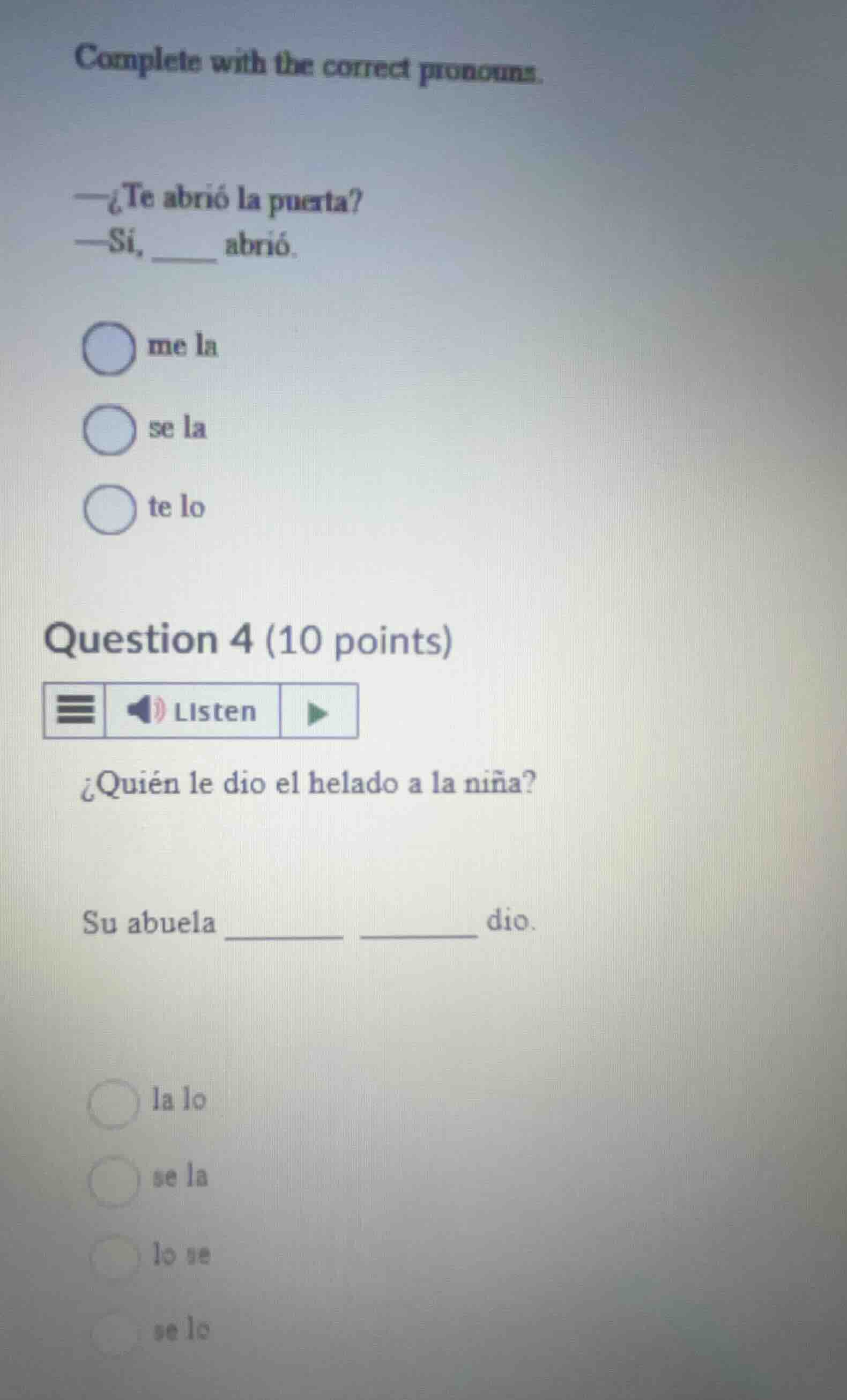
QUESTION IMAGE
Question
complete with the correct pronouns.
-\\u00bfte abri\\u00f3 la puerta?
-s\\u00ed, _____ abri\\u00f3.
me la
se la
te lo
question 4 (10 points)
\\u00bfqui\\u00e9n le dio el helado a la ni\\u00f1a?
su abuela ___ ___ dio.
la lo
se la
lo se
se lo
<pre_analysis>
{
"quality": "clear",
"question_count": 2,
"skills_matched": [
"direct_cot",
"multiple_choice_formatter",
"explain_then_answer",
"quick"
],
"needs_drawing": false,
"concepts_used": [
"Spanish Pronouns"
],
"new_concepts": [
"Spanish Double Object Pronouns"
],
"current_concepts": [
"Spanish Pronouns",
"Spanish Double Object Pronouns"
]
}
</pre_analysis>
<reasoning>
Analyze the first question
- Question: "—¿Te abrió la puerta? —Sí, _____ abrió."
- The question asks: "Did he/she open the door for you?"
- The response is: "Yes, he/she opened it for me."
- Indirect object pronoun: "for me" = "me"
- Direct object pronoun: "the door" ("la puerta", feminine singular) = "la"
- Combined double object pronouns: "me la"
Analyze the second question (Question 4)
- Question: "¿Quién le dio el helado a la niña? Su abuela ___ ___ dio."
- The question asks: "Who gave the ice cream to the girl?"
- The response is: "Her grandmother gave it to her."
- Indirect object pronoun: "to her" ("a la niña") = "le" (changes to "se" before "lo")
- Direct object pronoun: "the ice cream" ("el helado", masculine singular) = "lo"
- Combined double object pronouns: "se lo"
</reasoning>
<answer>
Question 1
<mcq-correct>me la</mcq-correct>
<mcq-option>se la</mcq-option>
<mcq-option>te lo</mcq-option>
Question 2
<mcq-option>la lo</mcq-option>
<mcq-option>se la</mcq-option>
<mcq-option>lo se</mcq-option>
<mcq-correct>se lo</mcq-correct>
</answer>
<post_analysis>
{
"subject": "Others",
"question_type": "Multiple Choice",
"knowledge_point": [
"Others",
"Spanish",
"Spanish Double Object Pronouns"
]
}
</post_analysis>
Snap & solve any problem in the app
Get step-by-step solutions on Sovi AI
Photo-based solutions with guided steps
Explore more problems and detailed explanations
<pre_analysis>
{
"quality": "clear",
"question_count": 2,
"skills_matched": [
"direct_cot",
"multiple_choice_formatter",
"explain_then_answer",
"quick"
],
"needs_drawing": false,
"concepts_used": [
"Spanish Pronouns"
],
"new_concepts": [
"Spanish Double Object Pronouns"
],
"current_concepts": [
"Spanish Pronouns",
"Spanish Double Object Pronouns"
]
}
</pre_analysis>
<reasoning>
Analyze the first question
- Question: "—¿Te abrió la puerta? —Sí, _____ abrió."
- The question asks: "Did he/she open the door for you?"
- The response is: "Yes, he/she opened it for me."
- Indirect object pronoun: "for me" = "me"
- Direct object pronoun: "the door" ("la puerta", feminine singular) = "la"
- Combined double object pronouns: "me la"
Analyze the second question (Question 4)
- Question: "¿Quién le dio el helado a la niña? Su abuela ___ ___ dio."
- The question asks: "Who gave the ice cream to the girl?"
- The response is: "Her grandmother gave it to her."
- Indirect object pronoun: "to her" ("a la niña") = "le" (changes to "se" before "lo")
- Direct object pronoun: "the ice cream" ("el helado", masculine singular) = "lo"
- Combined double object pronouns: "se lo"
</reasoning>
<answer>
Question 1
<mcq-correct>me la</mcq-correct>
<mcq-option>se la</mcq-option>
<mcq-option>te lo</mcq-option>
Question 2
<mcq-option>la lo</mcq-option>
<mcq-option>se la</mcq-option>
<mcq-option>lo se</mcq-option>
<mcq-correct>se lo</mcq-correct>
</answer>
<post_analysis>
{
"subject": "Others",
"question_type": "Multiple Choice",
"knowledge_point": [
"Others",
"Spanish",
"Spanish Double Object Pronouns"
]
}
</post_analysis>