QUESTION IMAGE
Question
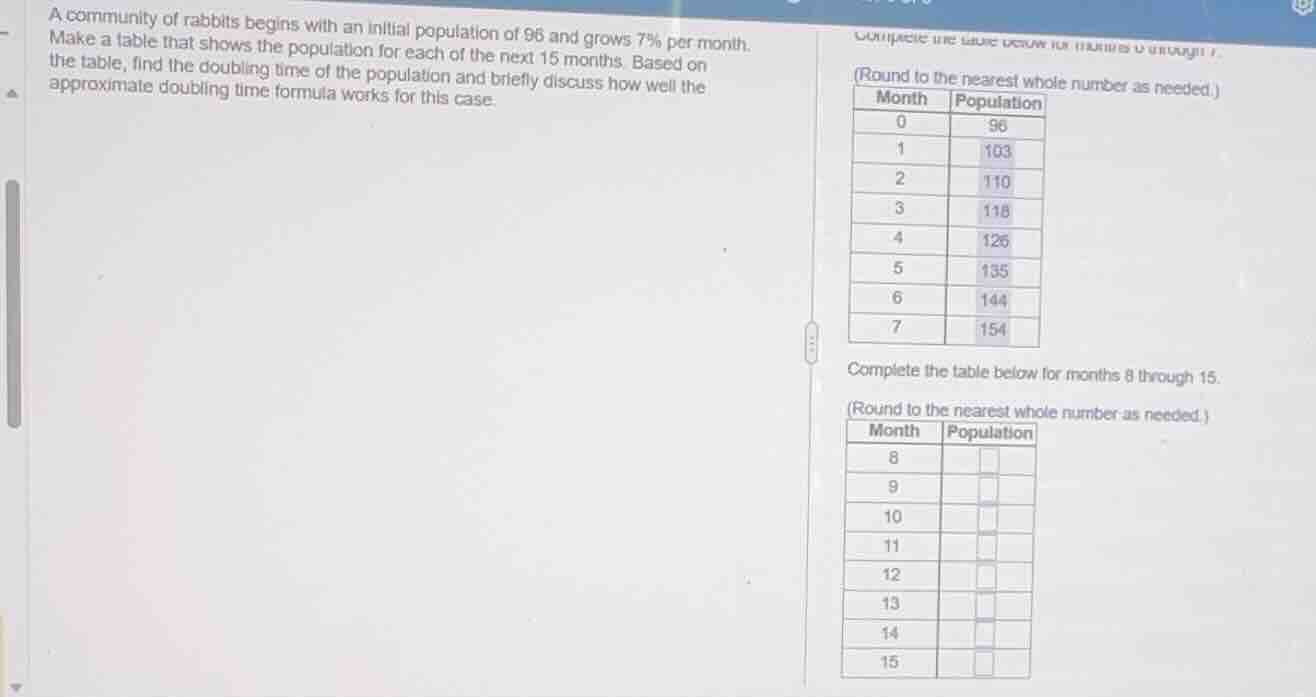
a community of rabbits begins with an initial population of 96 and grows 7% per month. make a table that shows the population for each of the next 15 months. based on the table, find the doubling time of the population and briefly discuss how well the approximate doubling time formula works for this case.
complete the table below for months 0 through 7.
(round to the nearest whole number as needed.)
\
complete the table below for months 8 through 15.
(round to the nearest whole number as needed.)
\
Model the population growth
We model the rabbit population using the Exponential Growth formula:
Given:
- Initial population \(P_0 = 96\)
- Growth rate \(r = 0.07\) per month
- Time \(t\) in months
The model is:
Calculate populations for months 8 through 15
We calculate the population for each month \(t\) from 8 to 15, rounding to the nearest whole number:
- For \(t = 8\): \(P(8) = 96(1.07)^8 \approx 164.95
ightarrow 165\)
- For \(t = 9\): \(P(9) = 96(1.07)^9 \approx 176.49
ightarrow 176\)
- For \(t = 10\): \(P(10) = 96(1.07)^{10} \approx 188.85
ightarrow 189\)
- For \(t = 11\): \(P(11) = 96(1.07)^{11} \approx 202.07
ightarrow 202\)
- For \(t = 12\): \(P(12) = 96(1.07)^{12} \approx 216.21
ightarrow 216\)
- For \(t = 13\): \(P(13) = 96(1.07)^{13} \approx 231.35
ightarrow 231\)
- For \(t = 14\): \(P(14) = 96(1.07)^{14} \approx 247.54
ightarrow 248\)
- For \(t = 15\): \(P(15) = 96(1.07)^{15} \approx 264.87
ightarrow 265\)
Determine the doubling time from the table
Using the Doubling Time concept, we find when the population reaches twice the initial value:
Looking at our calculated values:
- At \(t = 10\), the population is \(189\) (just under \(192\)).
- At \(t = 11\), the population is \(202\) (just over \(192\)).
Thus, the population doubles between month 10 and month 11, which is approximately 10.2 months.
Compare with the approximate doubling time formula
Using the Rule of 70 approximation formula:
where \(R\) is the percentage growth rate:
The approximate formula yields 10 months, which is very close to the actual doubling time of approximately 10.2 months observed from the table.

Snap & solve any problem in the app
Get step-by-step solutions on Sovi AI
Photo-based solutions with guided steps
Explore more problems and detailed explanations
| Month | Population |
|---|---|
| 9 | 176 |
| 10 | 189 |
| 11 | 202 |
| 12 | 216 |
| 13 | 231 |
| 14 | 248 |
| 15 | 265 |
Doubling Time Analysis:
- From the table: The initial population is 96. Doubling this population requires reaching 192. The population is 189 at month 10 and 202 at month 11, indicating a doubling time of approximately 10.2 months.
- From the formula: The approximate doubling time formula (Rule of 70) gives \(T_{\text{double}} \approx \frac{70}{7} = 10\) months. This approximation works remarkably well, as it is extremely close to the actual doubling time of about 10.2 months.