QUESTION IMAGE
Question
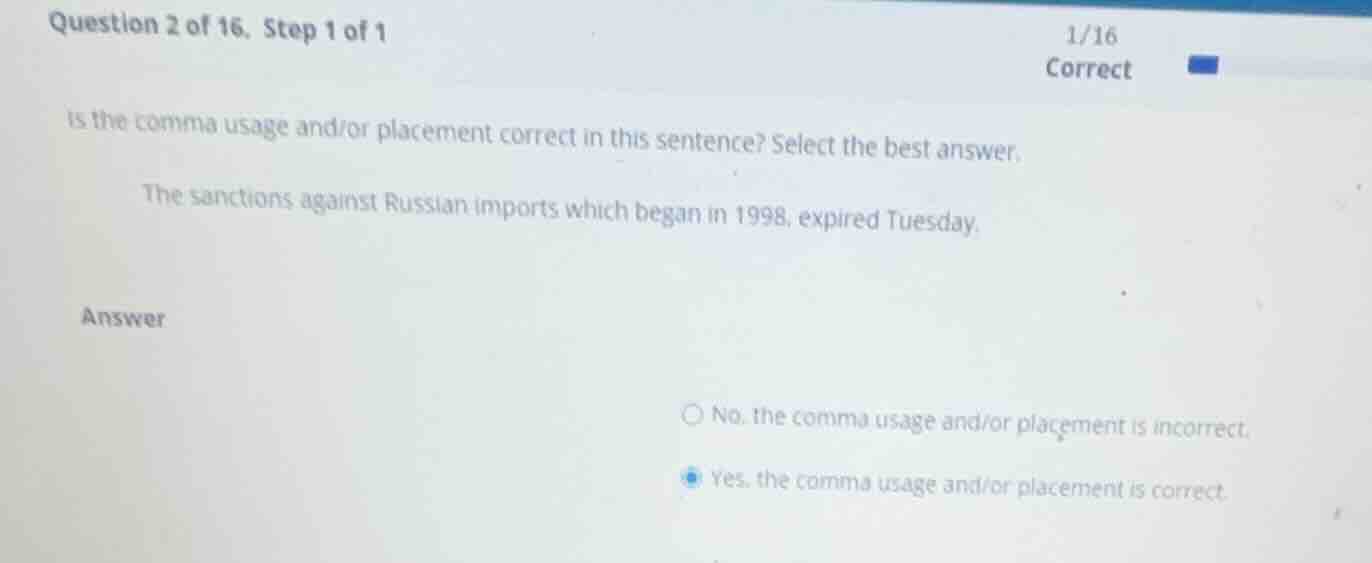
is the comma usage and/or placement correct in this sentence? select the best answer.
the sanctions against russian imports which began in 1998, expired tuesday.
answer
no, the comma usage and/or placement is incorrect.
yes, the comma usage and/or placement is correct.
🆕 New Concept Discovered: Restrictive vs. Non-Restrictive Clauses
Identifying essential vs. extra information in a sentence.
Step 1: Analyze the clause structure
The sentence is:
"The sanctions against Russian imports which began in 1998, expired Tuesday."
Let's look at the clause: "which began in 1998".
In English grammar, relative clauses starting with "which" can be either:
- Non-restrictive (non-essential): They add extra information that isn't required to identify the noun. These must be set off by commas on both sides.
- Restrictive (essential): They define exactly which noun we are talking about. These do not use commas at all.
Step 2: Evaluate the comma placement
In this sentence, there is a single comma after the clause:"...imports which began in 1998, expired Tuesday."
- If the clause is meant to be non-restrictive (extra information), it is missing a matching comma before "which":
- Incorrect: "...imports which began in 1998, expired..."
- Correct: "...imports, which began in 1998, expired..."
- If the clause is meant to be restrictive (essential information identifying which specific sanctions expired), there should be no commas at all:
- Correct: "...imports which began in 1998 expired..."
Because there is only one comma separating the subject and its verb (expired), the punctuation is grammatically incorrect.

Snap & solve any problem in the app
Get step-by-step solutions on Sovi AI
Photo-based solutions with guided steps
Explore more problems and detailed explanations
No, the comma usage and/or placement is incorrect.