QUESTION IMAGE
Question
clues
across (a)
- see 3d
- cube
- 5 times 3d
down (d)
- square
- 4 times 1a
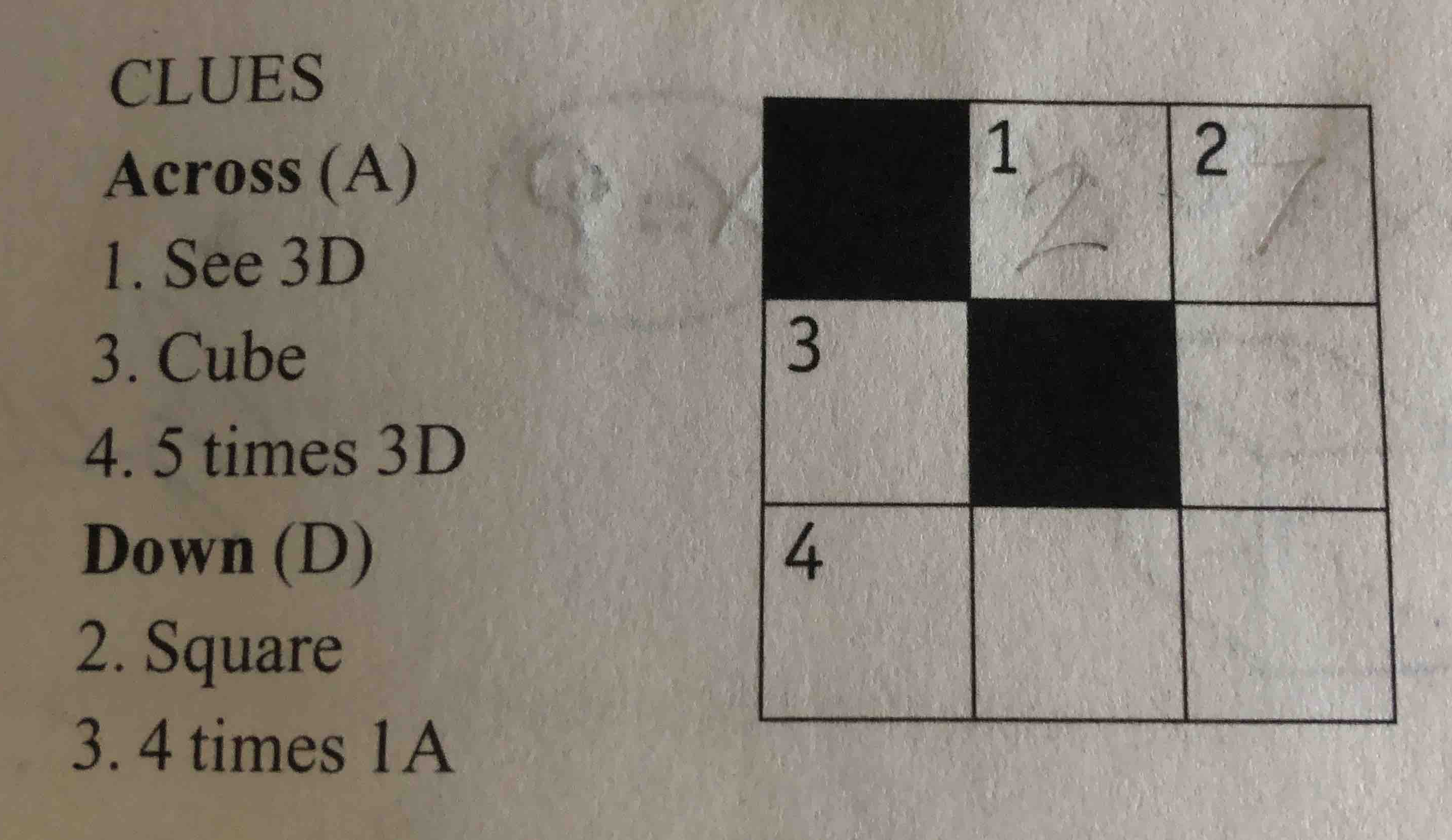
Analyze grid structure
The grid is a \(3 \times 3\) crossnumber puzzle. Let the digit in row \(r\) and column \(c\) be \(d_{r,c}\) for \(r, c \in \{1, 2, 3\}\).
- Row 1: Column 1 is black. Column 2 is labeled 1. Column 3 is labeled 2.
- \(1\text{A}\) is a 2-digit number: \(10 \cdot d_{1,2} + d_{1,3}\).
- Row 2: Column 1 is labeled 3. Column 2 is black. Column 3 has no label.
- \(3\text{A}\) is a 1-digit number: \(d_{2,1}\).
- The cell in Row 2, Column 3 is \(d_{2,3}\).
- Row 3: Column 1 is labeled 4. Column 2 has no label. Column 3 has no label.
- \(4\text{A}\) is a 3-digit number: \(100 \cdot d_{3,1} + 10 \cdot d_{3,2} + d_{3,3}\).
- Column 1: Row 1 is black. Row 2 is labeled 3. Row 3 is labeled 4.
- \(3\text{D}\) is a 2-digit number: \(10 \cdot d_{2,1} + d_{3,1}\).
- Column 2: Row 1 is labeled 1. Row 2 is black. Row 3 has no label.
- There is no vertical clue starting at 1.
- Column 3: Row 1 is labeled 2. Row 2 has no label. Row 3 has no label.
- \(2\text{D}\) is a 3-digit number: \(100 \cdot d_{1,3} + 10 \cdot d_{2,3} + d_{3,3}\).
Formulate clue equations
Let:
- \(x = 1\text{A}\) (a 2-digit number)
- \(y = 3\text{D}\) (a 2-digit number)
From the clues:
- \(1\text{A} = \text{See } 3\text{D}\)
- \(3\text{A} = \text{Cube}\)
- \(4\text{A} = 5 \times 3\text{D}\)
- \(2\text{D} = \text{Square}\)
- \(3\text{D} = 4 \times 1\text{A}\)
From clue 5:
From clue 1:
Since \(1\text{A}\) is "See \(3\text{D}\)", and \(3\text{D} = 4x\), \(1\text{A}\) must relate directly to the digits or value of \(3\text{D}\). Since \(1\text{A} = x\) and \(3\text{D} = y = 4x\), the clue "See \(3\text{D}\)" combined with \(3\text{D} = 4 \times 1\text{A}\) is consistent with \(y = 4x\).
Determine values of x and y
Since \(x\) is a 2-digit number, \(10 \le x \le 99\).
Since \(y = 3\text{D}\) is a 2-digit number, \(10 \le y \le 99\).
Since \(y = 4x\):
Let's look at \(3\text{A}\), which is the single digit \(d_{2,1}\).
\(3\text{D}\) is the 2-digit number \(10 \cdot d_{2,1} + d_{3,1}\).
Thus, the tens digit of \(3\text{D}\) is \(d_{2,1}\).
We are given that \(3\text{A}\) (which is \(d_{2,1}\)) is a perfect cube.
The only single-digit perfect cubes are \(1\) and \(8\) (since \(0\) is typically not a leading digit, and \(27\) is 2-digit).
Thus, \(d_{2,1} \in \{1, 8\}\).
This means the tens digit of \(y = 3\text{D}\) must be either \(1\) or \(8\).
Since \(y = 4x\), let's test the possible values of \(x\) (\(10 \le x \le 24\)):
- If \(d_{2,1} = 1\), then \(10 \le y \le 19\).
- Since \(y = 4x\), the only multiple of 4 in this range is \(12\) (\(x = 3\), but \(x\) must be a 2-digit number, so \(x \ge 10\), which is a contradiction) and \(16\) (\(x = 4\), also a contradiction).
- If \(d_{2,1} = 8\), then \(80 \le y \le 89\).
- The multiples of 4 in this range are:
- \(y = 80 \implies x = 20\)
- \(y = 84 \implies x = 21\)
- \(y = 88 \implies x = 22\)
Let's test these three cases.
Evaluate candidate solutions
We have \(y = 3\text{D}\) and \(x = 1\text{A}\).
Since \(x = 1\text{A}\), the digits of \(x\) are \(d_{1,2}\) and \(d_{1,3}\).
Since \(y = 3\text{D}\), the d…

Snap & solve any problem in the app
Get step-by-step solutions on Sovi AI
Photo-based solutions with guided steps
Explore more problems and detailed explanations
The completed crossnumber grid is:
| Col 1 | Col 2 | Col 3 | |
|---|---|---|---|
| Row 2 | 8 | ⬛ | 0 |
| Row 3 | 4 | 2 | 0 |