QUESTION IMAGE
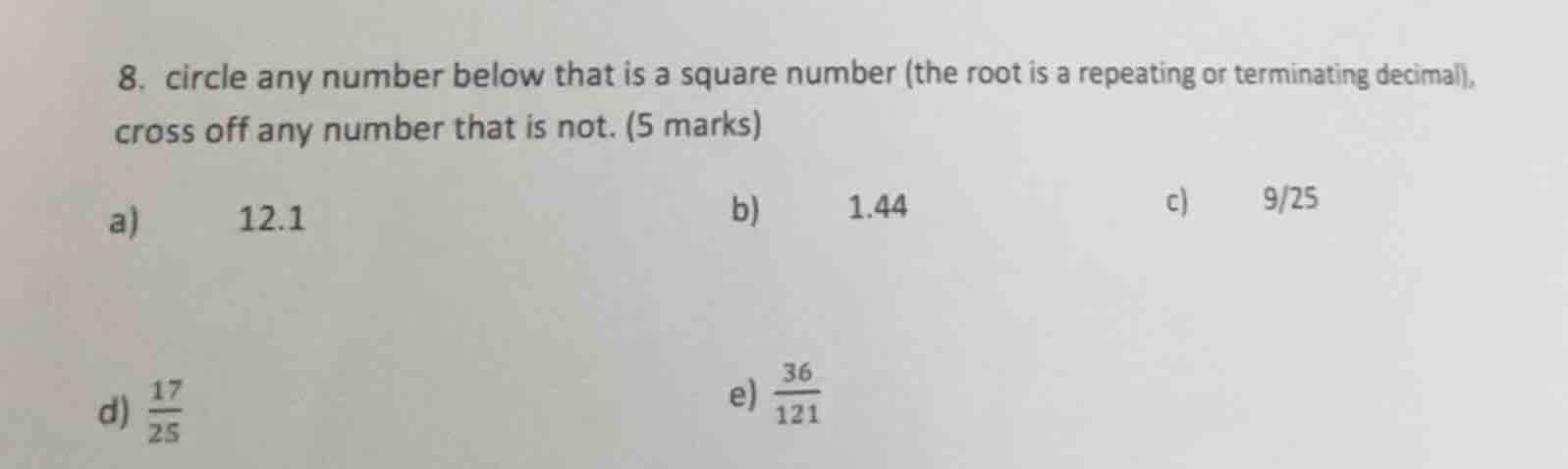
Question
- circle any number below that is a square number (the root is a repeating or terminating decimal), cross off any number that is not. (5 marks)
a) 12.1
b) 1.44
c) \\(\frac{9}{25}\\)
d) \\(\frac{17}{25}\\)
e) \\(\frac{36}{121}\\)
Analyze the definition of a square number
To determine if a number is a square number, we find its square root. The problem specifies that the square root must be a repeating or terminating decimal (which means the square root must be a rational number).
Evaluate part a
Using the Square Root of Decimals and Perfect Square Decimals knowledge points
Since \(\sqrt{10}\) is irrational, the square root is an infinite, non-repeating decimal. Thus, \(12.1\) is not a square number.
Evaluate part b
Using the Square Root of Decimals and Perfect Square Decimals knowledge points
Since \(1.2\) is a terminating decimal, \(1.44\) is a square number.
Evaluate part c
Using the Square Root of Fractions and Perfect Square Fractions knowledge points
Since \(0.6\) is a terminating decimal, \(\frac{9}{25}\) is a square number.
Evaluate part d
Using the Square Root of Fractions and Perfect Square Fractions knowledge points
Since \(\sqrt{17}\) is irrational, the square root is an infinite, non-repeating decimal. Thus, \(\frac{17}{25}\) is not a square number.
Evaluate part e
Using the Square Root of Fractions and Perfect Square Fractions knowledge points
Since \(0.\overline{54}\) is a repeating decimal, \(\frac{36}{121}\) is a square number.

Snap & solve any problem in the app
Get step-by-step solutions on Sovi AI
Photo-based solutions with guided steps
Explore more problems and detailed explanations
Question a
Cross off: \(12.1\) is not a square number.
Question b
Circle: \(1.44\) is a square number because \(\sqrt{1.44} = 1.2\).
Question c
Circle: \(\frac{9}{25}\) is a square number because \(\sqrt{\frac{9}{25}} = \frac{3}{5} = 0.6\).
Question d
Cross off: \(\frac{17}{25}\) is not a square number.
Question e
Circle: \(\frac{36}{121}\) is a square number because \(\sqrt{\frac{36}{121}} = \frac{6}{11} = 0.\overline{54}\).