QUESTION IMAGE
Question
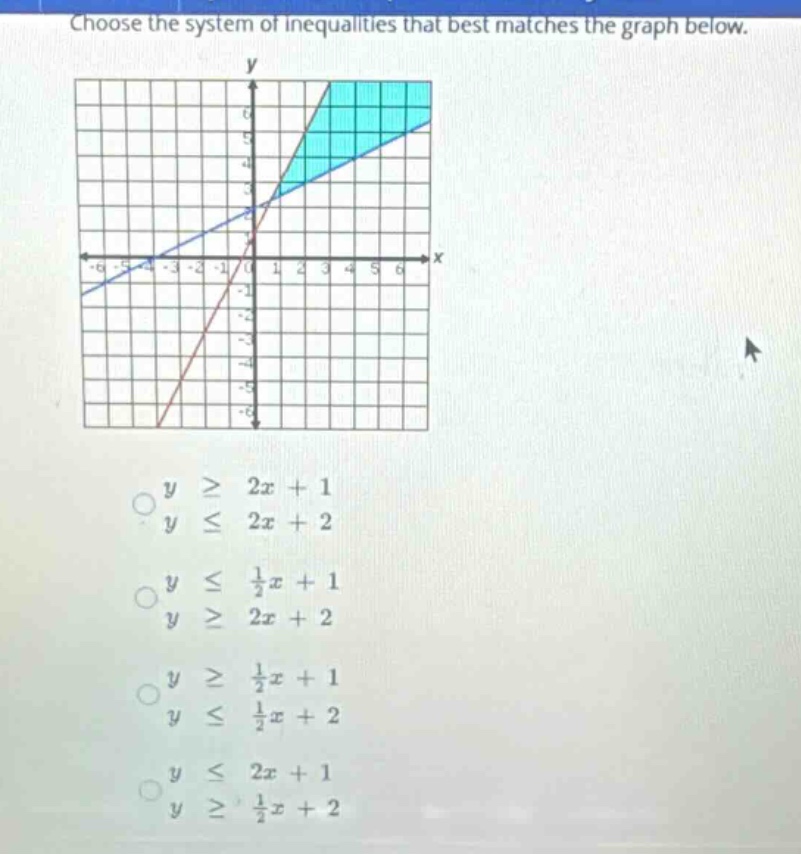
choose the system of inequalities that best matches the graph below.
\\(\
\\)
\\(\
\\)
\\(\
\\)
\\(\
\\)
🆕 New Concept Discovered: Graphing Systems of Linear Inequalities
Shading regions where multiple boundary lines overlap
Step 1: Find the equation of the steeper boundary line (red line)
Let's identify two points on the steeper line to find its equation:
- The \(y\)-intercept is at \((0, 1)\).
- Another clear grid intersection is at \((1, 3)\) or \((2, 5)\).
Using the slope formula \(m = \frac{y_2 - y_1}{x_2 - x_1}\):
Using the slope-intercept form \(y = mx + b\):
Now, determine the inequality direction. The shaded region is to the left/above this line. Let's test a point in the shaded region, such as \((3, 5)\):
Let's test another point deep in the shaded region, like \((4, 6)\):
Let's test \((3, 6)\):
Let's look closely at the boundary: for any \(x\)-value in the shaded region (e.g., \(x = 3\)), the shaded \(y\)-values are above the flatter line but to the left of the steeper line.
For the steeper line \(y = 2x + 1\), at \(x = 2\), the line is at \(y = 5\). The shaded region at \(x = 2\) is around \(y = 3\) and \(y = 4\), which is below the line.
Let's test \((2, 3)\) which is in the shaded region:
Thus, the inequality for this boundary is:
Step 2: Find the equation of the flatter boundary line (blue line)
Let's identify two points on the flatter line:
- The \(y\)-intercept is at \((0, 2)\).
- The \(x\)-intercept is at \((-4, 0)\).
Using these points to find the slope:
Using the slope-intercept form:
Now, determine the inequality direction. The shaded region is above this line. Let's test the point \((2, 3)\) which is in the shaded region:
Thus, the inequality for this boundary is:
Step 3: Combine the inequalities
Combining the two identified inequalities gives the system:
This matches the fourth option.

Snap & solve any problem in the app
Get step-by-step solutions on Sovi AI
Photo-based solutions with guided steps
Explore more problems and detailed explanations