Sovi.AI - AI Math Tutor

Scan to solve math questions

QUESTION IMAGE

choose the correct answer. how did andrew carnegie live according to th…

Question

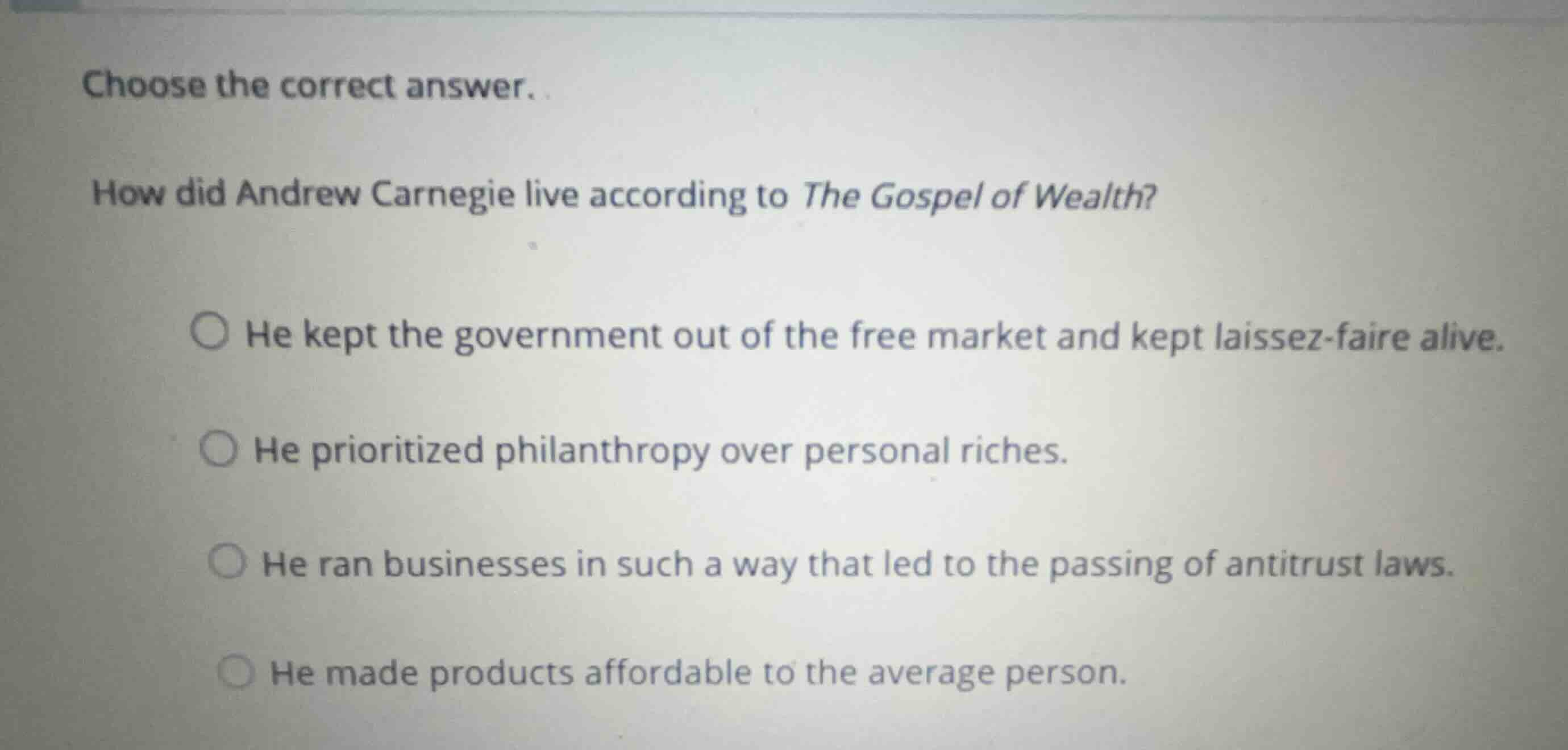
choose the correct answer.

how did andrew carnegie live according to the gospel of wealth?

he kept the government out of the free market and kept laissez-faire alive.
he prioritized philanthropy over personal riches.
he ran businesses in such a way that led to the passing of antitrust laws.
he made products affordable to the average person.

Explanation:

Response

<pre_analysis>
{
"quality": "clear",
"question_count": 1,
"skills_matched": [
"direct_cot",
"multiple_choice_formatter",
"explain_then_answer",
"tutor"
],
"needs_drawing": false,
"concepts_used": [
"Historical Entrepreneurs"
],
"new_concepts": [
"The Gospel of Wealth",
"Andrew Carnegie",
"Gilded Age Philanthropy"
],
"current_concepts": [
"Historical Entrepreneurs",
"The Gospel of Wealth",
"Andrew Carnegie",
"Gilded Age Philanthropy"
]
}
</pre_analysis>

<reasoning>

Analyze Carnegie's philosophy

In 1889, industrialist Andrew Carnegie wrote an article titled The Gospel of Wealth. In this essay, he argued that extremely wealthy self-made men had a moral obligation to distribute their surplus wealth in a responsible and philanthropic manner to benefit society, rather than spending it on personal luxury or hoarding it for their heirs.

Evaluate the options

  • Option 1: "He kept the government out of the free market and kept laissez-faire alive." While Carnegie supported laissez-faire capitalism, this does not describe how he lived according to the specific moral duties outlined in The Gospel of Wealth.
  • Option 2: "He prioritized philanthropy over personal riches." This directly aligns with his thesis in The Gospel of Wealth, which asserted that "the man who dies thus rich dies disgraced." Carnegie practiced this by donating the vast majority of his fortune to fund public libraries, universities, and scientific research.
  • Option 3: "He ran businesses in such a way that led to the passing of antitrust laws." This describes a consequence of Gilded Age monopolistic practices, not a personal lifestyle choice guided by his essay.
  • Option 4: "He made products affordable to the average person." While steel production became highly efficient, this was a business outcome rather than the core guiding principle of The Gospel of Wealth.

Connect to historical context

Using the Historical Entrepreneurs concept, we can see how Carnegie distinguished himself from other Gilded Age tycoons. His primary personal mission in his later years was active philanthropy, establishing institutions that allowed the public to help themselves, which is the central tenet of his famous essay.
</reasoning>

<answer>
<mcq-option>(A) He kept the government out of the free market and kept laissez-faire alive.</mcq-option>
<mcq-correct>(B) He prioritized philanthropy over personal riches.</mcq-correct>
<mcq-option>(C) He ran businesses in such a way that led to the passing of antitrust laws.</mcq-option>
<mcq-option>(D) He made products affordable to the average person.</mcq-option>
</answer>

<post_analysis>
{
"subject": "Social Science",
"question_type": "Multiple Choice",
"knowledge_point": [
"Social Science",
"US History",
"Gilded Age Philanthropy"
]
}
</post_analysis>

Answer:

<pre_analysis>
{
"quality": "clear",
"question_count": 1,
"skills_matched": [
"direct_cot",
"multiple_choice_formatter",
"explain_then_answer",
"tutor"
],
"needs_drawing": false,
"concepts_used": [
"Historical Entrepreneurs"
],
"new_concepts": [
"The Gospel of Wealth",
"Andrew Carnegie",
"Gilded Age Philanthropy"
],
"current_concepts": [
"Historical Entrepreneurs",
"The Gospel of Wealth",
"Andrew Carnegie",
"Gilded Age Philanthropy"
]
}
</pre_analysis>

<reasoning>

Analyze Carnegie's philosophy

In 1889, industrialist Andrew Carnegie wrote an article titled The Gospel of Wealth. In this essay, he argued that extremely wealthy self-made men had a moral obligation to distribute their surplus wealth in a responsible and philanthropic manner to benefit society, rather than spending it on personal luxury or hoarding it for their heirs.

Evaluate the options

  • Option 1: "He kept the government out of the free market and kept laissez-faire alive." While Carnegie supported laissez-faire capitalism, this does not describe how he lived according to the specific moral duties outlined in The Gospel of Wealth.
  • Option 2: "He prioritized philanthropy over personal riches." This directly aligns with his thesis in The Gospel of Wealth, which asserted that "the man who dies thus rich dies disgraced." Carnegie practiced this by donating the vast majority of his fortune to fund public libraries, universities, and scientific research.
  • Option 3: "He ran businesses in such a way that led to the passing of antitrust laws." This describes a consequence of Gilded Age monopolistic practices, not a personal lifestyle choice guided by his essay.
  • Option 4: "He made products affordable to the average person." While steel production became highly efficient, this was a business outcome rather than the core guiding principle of The Gospel of Wealth.

Connect to historical context

Using the Historical Entrepreneurs concept, we can see how Carnegie distinguished himself from other Gilded Age tycoons. His primary personal mission in his later years was active philanthropy, establishing institutions that allowed the public to help themselves, which is the central tenet of his famous essay.
</reasoning>

<answer>
<mcq-option>(A) He kept the government out of the free market and kept laissez-faire alive.</mcq-option>
<mcq-correct>(B) He prioritized philanthropy over personal riches.</mcq-correct>
<mcq-option>(C) He ran businesses in such a way that led to the passing of antitrust laws.</mcq-option>
<mcq-option>(D) He made products affordable to the average person.</mcq-option>
</answer>

<post_analysis>
{
"subject": "Social Science",
"question_type": "Multiple Choice",
"knowledge_point": [
"Social Science",
"US History",
"Gilded Age Philanthropy"
]
}
</post_analysis>