QUESTION IMAGE
Question
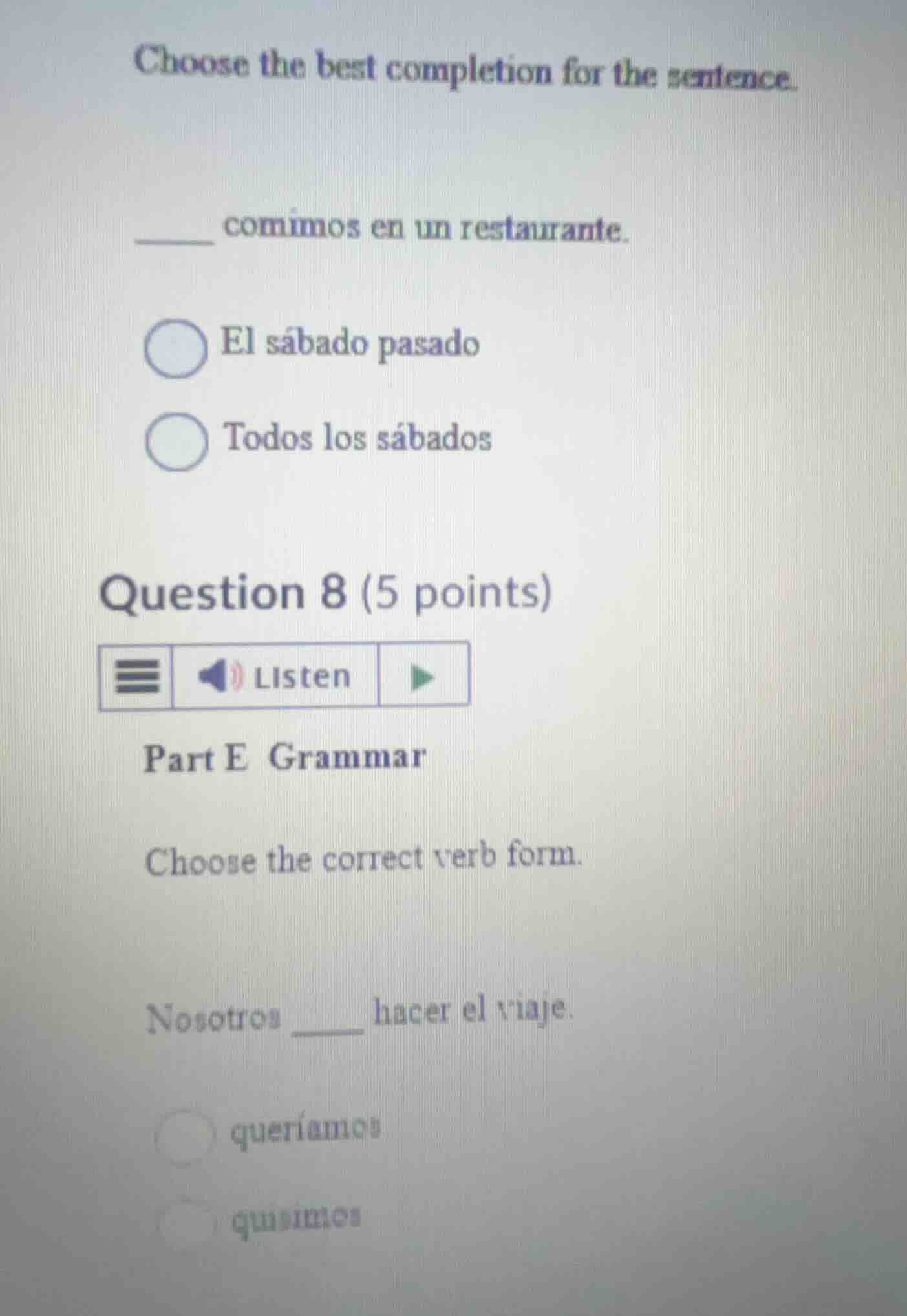
choose the best completion for the sentence.
____ comimos en un restaurante.
- el sábado pasado
- todos los sábados
question 8 (5 points)
part e grammar
choose the correct verb form.
nosotros ____ hacer el viaje.
- queríamos
- quisimos
<pre_analysis>
{
"quality": "clear",
"question_count": 2,
"skills_matched": [
"direct_cot",
"multiple_choice_formatter",
"explain_then_answer",
"quick"
],
"needs_drawing": false,
"concepts_used": [],
"new_concepts": [
"Spanish Preterite vs Imperfect",
"Spanish Time Expressions"
],
"current_concepts": [
"Spanish Preterite vs Imperfect",
"Spanish Time Expressions",
"Spanish Verb Conjugation"
]
}
</pre_analysis>
<reasoning>
Analyze the first question
The sentence is "\_\_\_\_\_ comimos en un restaurante."
The verb "comimos" is conjugated in the preterite tense (we ate), which indicates a completed action at a specific point in time.
"El sábado pasado" (Last Saturday) is a specific time marker that triggers the preterite tense.
"Todos los sábados" (Every Saturday) indicates habitual action, which would trigger the imperfect tense ("comíamos").
Analyze the second question (Question 8)
The sentence is "Nosotros \_\_\_\_\_ hacer el viaje."
The options are "queríamos" (imperfect) and "quisimos" (preterite).
In Spanish, the verb "querer" in the imperfect ("queríamos") describes an ongoing mental state, desire, or intention in the past ("we wanted to make the trip") without focusing on a specific beginning or end.
The preterite "quisimos" means "we tried to/attempted to" or "we willed it" at a specific moment.
For describing a general desire or state of wanting to make a trip, the imperfect "queríamos" is the standard and correct choice.
</reasoning>
<answer>
Question 1
<mcq-correct>(A) El sábado pasado</mcq-correct>
<mcq-option>(B) Todos los sábados</mcq-option>
Question 8
<mcq-correct>(A) queríamos</mcq-correct>
<mcq-option>(B) quisimos</mcq-option>
</answer>
<post_analysis>
{
"subject": "Others",
"question_type": "Multiple Choice",
"knowledge_point": [
"Others",
"Spanish",
"Spanish Preterite vs Imperfect"
]
}
</post_analysis>
Snap & solve any problem in the app
Get step-by-step solutions on Sovi AI
Photo-based solutions with guided steps
Explore more problems and detailed explanations
<pre_analysis>
{
"quality": "clear",
"question_count": 2,
"skills_matched": [
"direct_cot",
"multiple_choice_formatter",
"explain_then_answer",
"quick"
],
"needs_drawing": false,
"concepts_used": [],
"new_concepts": [
"Spanish Preterite vs Imperfect",
"Spanish Time Expressions"
],
"current_concepts": [
"Spanish Preterite vs Imperfect",
"Spanish Time Expressions",
"Spanish Verb Conjugation"
]
}
</pre_analysis>
<reasoning>
Analyze the first question
The sentence is "\_\_\_\_\_ comimos en un restaurante."
The verb "comimos" is conjugated in the preterite tense (we ate), which indicates a completed action at a specific point in time.
"El sábado pasado" (Last Saturday) is a specific time marker that triggers the preterite tense.
"Todos los sábados" (Every Saturday) indicates habitual action, which would trigger the imperfect tense ("comíamos").
Analyze the second question (Question 8)
The sentence is "Nosotros \_\_\_\_\_ hacer el viaje."
The options are "queríamos" (imperfect) and "quisimos" (preterite).
In Spanish, the verb "querer" in the imperfect ("queríamos") describes an ongoing mental state, desire, or intention in the past ("we wanted to make the trip") without focusing on a specific beginning or end.
The preterite "quisimos" means "we tried to/attempted to" or "we willed it" at a specific moment.
For describing a general desire or state of wanting to make a trip, the imperfect "queríamos" is the standard and correct choice.
</reasoning>
<answer>
Question 1
<mcq-correct>(A) El sábado pasado</mcq-correct>
<mcq-option>(B) Todos los sábados</mcq-option>
Question 8
<mcq-correct>(A) queríamos</mcq-correct>
<mcq-option>(B) quisimos</mcq-option>
</answer>
<post_analysis>
{
"subject": "Others",
"question_type": "Multiple Choice",
"knowledge_point": [
"Others",
"Spanish",
"Spanish Preterite vs Imperfect"
]
}
</post_analysis>