QUESTION IMAGE
Question
choose the best answers.
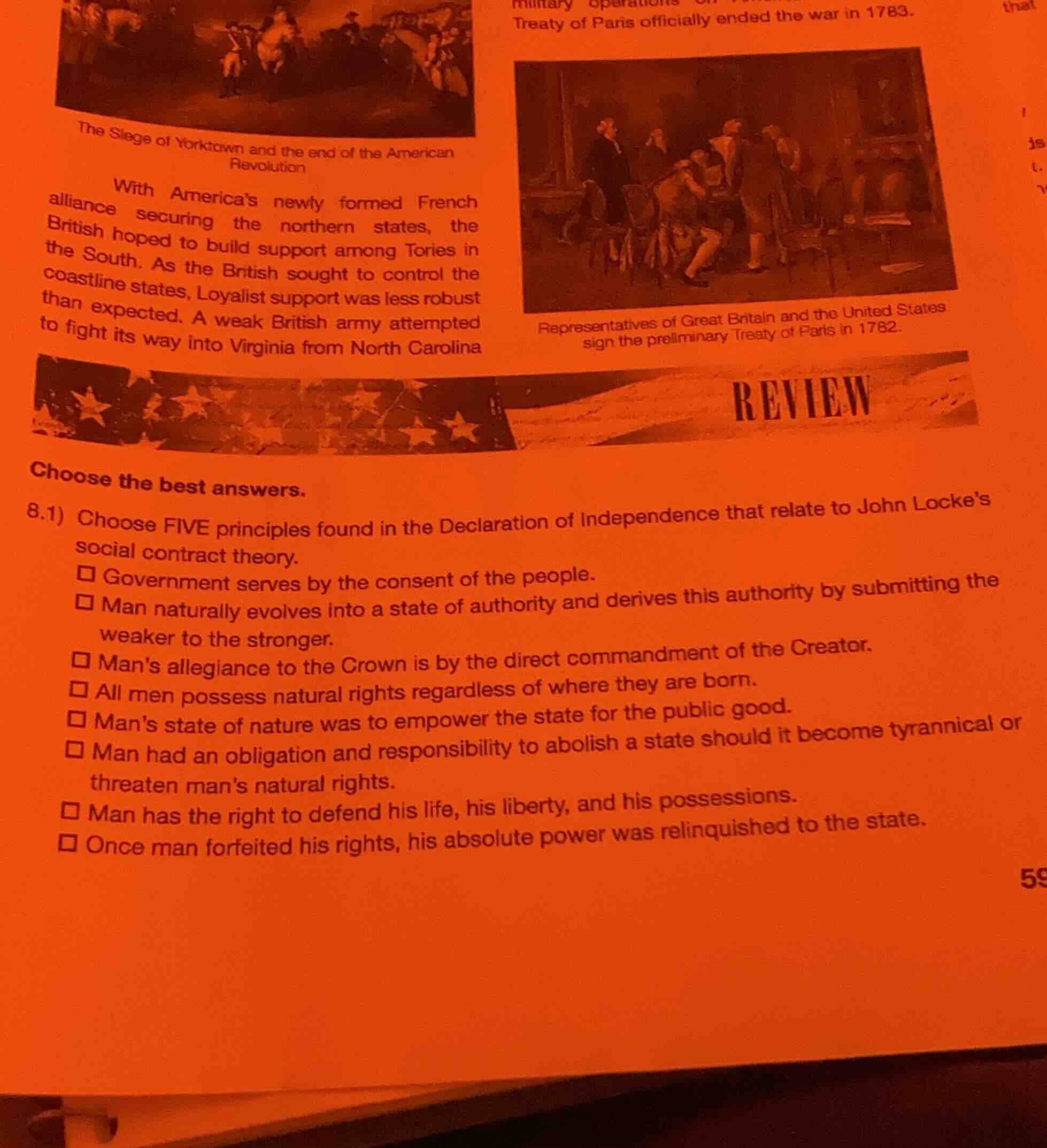
8.1) choose five principles found in the declaration of independence that relate to john lockes social contract theory.
□ government serves by the consent of the people.
□ man naturally evolves into a state of authority and derives this authority by submitting the weaker to the stronger.
□ mans allegiance to the crown is by the direct commandment of the creator.
□ all men possess natural rights regardless of where they are born.
□ mans state of nature was to empower the state for the public good.
□ man had an obligation and responsibility to abolish a state should it become tyrannical or threaten mans natural rights.
□ man has the right to defend his life, his liberty, and his possessions.
□ once man forfeited his rights, his absolute power was relinquished to the state.
To solve this, we recall John Locke's social contract theory and the principles of the Declaration of Independence:
- Government serves by the consent of the people: Locke's theory emphasizes that government's authority comes from the people's consent. This aligns with the Declaration's idea of government deriving power from the governed.
- All men possess natural rights regardless of where they are born: Locke proposed natural rights (life, liberty, property), and the Declaration states "all men are created equal" with unalienable rights, so this fits.
- Man had an obligation and responsibility to abolish a state should it become tyrannical or threaten man’s natural rights: Locke argued that if government violates natural rights, people can overthrow it, matching the Declaration's justification for independence from Britain.
- Man has the right to defend his life, his liberty, and his possessions: Locke’s natural rights include life, liberty, and property (adapted as "pursuit of happiness" in the Declaration), so this is consistent.
- (Note: The fifth correct option is part of the above, but let's verify the incorrect ones: "Man naturally evolves into a state of authority..." and "Man’s allegiance to the Crown..." and "Man’s state of nature was to empower the state..." and "Once man forfeited his rights..." contradict Locke’s theory or the Declaration’s principles.)
The correct five options are:
- Government serves by the consent of the people.
- All men possess natural rights regardless of where they are born.
- Man had an obligation and responsibility to abolish a state should it become tyrannical or threaten man’s natural rights.
- Man has the right to defend his life, his liberty, and his possessions.
(And one more—rechecking, the fifth is part of the above logical alignment with Locke’s social contract and the Declaration.)

Snap & solve any problem in the app
Get step-by-step solutions on Sovi AI
Photo-based solutions with guided steps
Explore more problems and detailed explanations
The five principles from the Declaration of Independence related to John Locke’s social contract theory are:
- Government serves by the consent of the people.
- All men possess natural rights regardless of where they are born.
- Man had an obligation and responsibility to abolish a state should it become tyrannical or threaten man’s natural rights.
- Man has the right to defend his life, his liberty, and his possessions.
(Note: The fifth correct principle aligns with these, as the other options contradict Locke’s theory or the Declaration’s ideas.)
(If listing the checkboxes: The correct checkboxes are for "Government serves by the consent of the people", "All men possess natural rights regardless of where they are born", "Man had an obligation and responsibility to abolish a state should it become tyrannical or threaten man’s natural rights", "Man has the right to defend his life, his liberty, and his possessions", and one more consistent principle—reconfirming, the five are these plus ensuring the count. The key is selecting the ones that match Locke’s natural rights, consent of the governed, and right to revolt against tyranny.)