QUESTION IMAGE
Question
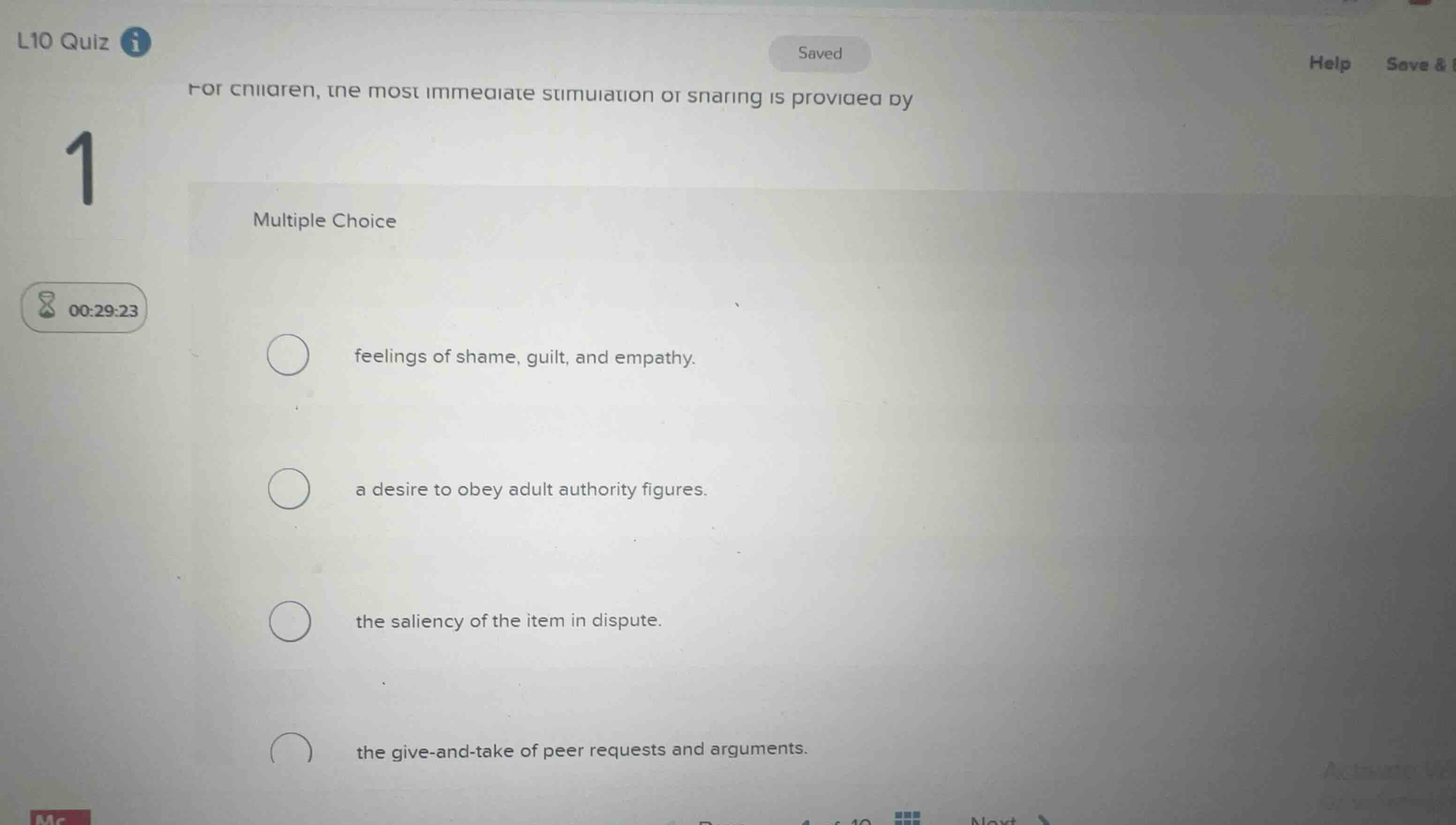
for children, the most immediate stimulation of sharing is provided by
multiple choice
feelings of shame, guilt, and empathy.
a desire to obey adult authority figures.
the saliency of the item in dispute.
the give-and-take of peer requests and arguments.
Analyze the question prompt
The question asks: "For children, the most immediate stimulation of sharing is provided by". This refers to the developmental triggers that prompt young children to engage in prosocial behaviors like sharing.
Evaluate the options
- Option 1: feelings of shame, guilt, and empathy. While empathy is a internal motivator for prosocial behavior, shame and guilt are complex self-conscious emotions that develop later and are not the most immediate situational triggers for sharing in early childhood peer contexts.
- Option 2: a desire to obey adult authority figures. Obedience to authority can motivate sharing when an adult is present, but it is not the most immediate or natural social driver of spontaneous peer sharing.
- Option 3: the saliency of the item in dispute. A highly salient (desirable) item usually decreases sharing and increases conflict or possessiveness.
- Option 4: the give-and-take of peer requests and arguments. In developmental psychology, research shows that children's sharing is most immediately stimulated by direct peer interactions, specifically when a peer requests an object or when they engage in the verbal give-and-take of negotiation and arguments.
Synthesize developmental context
Peer interactions serve as a primary catalyst for social-cognitive development. The immediate, reciprocal nature of peer requests and negotiations directly prompts children to coordinate their desires with others, leading to sharing behaviors.

Snap & solve any problem in the app
Get step-by-step solutions on Sovi AI
Photo-based solutions with guided steps
Explore more problems and detailed explanations
- feelings of shame, guilt, and empathy.
- a desire to obey adult authority figures.
- the saliency of the item in dispute.
- the give-and-take of peer requests and arguments. (Correct answer)