QUESTION IMAGE
Question
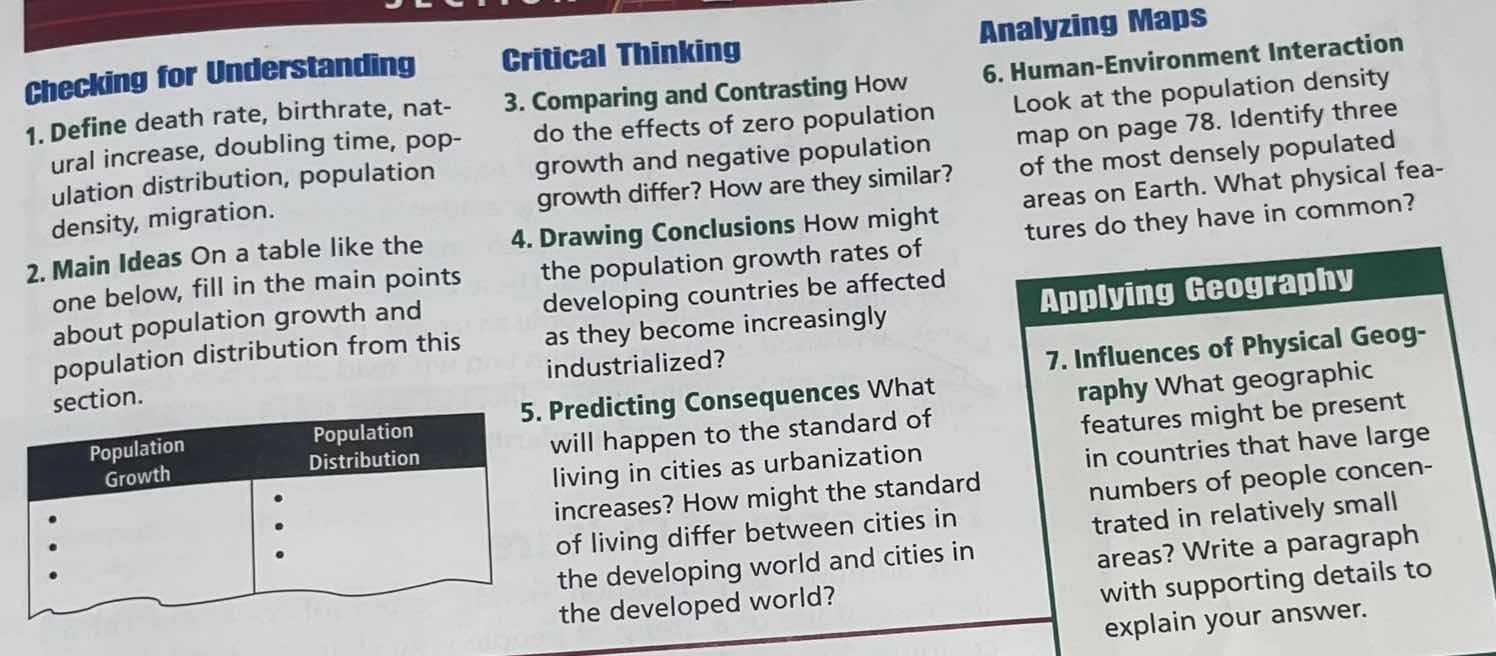
checking for understanding
- define death rate, birthrate, natural increase, doubling time, population distribution, population density, migration.
- main ideas on a table like the one below, fill in the main points about population growth and population distribution from this section.
population growth | population distribution
critical thinking
- comparing and contrasting how do the effects of zero population growth and negative population growth differ? how are they similar?
- drawing conclusions how might the population growth rates of developing countries be affected as they become increasingly industrialized?
- predicting consequences what will happen to the standard of living in cities as urbanization increases? how might the standard of living differ between cities in the developing world and cities in the developed world?
analyzing maps
- human-environment interaction look at the population density map on page 78. identify three of the most densely populated areas on earth. what physical features do they have in common?
applying geography
- influences of physical geography what geographic features might be present in countries that have large numbers of people concentrated in relatively small areas? write a paragraph with supporting details to explain your answer.
Define demographic terms
We define the key demographic metrics requested in Question 1:
- Death rate: The number of deaths per 1,000 individuals in a population per year.
- Birthrate: The number of live births per 1,000 individuals in a population per year.
- Natural increase: The rate of population growth calculated by subtracting the death rate from the birthrate, expressed as a percentage.
- Doubling time: The number of years needed for a population to double in size, assuming a constant rate of natural increase.
- Population distribution: The spatial pattern of where people live across a region or the globe.
- Population density: The average number of people living in a unit of area (e.g., per square mile or square kilometer).
- Migration: The movement of people from one place or country to another to establish new residence.
Summarize population concepts
For Question 2, we summarize the main ideas of population growth and distribution:
- Population Growth: Driven by the balance between birthrates and death rates, as well as migration. Historically, growth was slow but accelerated rapidly with industrialization, improved healthcare, and food security.
- Population Distribution: Highly uneven globally. Most people live in areas with favorable climates, fertile soil, flat terrain, and access to fresh water, while extreme environments (deserts, high mountains, polar regions) remain sparsely populated.
Compare population growth types
For Question 3, we compare zero population growth and negative population growth:
- Differences: Zero population growth means the population size remains stable over time (birthrate plus immigration equals death rate plus emigration). Negative population growth means the population size is actively shrinking because deaths and emigration exceed births and immigration.
- Similarities: Both represent a departure from rapid population expansion, typically occur in highly developed nations with low birthrates, and present economic challenges such as an aging workforce.
Analyze industrialization effects
For Question 4, we analyze how industrialization affects developing countries:
- As countries industrialize, population growth rates typically decline.
- This shift occurs because urbanization, improved education, and increased economic opportunities for women lead to lower birthrates, transitioning the country from high birth and death rates to low birth and death rates (demographic transition).
Predict urbanization consequences
For Question 5, we evaluate the impact of urbanization on the standard of living:
- General impact: Rapid urbanization can strain city infrastructure, leading to housing shortages, traffic congestion, pollution, and overburdened public services.
- Developed vs. Developing: In developed nations, cities generally have better infrastructure, financial resources, and planning to manage growth, maintaining a higher standard of living. In developing nations, rapid rural-to-urban migration often outpaces municipal resources, resulting in widespread informal settlements (slums) an…

Snap & solve any problem in the app
Get step-by-step solutions on Sovi AI
Photo-based solutions with guided steps
Explore more problems and detailed explanations
Question 1
- Death rate: The annual number of deaths per 1,000 people.
- Birthrate: The annual number of live births per 1,000 people.
- Natural increase: The rate of population growth based solely on the difference between the birthrate and the death rate.
- Doubling time: The number of years required for a population to double in size at its current rate of growth.
- Population distribution: The geographic pattern of where people live on Earth.
- Population density: The average number of people living in a specific unit of area, such as a square mile or square kilometer.
- Migration: The movement of people from one location to another to settle permanently or semi-permanently.
Question 2
| Population Growth | Population Distribution |
|---|---|
| • Has accelerated dramatically in modern history due to medical and agricultural advances. | • Heavily concentrated in areas with favorable climates, fertile soil, and water access. |
| • Tends to slow down as countries undergo economic development. | • Extremely sparse in deserts, high mountains, and polar regions. |
Question 3
- Differences: Zero population growth results in a stable, unchanging population size, whereas negative population growth results in a shrinking population size over time.
- Similarities: Both conditions are characterized by low birthrates, are common in highly developed nations, and lead to demographic challenges such as an aging population and a shrinking labor force.
Question 4
As developing countries become increasingly industrialized, their population growth rates are likely to decrease. Industrialization leads to urbanization, better healthcare, higher education levels, and increased career opportunities for women, all of which historically contribute to a decline in birthrates.
Question 5
- Standard of Living: Rapid urbanization can lower the standard of living by straining municipal infrastructure, leading to housing shortages, traffic congestion, pollution, and inadequate public services.
- Comparison: In the developed world, cities generally have the infrastructure and financial resources to manage urban growth, maintaining a higher standard of living. In the developing world, rapid urbanization often outpaces municipal planning, leading to the growth of informal settlements (slums) with poor sanitation and limited access to clean water.
Question 6
- Three Densely Populated Areas: East Asia, South Asia, and Europe.
- Common Physical Features: These regions share flat or low-lying terrain (such as plains and river valleys), fertile soils suitable for agriculture, temperate or warm climates, and close proximity to major rivers or coastlines for water and trade.
Question 7
Countries with large populations concentrated in relatively small areas are typically shaped by stark contrasts in physical geography. These nations often feature highly productive zones—such as fertile river valleys, coastal plains, and areas with moderate climates—that are ideal for agriculture, industry, and human settlement. At the same time, the remainder of the country may consist of inhospitable terrain, such as rugged mountains, arid deserts, or dense forests, which discourages habitation. As a result, the population is naturally channeled and densely clustered within the limited hospitable regions where survival, resource access, and economic activity are most viable.