QUESTION IMAGE
Question
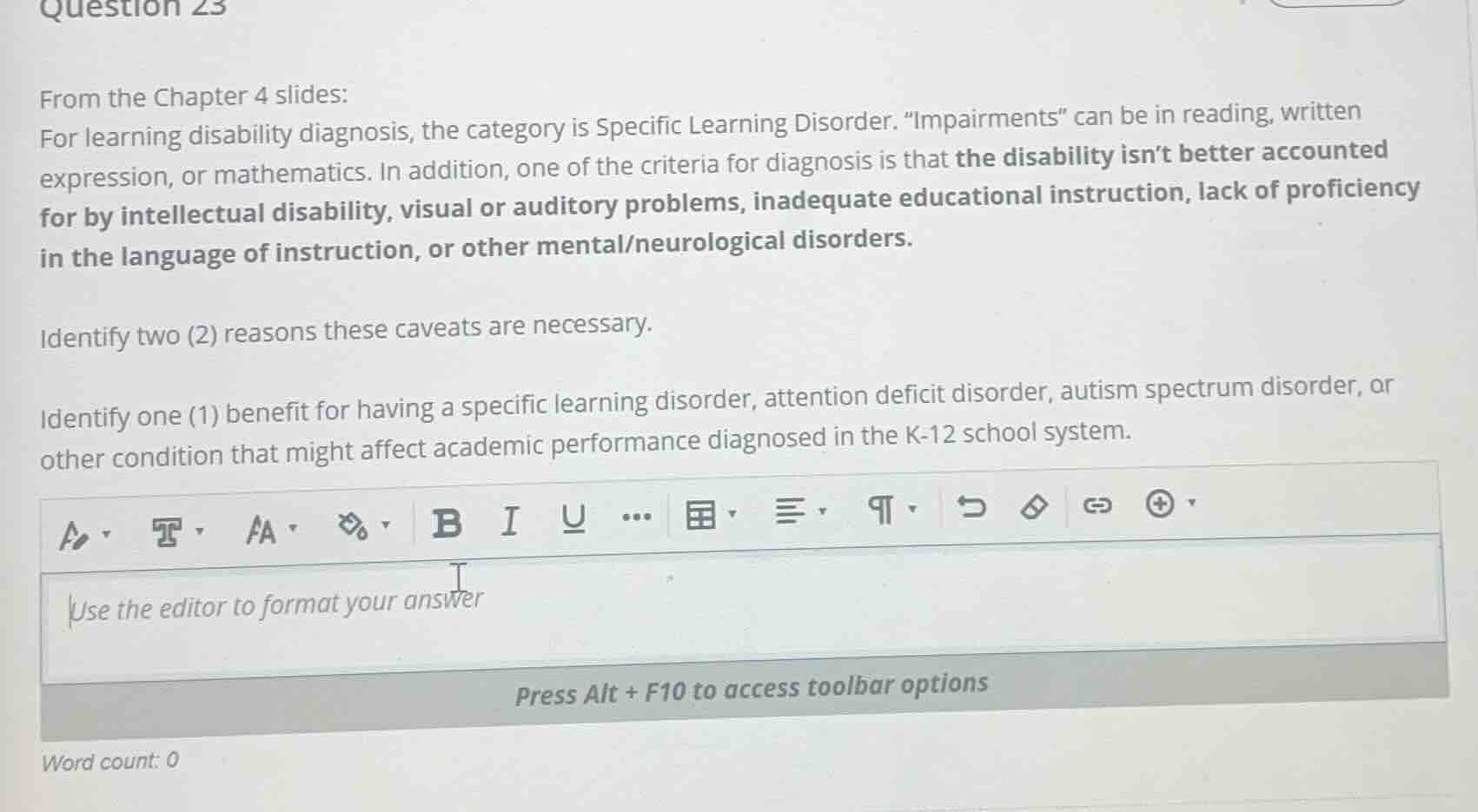
from the chapter 4 slides:
for learning disability diagnosis, the category is specific learning disorder. \impairments\ can be in reading, written expression, or mathematics. in addition, one of the criteria for diagnosis is that the disability isnt better accounted for by intellectual disability, visual or auditory problems, inadequate educational instruction, lack of proficiency in the language of instruction, or other mental/neurological disorders.
identify two (2) reasons these caveats are necessary.
identify one (1) benefit for having a specific learning disorder, attention deficit disorder, autism spectrum disorder, or other condition that might affect academic performance diagnosed in the k-12 school system.
Analyze the diagnostic caveats
The prompt asks for two reasons why diagnostic caveats (excluding intellectual disability, sensory deficits, inadequate instruction, or language barriers) are necessary for diagnosing a Specific Learning Disorder (SLD).
- Ensuring diagnostic accuracy (Differential Diagnosis): It is critical to distinguish SLD from other primary causes of academic struggle. If a student's difficulties are due to a lack of instruction or a language barrier, the underlying issue is environmental or linguistic, not a neurological learning disability.
- Targeting appropriate interventions: Different causes require completely different support systems. A student with a visual impairment needs corrective lenses or braille, whereas a student with an SLD needs specialized cognitive and academic interventions. Misdiagnosis leads to ineffective treatment.
Analyze benefits of diagnosis
The prompt asks for one benefit of having a diagnosis (such as SLD, ADHD, or ASD) within the K-12 school system.
- Access to accommodations and support: A formal diagnosis legally qualifies a student for tailored educational support, such as an Individualized Education Program (IEP) or a 504 Plan. This provides essential accommodations like extended test time, assistive technology, or specialized instruction.

Snap & solve any problem in the app
Get step-by-step solutions on Sovi AI
Photo-based solutions with guided steps
Explore more problems and detailed explanations
Question 1
Two reasons these diagnostic caveats are necessary:
- To ensure diagnostic accuracy: They rule out alternative explanations (like sensory impairments or language barriers) to confirm the learning difficulty is a neurological disorder.
- To guide appropriate intervention: Correctly identifying the root cause ensures the student receives the right support (e.g., language classes vs. specialized cognitive training).
Question 2
One benefit of having a diagnosis in the K-12 school system:
- Access to legal accommodations: It qualifies the student for formalized support plans, such as an IEP or 504 Plan, which provide accommodations like extra test time or specialized instruction.