QUESTION IMAGE
Question
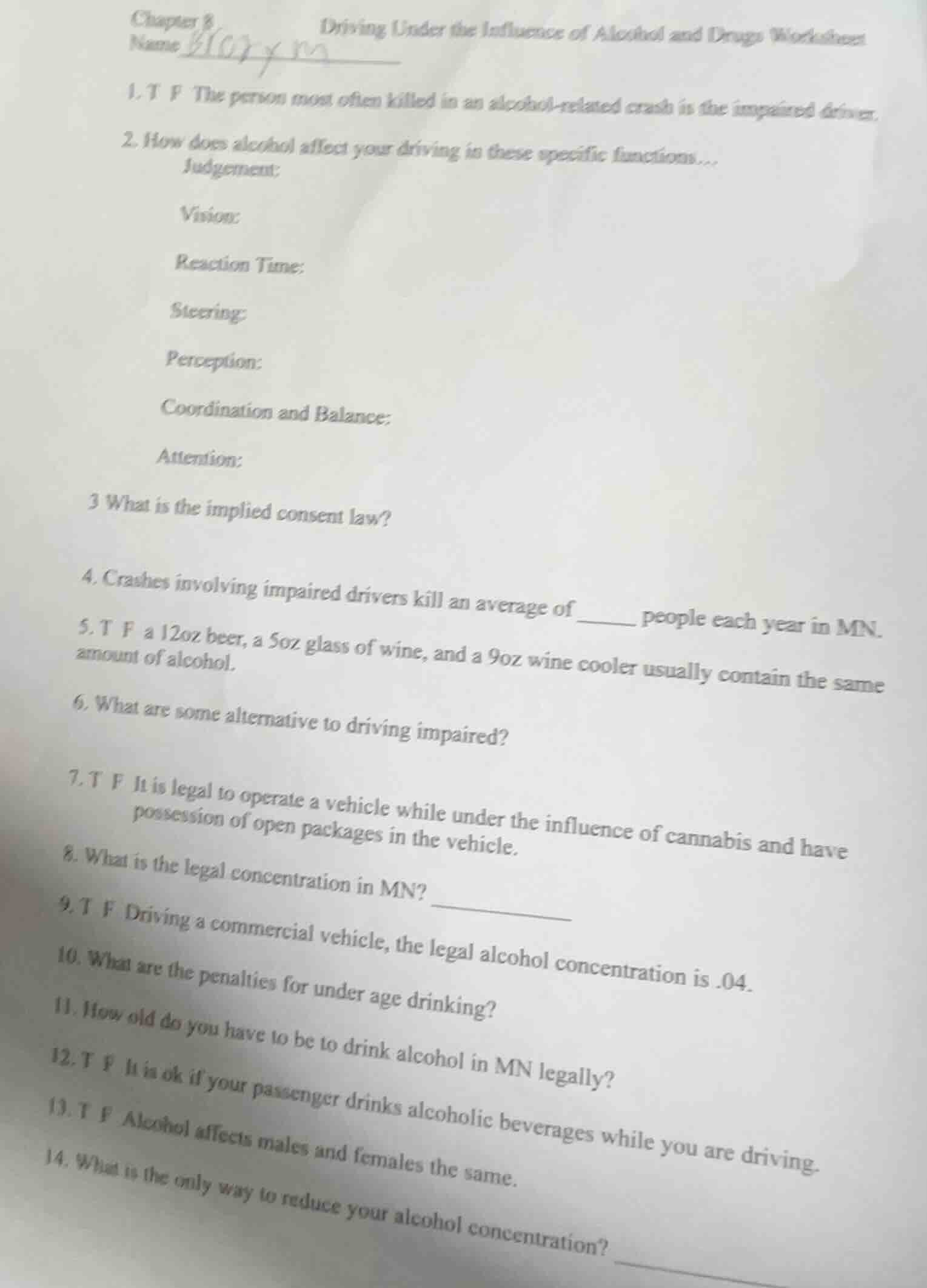
chapter 8 driving under the influence of alcohol and drugs worksheet
name: broxym
- t f the person most often killed in an alcohol-related crash is the impaired driver.
- how does alcohol affect your driving in these specific functions...
judgement:
vision:
reaction time:
steering:
perception:
coordination and balance:
attention:
- what is the implied consent law?
- crashes involving impaired drivers kill an average of ______ people each year in mn.
- t f a 12oz beer, a 5oz glass of wine, and a 9oz wine cooler usually contain the same amount of alcohol.
- what are some alternative to driving impaired?
- t f it is legal to operate a vehicle while under the influence of cannabis and have possession of open packages in the vehicle.
- what is the legal concentration in mn? ______
- t f driving a commercial vehicle, the legal alcohol concentration is .04.
- what are the penalties for under age drinking?
- how old do you have to be to drink alcohol in mn legally?
- t f it is ok if your passenger drinks alcoholic beverages while you are driving.
- t f alcohol affects males and females the same.
- what is the only way to reduce your alcohol concentration? ______
Analyze alcohol-related crash fatalities
We evaluate Question 1. Statistically, the person most often killed in alcohol-related crashes is the impaired driver themselves, followed closely by their passengers and occupants of other vehicles. Therefore, the statement is True.
Describe physiological effects of alcohol
We evaluate Question 2. Alcohol is a central nervous system depressant. It degrades driving functions:
- Judgement: Reduces risk awareness and increases risk-taking behavior.
- Vision: Blurs sight, reduces peripheral vision, and impairs depth perception.
- Reaction Time: Slows down the brain's ability to process information and respond.
- Steering: Causes oversteering or drifting due to loss of fine motor control.
- Perception: Impairs the ability to correctly interpret traffic situations.
- Coordination and Balance: Disrupts physical control and muscle synchronization.
- Attention: Reduces the ability to divide attention between multiple driving tasks.
Define the implied consent law
We evaluate Question 3. Under Driver Education principles, the implied consent law means that by operating a motor vehicle, a driver automatically consents to a chemical test (breath, blood, or urine) to determine alcohol or drug concentration if requested by an officer.
Determine Minnesota crash statistics
We evaluate Question 4. In Minnesota (MN), crashes involving impaired drivers kill an average of around 100 people each year (typically ranging between 80 to 110 depending on the multi-year average period).
Compare standard drink sizes
We evaluate Question 5. A standard drink contains about 0.6 ounces of pure alcohol. This is found in 12 oz of beer (5% ABV), 5 oz of wine (12% ABV), and 12 oz of a wine cooler (5% ABV). A 9 oz wine cooler contains less alcohol than a standard drink, making the statement False.
Identify safe alternatives to impaired driving
We evaluate Question 6. Safe alternatives include using a designated driver, calling a taxi or rideshare service, using public transportation, or staying overnight at the location.
Analyze open container laws
We evaluate Question 7. It is illegal to operate a vehicle under the influence of cannabis or to have open packages of cannabis in the passenger compartment of a vehicle. Therefore, the statement is False.
Identify legal alcohol limits
We evaluate Question 8. The legal blood alcohol concentration (BAC) limit for driving in Minnesota for drivers 21 and older is 0.08%.
Evaluate commercial driver limits
We evaluate Question 9. For commercial motor vehicle drivers, the legal alcohol concentration limit is 0.04%. Therefore, the statement is True.
Analyze underage drinking penalties
We evaluate Question 10. Underage drinking and driving (Vanessa's Law / Zero Tolerance) results in the suspension of driving privileges, fines, and potential impoundment or jail time depending on the violation.
Identify legal drinking age
We evaluate Question 11. To drink alcohol legally in Minnesota, a person must be at…

Snap & solve any problem in the app
Get step-by-step solutions on Sovi AI
Photo-based solutions with guided steps
Explore more problems and detailed explanations
Question 1
True (The impaired driver is statistically the most frequent fatality in alcohol-related crashes).
Question 2
- Judgement: Impairs decision-making, lowers inhibitions, and increases risk-taking.
- Vision: Blurs vision, reduces peripheral field, and impairs depth perception.
- Reaction Time: Slows physical and mental response times to hazards.
- Steering: Causes poor tracking, overcorrecting, and difficulty maintaining a straight path.
- Perception: Impairs the ability to accurately judge speed, distance, and traffic flow.
- Coordination and Balance: Disrupts motor skills and physical control of the vehicle.
- Attention: Reduces the ability to focus on multiple driving tasks simultaneously.
Question 3
The implied consent law states that by driving on public roads, you automatically agree to submit to a chemical test (breath, blood, or urine) to determine alcohol or drug concentration if an officer has probable cause to suspect impaired driving.
Question 4
Crashes involving impaired drivers kill an average of 100 people each year in MN.
Question 5
False (A standard wine cooler is 12 oz; a 9 oz wine cooler contains less alcohol than a standard 12 oz beer or 5 oz glass of wine).
Question 6
- Designating a sober driver
- Calling a rideshare service (Uber, Lyft) or taxi
- Using public transportation
- Staying overnight at your location
Question 7
False (It is illegal to drive under the influence of cannabis or to possess open packages of cannabis within the passenger compartment of a vehicle).
Question 8
The legal alcohol concentration limit for drivers age 21 or older in MN is 0.08%.
Question 9
True (The legal limit for commercial drivers is 0.04%).
Question 10
Penalties include immediate loss of driving privileges (minimum 30-day suspension), fines, court costs, and potential vehicle impoundment or jail time. Under Vanessa's Law, unlicensed teen drivers face stricter delays in obtaining a license.
Question 11
You must be at least 21 years old to drink alcohol legally in MN.
Question 12
False (It is illegal for passengers to consume or possess open containers of alcohol in a motor vehicle on public roads).
Question 13
False (Alcohol affects males and females differently due to differences in body chemistry, weight, and metabolism).
Question 14
The only way to reduce your alcohol concentration is time.