QUESTION IMAGE
Question
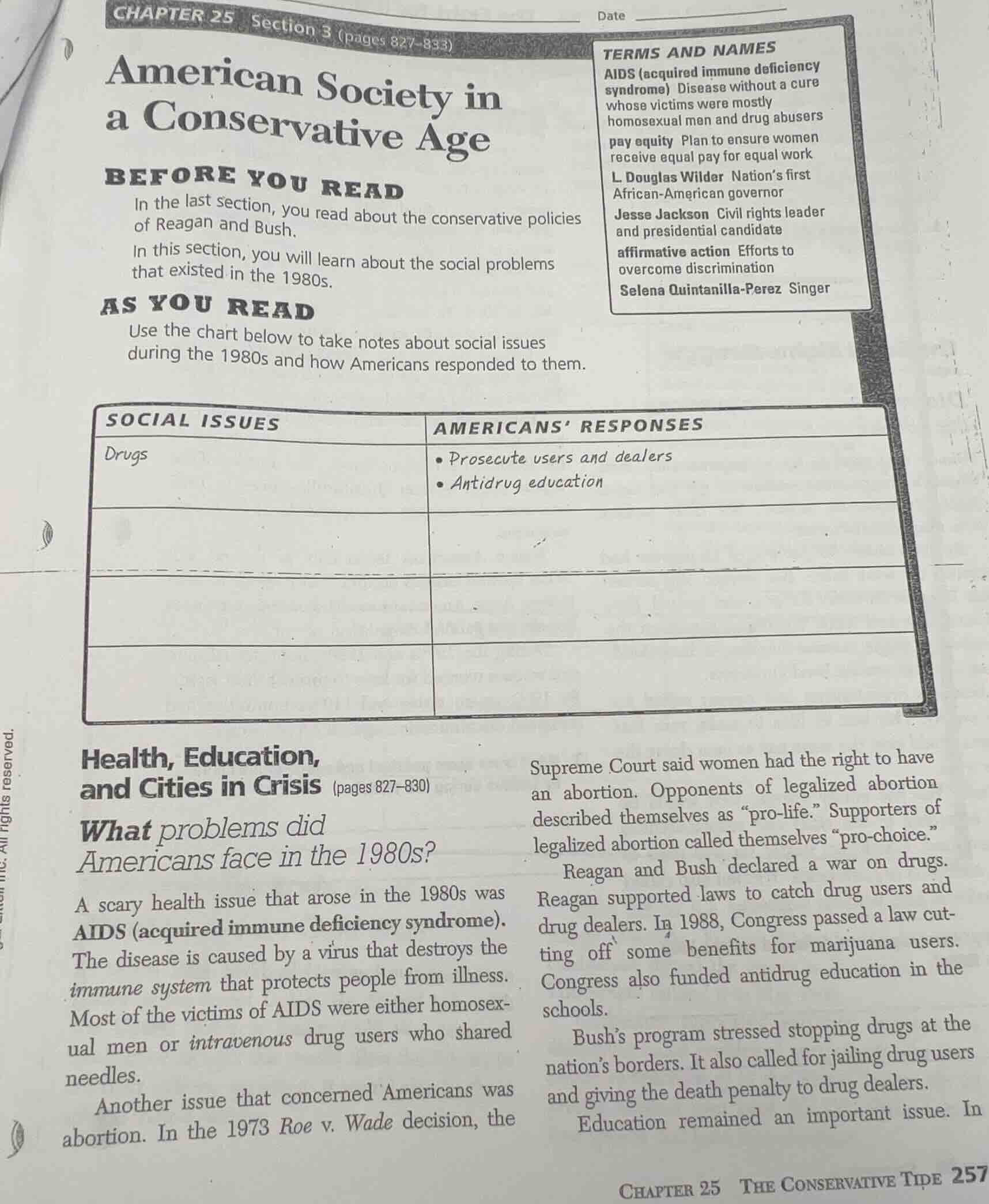
chapter 25 section 3 (pages 827-833)
american society in a conservative age
before you read
in the last section, you read about the conservative policies of reagan and bush.
in this section, you will learn about the social problems that existed in the 1980s.
as you read
use the chart below to take notes about social issues during the 1980s and how americans responded to them.
terms and names
aids (acquired immune deficiency syndrome) disease without a cure whose victims were mostly homosexual men and drug abusers
pay equity plan to ensure women receive equal pay for equal work
l. douglas wilder nations first african-american governor
jesse jackson civil rights leader and presidential candidate
affirmative action efforts to overcome discrimination
selena quintanilla-perez singer
social issues | americans responses
drugs | - prosecute users and dealers
- antidrug education
health, education, and cities in crisis (pages 827-830)
what problems did americans face in the 1980s?
a scary health issue that arose in the 1980s was aids (acquired immune deficiency syndrome). the disease is caused by a virus that destroys the immune system that protects people from illness. most of the victims of aids were either homosexual men or intravenous drug users who shared needles.
another issue that concerned americans was abortion. in the 1973 roe v. wade decision, the supreme court said women had the right to have an abortion. opponents of legalized abortion described themselves as \pro-life.\ supporters of legalized abortion called themselves \pro-choice.\
reagan and bush declared a war on drugs. reagan supported laws to catch drug users and drug dealers. in 1988, congress passed a law cutting off some benefits for marijuana users. congress also funded antidrug education in the schools.
bushs program stressed stopping drugs at the nations borders. it also called for jailing drug users and giving the death penalty to drug dealers.
education remained an important issue.
Identify the core task
The worksheet asks to use the provided reading text to fill in the chart about social issues during the 1980s and how Americans responded to them. The first row for "Drugs" is already filled out. We need to identify the remaining social issues and responses discussed in the text.
Analyze the reading text
The text under "Health, Education, and Cities in Crisis" discusses several key social issues:
- AIDS (acquired immune deficiency syndrome): Described as a scary health issue arising in the 1980s.
- Abortion: Described as another issue that concerned Americans, referencing the 1973 Roe v. Wade decision.
- Drugs: Already filled in the chart.
- Education: Mentioned at the bottom as remaining an important issue.
Determine the responses for each issue
- AIDS: The text does not explicitly detail a policy response in this excerpt, but it defines the crisis.
- Abortion: Opponents described themselves as "pro-life" while supporters called themselves "pro-choice."
- Education: The text cuts off, but mentions it remained an important issue.
Based on the structure of the worksheet, the two primary social issues following "Drugs" that have clear, explicit responses in this section of the text are AIDS and Abortion.
- AIDS:
- Social Issue: AIDS (Acquired Immune Deficiency Syndrome)
- Americans' Responses: Increased awareness of the disease; research and prevention efforts (implied by the text's description of its causes).
- Abortion:
- Social Issue: Abortion
- Americans' Responses: Opponents mobilized as "pro-life"; supporters mobilized as "pro-choice."
Let's format the completed chart rows clearly.

Snap & solve any problem in the app
Get step-by-step solutions on Sovi AI
Photo-based solutions with guided steps
Explore more problems and detailed explanations
Social Issues and Americans' Responses in the 1980s
| SOCIAL ISSUES | AMERICANS' RESPONSES |
|---|---|
| AIDS | • Increased public health awareness<br>• Research into prevention and treatment |
| Abortion | • Opponents mobilized as "pro-life"<br>• Supporters mobilized as "pro-choice" |