QUESTION IMAGE
Question
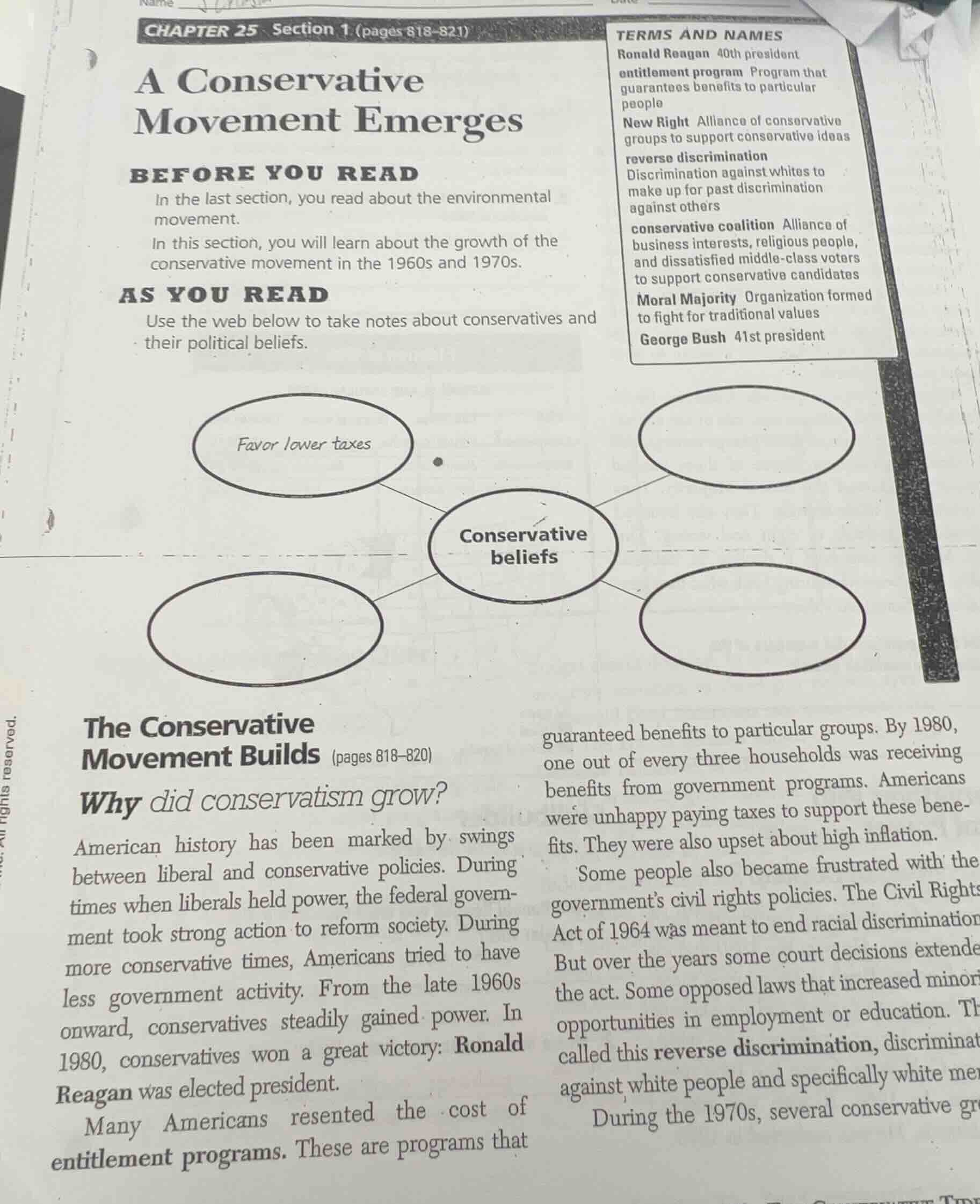
chapter 25 section 1 (pages 818-821)
a conservative movement emerges
before you read
in the last section, you read about the environmental movement.
in this section, you will learn about the growth of the conservative movement in the 1960s and 1970s.
as you read
use the web below to take notes about conservatives and their political beliefs.
conservative beliefs
- favor lower taxes
terms and names
ronald reagan 40th president
entitlement program program that guarantees benefits to particular people
new right alliance of conservative groups to support conservative ideas
reverse discrimination discrimination against whites to make up for past discrimination against others
conservative coalition alliance of business interests, religious people, and dissatisfied middle-class voters to support conservative candidates
moral majority organization formed to fight for traditional values
george bush 41st president
the conservative movement builds (pages 818-820)
why did conservatism grow?
american history has been marked by swings between liberal and conservative policies. during times when liberals held power, the federal government took strong action to reform society. during more conservative times, americans tried to have less government activity. from the late 1960s onward, conservatives steadily gained power. in 1980, conservatives won a great victory: ronald reagan was elected president.
many americans resented the cost of entitlement programs. these are programs that guaranteed benefits to particular groups. by 1980, one out of every three households was receiving benefits from government programs. americans were unhappy paying taxes to support these benefits. they were also upset about high inflation.
some people also became frustrated with the governments civil rights policies. the civil rights act of 1964 was meant to end racial discrimination. but over the years some court decisions extended the act. some opposed laws that increased minority opportunities in employment or education. they called this reverse discrimination, discriminating against white people and specifically white men.
during the 1970s, several conservative groups...
Identify the core task
The task is to complete the graphic organizer titled "Conservative beliefs" based on the provided reading passage "The Conservative Movement Builds" and the "Terms and Names" sidebar. One bubble is already filled with "Favor lower taxes". We need to find four other core conservative beliefs mentioned in the text.
Analyze the reading passage
The text highlights several areas of conservative dissatisfaction and belief:
- "Americans tried to have less government activity." This points to a belief in limiting the power/size of the federal government (or deregulation).
- "Many Americans resented the cost of entitlement programs." This points to a belief in reducing government spending on entitlement programs.
- "Some people also became frustrated with the government's civil rights policies... some opposed laws that increased minority opportunities... called this reverse discrimination." This points to opposition to affirmative action or opposition to reverse discrimination.
- The sidebar mentions the "Moral Majority" which was formed "to fight for traditional values." This points to a belief in promoting traditional values (or family values).
Select four distinct beliefs
To fill the remaining four empty bubbles surrounding "Conservative beliefs", we can extract:
- Limit the power and size of the federal government (shrink government activity).
- Reduce government spending on entitlement programs.
- Oppose policies seen as reverse discrimination (such as affirmative action/quotas).
- Promote traditional moral values and family structures.

Snap & solve any problem in the app
Get step-by-step solutions on Sovi AI
Photo-based solutions with guided steps
Explore more problems and detailed explanations
Based on the provided text, the graphic organizer for Conservative beliefs can be completed with the following points:
- Favor lower taxes (already provided)
- <blank>Shrink the size and power of the federal government</blank>
- <blank>Reduce spending on government entitlement programs</blank>
- <blank>Oppose policies perceived as reverse discrimination</blank>
- <blank>Promote traditional moral and family values</blank>