QUESTION IMAGE
Question
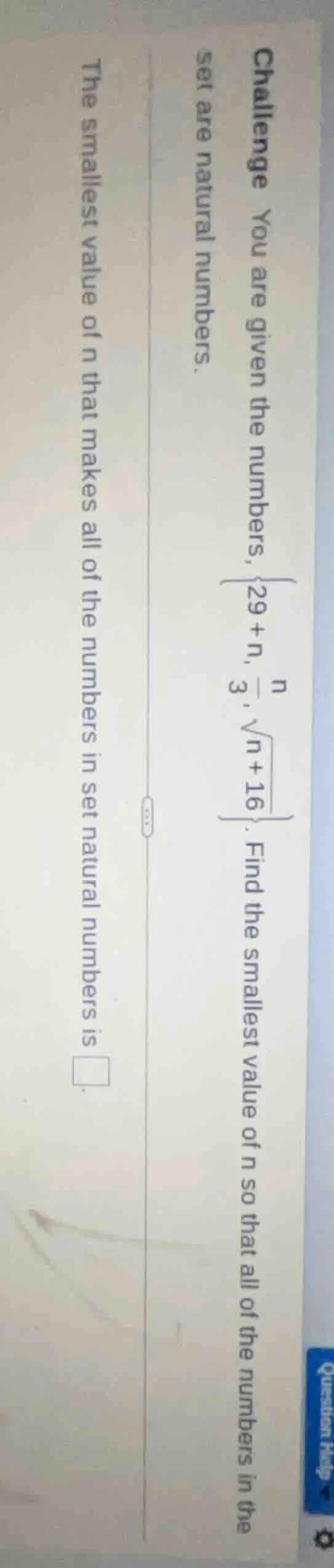
challenge you are given the numbers, \\(\
\\). find the smallest value of n so that all of the numbers in the set are natural numbers. the smallest value of n that makes all of the numbers in set natural numbers is \\(\square\\).
Step1: Analyze \(\frac{n}{3}\)
For \(\frac{n}{3}\) to be a natural number, \(n\) must be a multiple of 3. Let \(n = 3k\) where \(k\) is a natural number.
Step2: Analyze \(\sqrt{n + 16}\)
For \(\sqrt{n + 16}\) to be a natural number, \(n + 16\) must be a perfect square. Let \(n + 16 = m^2\), where \(m\) is a natural number, so \(n=m^2 - 16\).
Step3: Analyze \(29 + n\)
\(29 + n\) is a natural number as long as \(n\) is a natural number (since 29 is natural and sum of naturals is natural).
Step4: Combine conditions
From \(n = 3k\) and \(n=m^2 - 16\), we have \(m^2-16 = 3k\), so \(m^2\equiv16\pmod{3}\). Since \(16\equiv1\pmod{3}\), \(m^2\equiv1\pmod{3}\), so \(m\equiv\pm1\pmod{3}\), i.e., \(m = 3t\pm1\) for natural number \(t\).
Start with smallest \(m\) such that \(n=m^2 - 16\) is multiple of 3:
- \(m = 5\): \(n=25 - 16 = 9\). Check \(\frac{9}{3}=3\) (natural), \(\sqrt{9 + 16}=\sqrt{25}=5\) (natural), \(29+9 = 38\) (natural). All are natural.
Check smaller \(m\):
- \(m = 4\): \(n = 16 - 16=0\), but \(\frac{0}{3}=0\) (some definitions of natural numbers start at 1, so 0 may not be considered. If natural numbers start at 1, \(n = 0\) is invalid).
- \(m = 5\) gives \(n = 9\), and all \(\frac{9}{3}=3\), \(\sqrt{9 + 16}=5\), \(29 + 9 = 38\) are natural numbers (assuming natural numbers start at 1, 0 is excluded here as \(\frac{0}{3}=0\) may not be natural in some contexts).

Snap & solve any problem in the app
Get step-by-step solutions on Sovi AI
Photo-based solutions with guided steps
Explore more problems and detailed explanations
\(9\)