QUESTION IMAGE
Question
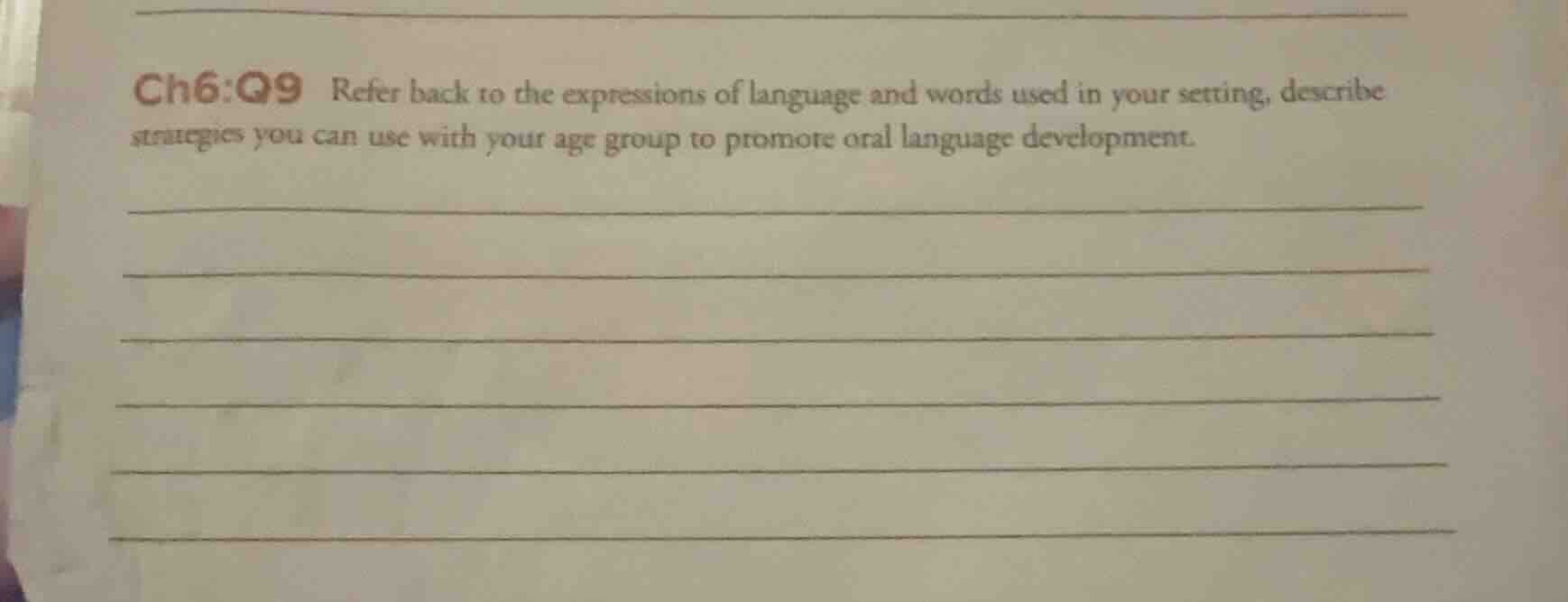
ch6: q9 refer back to the expressions of language and words used in your setting, describe strategies you can use with your age group to promote oral language development.
For young children (preschool - early elementary), strategies include: 1. Dialogic Reading: While reading books, ask open - ended questions like “What do you think the rabbit will do next?” to encourage them to respond with more than one - word answers. 2. Storytelling and Retelling: Tell a short story and then have children retell it in their own words. This helps them organize their thoughts and use new vocabulary. 3. Open - ended Questioning: Instead of asking yes/no questions, ask questions like “How would you build a tower with these blocks?” to prompt longer, more descriptive responses. 4. Vocabulary Enrichment through Play: During playtime (e.g., in a pretend grocery store), introduce new words like “crate,” “aisle,” and “inventory” and encourage children to use them in their play dialogue. 5. Singing and Rhyming: Use nursery rhymes or simple songs with repetitive lyrics. The rhythm and repetition help children remember words and practice pronunciation.
For older children (upper elementary - middle school), strategies can be: 1. Debates and Discussions: Organize small - group debates on topics like “Should school uniforms be mandatory?” This requires them to formulate arguments, use academic vocabulary, and listen to others' perspectives. 2. Oral Presentations: Have students prepare and present on a topic of interest. They need to structure their speech, use appropriate language, and answer questions from peers. 3. Literature Circles with Oral Analysis: In literature circles, students discuss the themes, characters, and plot of a book. They practice using literary terms (e.g., “foil,” “symbolism”) and explaining their interpretations. 4. Interviewing Skills: Teach students how to conduct an interview (e.g., for a school project). They learn to ask follow - up questions, listen actively, and summarize the interviewee's responses. 5. Podcasting: Have students create a podcast on a topic (e.g., a book review, a history event). This involves scripting, recording, and editing, all of which enhance oral language skills as they focus on clarity, tone, and content delivery.

Snap & solve any problem in the app
Get step-by-step solutions on Sovi AI
Photo-based solutions with guided steps
Explore more problems and detailed explanations
Strategies for promoting oral language development vary by age group:
For young children (preschool - early elementary):
- Dialogic Reading: Ask open - ended questions during storytime (e.g., “What does the character feel?”) to prompt extended responses.
- Storytelling/Retelling: Share a story, then have children retell it to practice organizing thoughts and using new vocabulary.
- Open - Ended Questioning: Use questions like “How would you solve this puzzle?” instead of yes/no queries to encourage detailed answers.
- Play - Based Vocabulary Building: Introduce new words (e.g., “texture,” “gravity”) during play (e.g., sand or block play) and prompt children to use them.
- Singing/Rhyming: Use repetitive songs/rhymes (e.g., “The Itsy Bitsy Spider”) to reinforce pronunciation and vocabulary.
For older children (upper elementary - middle school):
- Debates/Discussions: Facilitate debates (e.g., “Should homework be banned?”) to practice argumentation and academic vocabulary.
- Oral Presentations: Assign topics (e.g., “The Impact of Social Media”) for students to research, organize, and present orally.
- Literature Circles: Discuss literary elements (e.g., “How does the setting influence the plot?”) to use literary terms and analyze text orally.
- Interviewing Skills: Teach students to conduct interviews (e.g., for a history project) to practice active listening and follow - up questions.
- Podcasting: Have students create podcasts (e.g., book reviews) to refine clarity, tone, and content delivery.