QUESTION IMAGE
Question
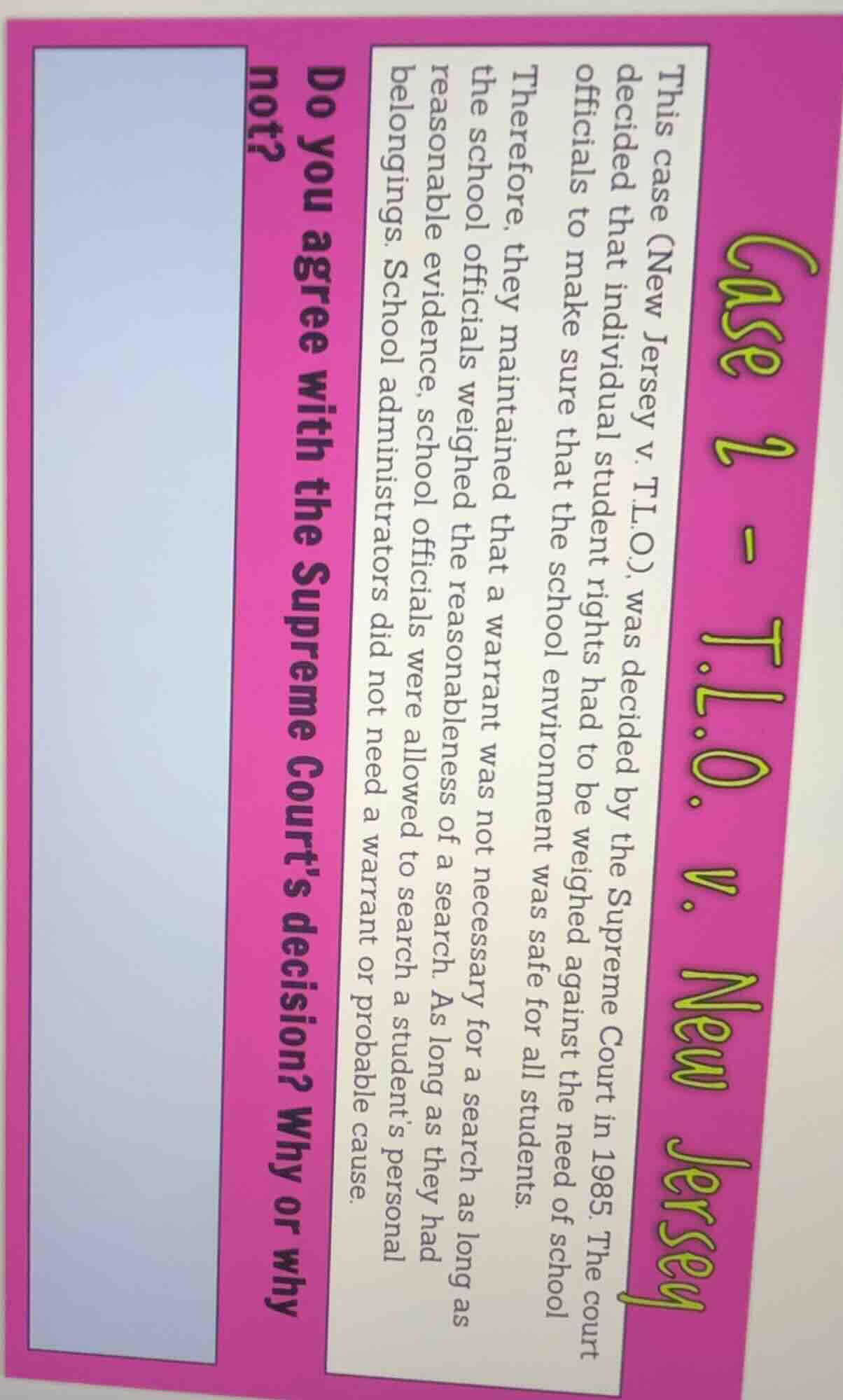
case 1 - t.l.o. v. new jersey
this case (new jersey v. t.l.o.) was decided by the supreme court in 1985. the court decided that individual student rights had to be weighed against the need of school officials to make sure that the school environment was safe for all students.
therefore, they maintained that a warrant was not necessary for a search as long as the school officials weighed the reasonableness of a search. as long as they had reasonable evidence, school officials were allowed to search a student’s personal belongings. school administrators did not need a warrant or probable cause.
do you agree with the supreme court’s decision? why or why not?
The case of New Jersey v. T.L.O. involves legal and educational policy, falling under Law (a subfield of Social Science). The Supreme Court's decision balances student rights and school safety. Agreeing could be based on the need for schools to maintain order without excessive legal hurdles, as reasonable suspicion is a practical standard for a school environment. Disagreeing could stem from concerns about privacy violations, as students still have Fourth Amendment rights that might be unduly restricted.

Snap & solve any problem in the app
Get step-by-step solutions on Sovi AI
Photo-based solutions with guided steps
Explore more problems and detailed explanations
(Example agreement response) I agree with the Supreme Court’s decision. In a school setting, ensuring a safe environment for all students is crucial. Requiring a warrant or probable cause for every student search would be impractical and hinder school officials’ ability to address issues promptly. The “reasonable suspicion” standard allows schools to maintain order while still respecting students’ rights to a degree, as searches are only permitted when there is good reason to believe a rule has been broken or safety is at risk.
(Example disagreement response) I disagree with the Supreme Court’s decision. Students, like all citizens, are entitled to Fourth Amendment protections against unreasonable searches and seizures. Allowing school officials to search without a warrant or probable cause (just “reasonable suspicion”) sets a precedent that could lead to overreach and violations of student privacy. The balance between school safety and individual rights was tipped too far in favor of school authority, and a higher legal standard should be required to protect students’ constitutional rights.