QUESTION IMAGE
Question
candidate assessment
- required
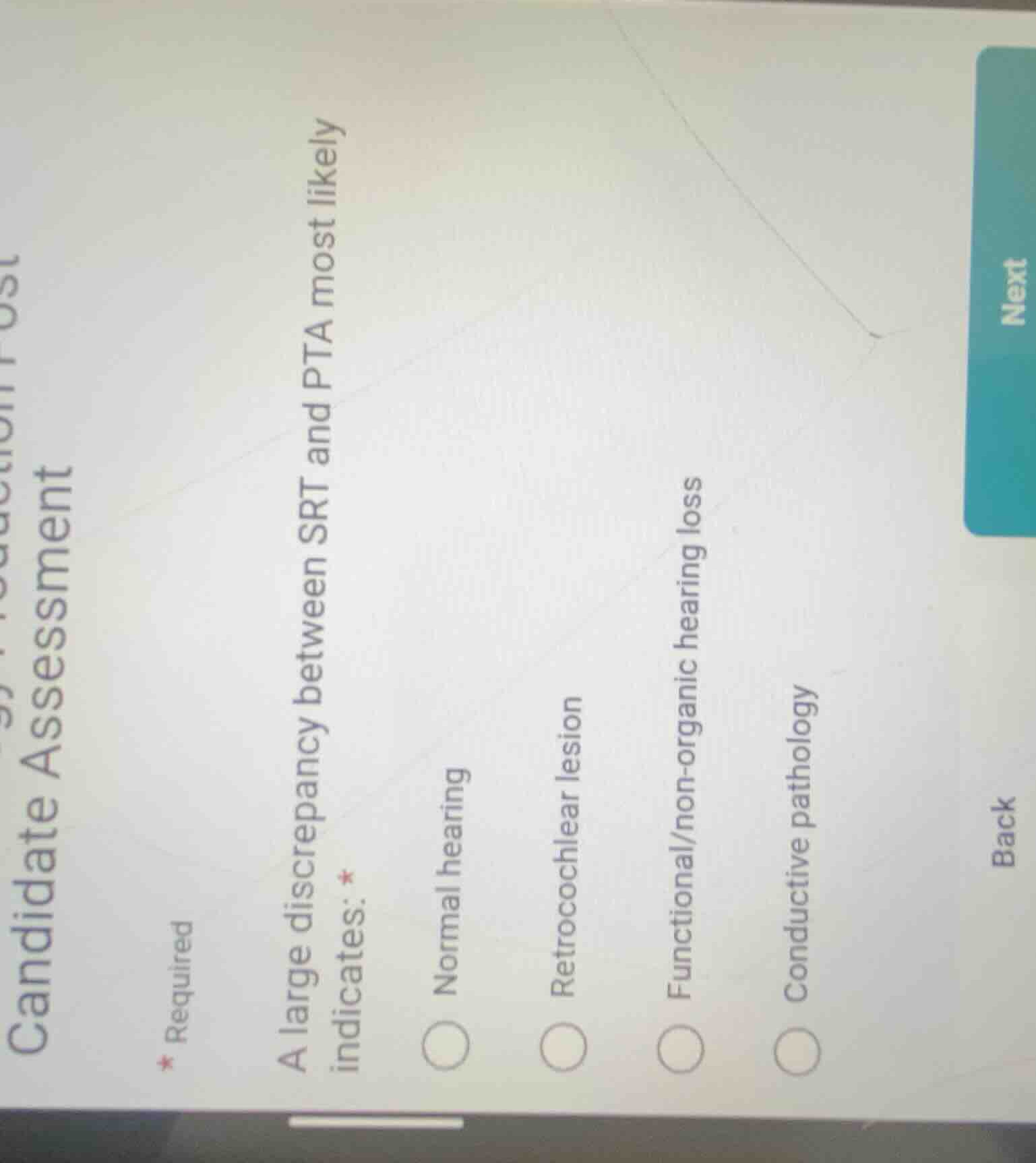
a large discrepancy between srt and pta most likely indicates: *
normal hearing
retrocochlear lesion
functional/non-organic hearing loss
conductive pathology
<pre_analysis>
{
"quality": "clear",
"question_count": 1,
"skills_matched": [
"direct_cot",
"multiple_choice_formatter",
"explain_then_answer",
"tutor"
],
"needs_drawing": false,
"concepts_used": [
"Clinical Audiometry"
],
"new_concepts": [
"SRT and PTA Agreement",
"Functional Hearing Loss"
],
"current_concepts": [
"Clinical Audiometry",
"SRT and PTA Agreement",
"Functional Hearing Loss"
]
}
</pre_analysis>
<reasoning>
Define SRT and PTA
In Clinical Audiometry, the Speech Recognition Threshold (SRT) is the lowest intensity level at which a patient can correctly repeat 50% of spondee words. The Pure-Tone Average (PTA) is the average of pure-tone hearing thresholds, typically calculated at 500, 1000, and 2000 Hz.
Analyze normal agreement
Under normal physiological conditions, the SRT and PTA should closely agree with each other, typically within \(\pm 6\text{ to }10\text{ dB}\). This agreement serves as an important internal reliability check for the behavioral audiometric test battery.
Evaluate clinical discrepancies
A large discrepancy where the SRT is significantly better (lower threshold) than the PTA is a classic hallmark of functional, non-organic, or pseudohypacusis (exaggerated or feigned hearing loss). Patients attempting to exaggerate a hearing loss often struggle to maintain a consistent reference level for complex speech stimuli compared to simple pure tones, leading to a much better SRT than PTA.
Rule out other options
- Normal hearing: SRT and PTA would both be within normal limits and in close agreement.
- Retrocochlear lesion: Typically characterized by poor speech recognition scores at suprathreshold levels, but SRT and PTA usually remain in reasonable agreement.
- Conductive pathology: Results in an organic hearing loss where both pure-tone and speech thresholds are elevated proportionally, maintaining good SRT-PTA agreement.
</reasoning>
<answer>
<mcq-option>Normal hearing</mcq-option>
<mcq-option>Retrocochlear lesion</mcq-option>
<mcq-correct>Functional/non-organic hearing loss</mcq-correct>
<mcq-option>Conductive pathology</mcq-option>
</answer>
<post_analysis>
{
"subject": "Natural Science",
"question_type": "Multiple Choice",
"knowledge_point": [
"Natural Science",
"Medicine",
"Audiology"
]
}
</post_analysis>
Snap & solve any problem in the app
Get step-by-step solutions on Sovi AI
Photo-based solutions with guided steps
Explore more problems and detailed explanations
<pre_analysis>
{
"quality": "clear",
"question_count": 1,
"skills_matched": [
"direct_cot",
"multiple_choice_formatter",
"explain_then_answer",
"tutor"
],
"needs_drawing": false,
"concepts_used": [
"Clinical Audiometry"
],
"new_concepts": [
"SRT and PTA Agreement",
"Functional Hearing Loss"
],
"current_concepts": [
"Clinical Audiometry",
"SRT and PTA Agreement",
"Functional Hearing Loss"
]
}
</pre_analysis>
<reasoning>
Define SRT and PTA
In Clinical Audiometry, the Speech Recognition Threshold (SRT) is the lowest intensity level at which a patient can correctly repeat 50% of spondee words. The Pure-Tone Average (PTA) is the average of pure-tone hearing thresholds, typically calculated at 500, 1000, and 2000 Hz.
Analyze normal agreement
Under normal physiological conditions, the SRT and PTA should closely agree with each other, typically within \(\pm 6\text{ to }10\text{ dB}\). This agreement serves as an important internal reliability check for the behavioral audiometric test battery.
Evaluate clinical discrepancies
A large discrepancy where the SRT is significantly better (lower threshold) than the PTA is a classic hallmark of functional, non-organic, or pseudohypacusis (exaggerated or feigned hearing loss). Patients attempting to exaggerate a hearing loss often struggle to maintain a consistent reference level for complex speech stimuli compared to simple pure tones, leading to a much better SRT than PTA.
Rule out other options
- Normal hearing: SRT and PTA would both be within normal limits and in close agreement.
- Retrocochlear lesion: Typically characterized by poor speech recognition scores at suprathreshold levels, but SRT and PTA usually remain in reasonable agreement.
- Conductive pathology: Results in an organic hearing loss where both pure-tone and speech thresholds are elevated proportionally, maintaining good SRT-PTA agreement.
</reasoning>
<answer>
<mcq-option>Normal hearing</mcq-option>
<mcq-option>Retrocochlear lesion</mcq-option>
<mcq-correct>Functional/non-organic hearing loss</mcq-correct>
<mcq-option>Conductive pathology</mcq-option>
</answer>
<post_analysis>
{
"subject": "Natural Science",
"question_type": "Multiple Choice",
"knowledge_point": [
"Natural Science",
"Medicine",
"Audiology"
]
}
</post_analysis>