QUESTION IMAGE
Question
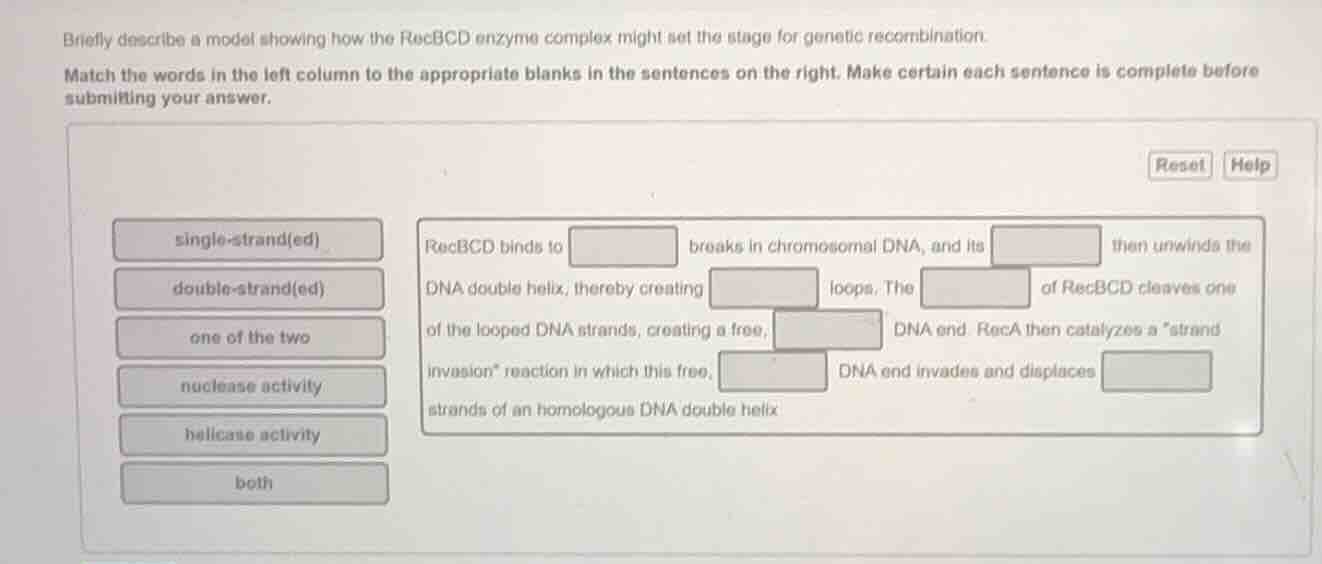
briefly describe a model showing how the recbcd enzyme complex might set the stage for genetic recombination.
match the words in the left column to the appropriate blanks in the sentences on the right. make certain each sentence is complete before submitting your answer.
single-strand(ed)
double-strand(ed)
one of the two
nuclease activity
helicase activity
both
recbcd binds to blank breaks in chromosomal dna, and its blank then unwinds the dna double helix, thereby creating blank loops. the blank of recbcd cleaves one of the looped dna strands, creating a free, blank dna end. reca then catalyzes a \strand invasion\ reaction in which this free, blank dna end invades and displaces blank strands of an homologous dna double helix.
Identify the biological pathway
The question asks to describe how the RecBCD enzyme complex initiates homologous genetic recombination in Escherichia coli. This pathway processes double-strand breaks to generate single-stranded DNA coated with RecA, which is essential for strand invasion.
Analyze the first sentence
The first sentence is: "RecBCD binds to [Blank 1] breaks in chromosomal DNA, and its [Blank 2] then unwinds the DNA double helix, thereby creating [Blank 3] loops."
- RecBCD specifically recognizes and binds to double-strand(ed) breaks.
- The unwinding of the DNA double helix is driven by the helicase activity of the RecB and RecD subunits.
- Unwinding the double helix while keeping the strands connected elsewhere creates single-strand(ed) loops (often referred to as rabbit-ear loops during the unwinding process).
Analyze the second sentence
The second sentence is: "The [Blank 4] of RecBCD cleaves one of the looped DNA strands, creating a free, [Blank 5] DNA end."
- Cleavage of DNA is performed by the nuclease activity of the RecB subunit (specifically regulated by the Chi site).
- Cleaving one strand of the loop creates a free, single-strand(ed) DNA end (specifically a 3' single-stranded overhang).
Analyze the third sentence
The third sentence is: "RecA then catalyzes a "strand invasion" reaction in which this free, [Blank 6] DNA end invades and displaces [Blank 7] strands of an homologous DNA double helix."
- The invading end is the free, single-strand(ed) DNA end coated with RecA.
- During strand invasion, this single strand invades a homologous duplex, displacing one of the two strands of the homologous DNA double helix to form a D-loop.

Snap & solve any problem in the app
Get step-by-step solutions on Sovi AI
Photo-based solutions with guided steps
Explore more problems and detailed explanations
RecBCD binds to <blank>double-strand(ed)</blank> breaks in chromosomal DNA, and its <blank>helicase activity</blank> then unwinds the DNA double helix, thereby creating <blank>single-strand(ed)</blank> loops. The <blank>nuclease activity</blank> of RecBCD cleaves one of the looped DNA strands, creating a free, <blank>single-strand(ed)</blank> DNA end. RecA then catalyzes a "strand invasion" reaction in which this free, <blank>single-strand(ed)</blank> DNA end invades and displaces <blank>one of the two</blank> strands of an homologous DNA double helix.