QUESTION IMAGE
Question
branching
ibs\ of bone present in spongy bone are known as:
lamellae
canaliculi
trabeculae
lacunae
question 31
what accounts for the majority of bone (osseous) tissue matrix?
osteoid
collagen fibers
calcium salts
bone marrow
Analyze the first question
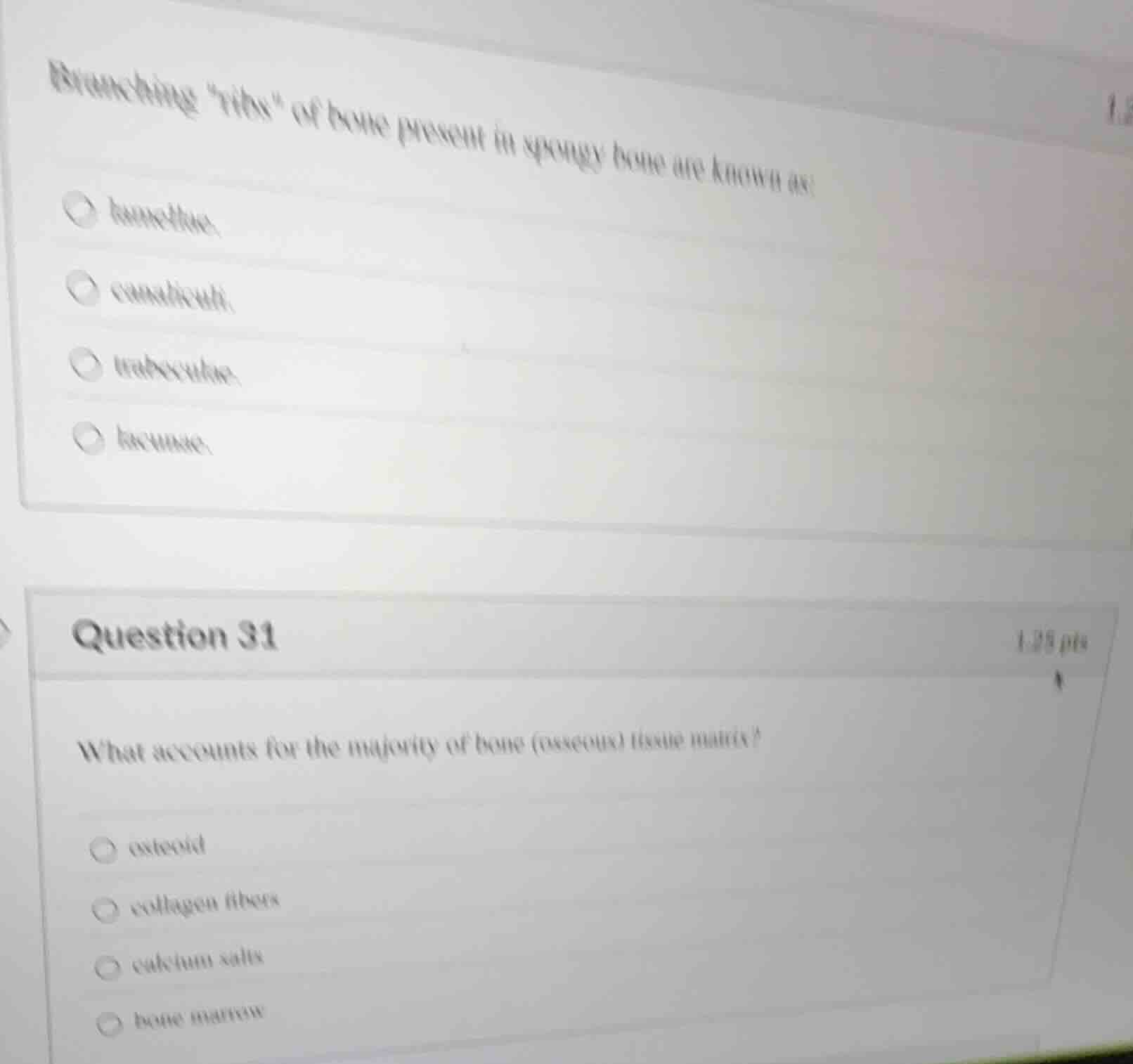
The first question asks: "Branching 'ribs' of bone present in spongy bone are known as:"
- Lamellae: Concentric rings of matrix found in compact bone osteons.
- Canaliculi: Tiny canals connecting lacunae.
- Trabeculae: The branching, needle-like lattice structures characteristic of spongy (cancellous) bone.
- Lacunae: Small cavities containing osteocytes.
Therefore, the correct choice is trabeculae. This relates to Skeletal Anatomy and Bone Histology.
Analyze the second question (Question 31)
The second question asks: "What accounts for the majority of bone (osseous) tissue matrix?"
- Osteoid: The organic part of the matrix (mostly collagen), making up about 1/3 of the matrix.
- Collagen fibers: Part of the organic matrix.
- Calcium salts: Inorganic mineral salts (primarily hydroxyapatite, a form of calcium phosphate) make up about 2/3 (the majority) of the bone matrix weight, providing hardness.
- Bone marrow: Soft tissue filling the cavities, not part of the extracellular matrix itself.
Therefore, calcium salts account for the majority of the bone tissue matrix.
Summarize the findings
- For the first question, the branching structures in spongy bone are trabeculae.
- For Question 31, the component making up the majority of the bone matrix is calcium salts.

Snap & solve any problem in the app
Get step-by-step solutions on Sovi AI
Photo-based solutions with guided steps
Explore more problems and detailed explanations
Question 1
- (A) lamellae
- (B) canaliculi
- (C) trabeculae (Correct answer)
- (D) lacunae
Question 2
- (A) osteoid
- (B) collagen fibers
- (C) calcium salts (Correct answer)
- (D) bone marrow