QUESTION IMAGE
Question
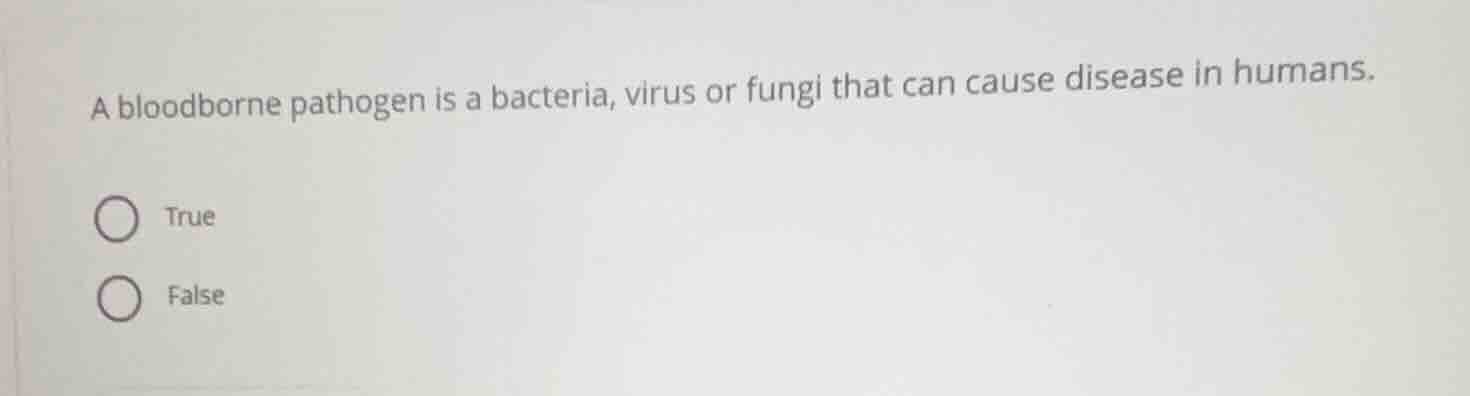
a bloodborne pathogen is a bacteria, virus or fungi that can cause disease in humans.
true
false
Define bloodborne pathogens
Using the Bloodborne Pathogens knowledge point, we define these as infectious microorganisms in human blood that can cause disease in humans. These pathogens include, but are not limited to, hepatitis B (HBV), hepatitis C (HCV), and human immunodeficiency virus (HIV).
Analyze the statement's components
The statement in the question asserts: "A bloodborne pathogen is a bacteria, virus or fungi that can cause disease in humans."
- Pathogens can indeed be bacteria, viruses, fungi, or parasites.
- However, the defining characteristic of a bloodborne pathogen is its transmission route—specifically, that it is carried and transmitted through human blood and other potentially infectious materials (OPIM).
Evaluate the strict definition
Under OSHA Standards (specifically 29 CFR 1910.1030), bloodborne pathogens are defined strictly as pathogenic microorganisms that are present in human blood and can cause disease in humans.
- The statement in the image is incomplete because it omits the critical requirement of being carried in the blood.
- A general pathogen can be any disease-causing microorganism (bacteria, virus, fungi) transmitted via air, water, food, or physical contact.
- Without specifying that these microorganisms are present in and transmitted through blood, the definition is technically incorrect or incomplete. Therefore, the statement is False.

Snap & solve any problem in the app
Get step-by-step solutions on Sovi AI
Photo-based solutions with guided steps
Explore more problems and detailed explanations
- True
- False (Correct answer)