QUESTION IMAGE
Question
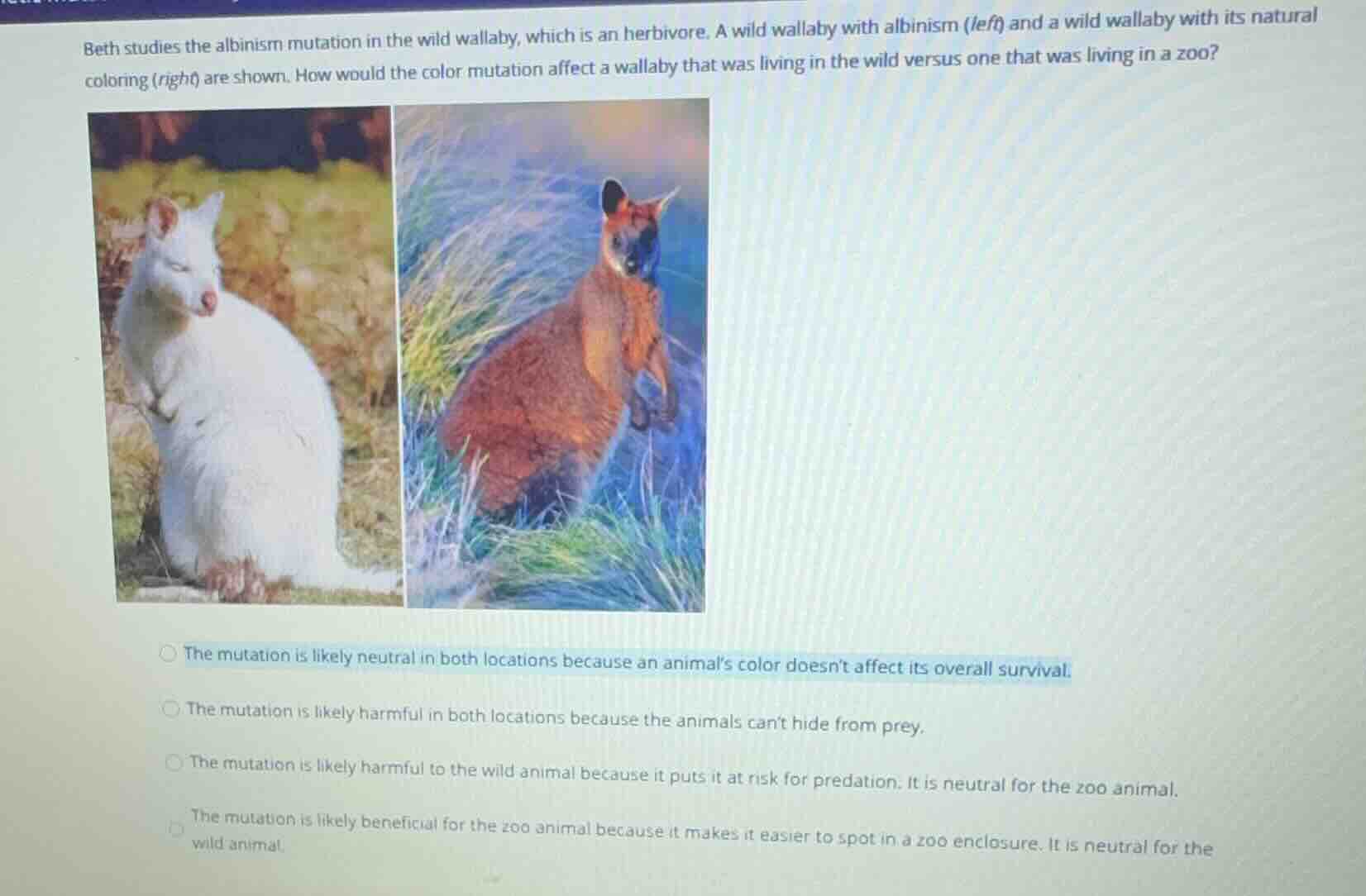
beth studies the albinism mutation in the wild wallaby, which is an herbivore. a wild wallaby with albinism (left) and a wild wallaby with its natural coloring (right) are shown. how would the color mutation affect a wallaby that was living in the wild versus one that was living in a zoo?
- the mutation is likely neutral in both locations because an animals color doesnt affect its overall survival.
- the mutation is likely harmful in both locations because the animals cant hide from prey.
- the mutation is likely harmful to the wild animal because it puts it at risk for predation. it is neutral for the zoo animal.
- the mutation is likely beneficial for the zoo animal because it makes it easier to spot in a zoo enclosure. it is neutral for the wild animal.
Analyze the impact of albinism in the wild
In the wild, a wallaby relies on its natural brown/grey coloring to blend into its grassy and brushy environment to avoid predators. An albino wallaby is bright white, making it highly visible to predators, which significantly increases its risk of predation. Therefore, the mutation is harmful in the wild.
Analyze the impact of albinism in a zoo
In a zoo, animals are protected from predators, and food is provided. The lack of camouflage does not affect the wallaby's survival or reproductive success. Therefore, the mutation is neutral for a zoo animal.
Evaluate the given options
- Option 1: Incorrect. Coloration strongly affects survival in the wild.
- Option 2: Incorrect. Wallabies are herbivores; they hide from predators, not prey.
- Option 3: Correct. It is harmful in the wild due to predation risk and neutral in a controlled zoo environment.
- Option 4: Incorrect. Being easier to spot in a zoo does not provide a biological survival or reproductive benefit (it is not "beneficial" in an evolutionary sense).

Snap & solve any problem in the app
Get step-by-step solutions on Sovi AI
Photo-based solutions with guided steps
Explore more problems and detailed explanations
- The mutation is likely neutral in both locations because an animal's color doesn't affect its overall survival.
- The mutation is likely harmful in both locations because the animals can't hide from prey.
- The mutation is likely harmful to the wild animal because it puts it at risk for predation. It is neutral for the zoo animal. (Correct answer)
- The mutation is likely beneficial for the zoo animal because it makes it easier to spot in a zoo enclosure. It is neutral for the wild animal.