QUESTION IMAGE
Question
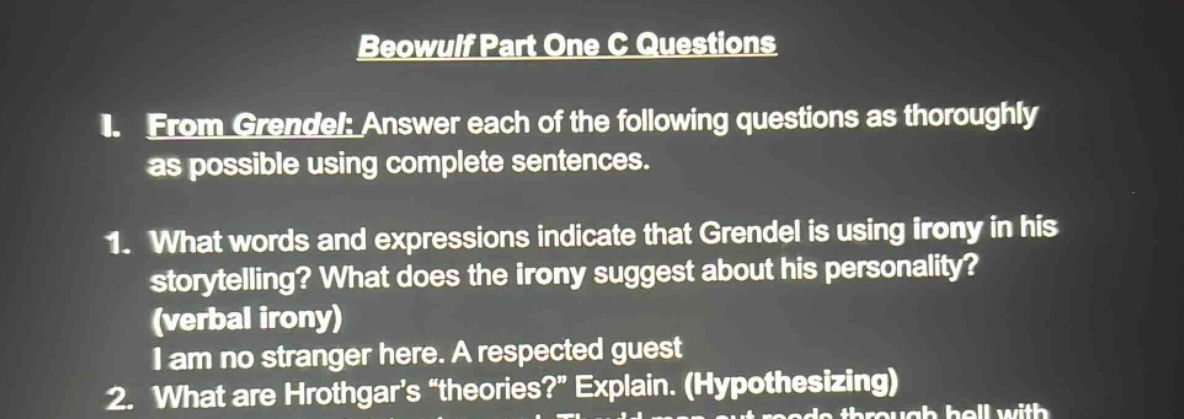
beowulf part one c questions
- from grendel: answer each of the following questions as thoroughly as possible using complete sentences.
- what words and expressions indicate that grendel is using irony in his storytelling? what does the irony suggest about his personality? (verbal irony)
i am no stranger here. a respected guest
- what are hrothgar’s “theories?” explain. (hypothesizing)
th
d men out reads through hell with
Since the problem is about analyzing a literary work (Beowulf, specifically the Grendel section) and involves literary analysis (looking at irony in storytelling and character's theories), the discipline is Arts and the subfield is Literature. We'll use the Answer - Explanation Format.
For question 1:
To identify irony in Grendel's statement "I am no stranger here. A respected guest", we note that Grendel is a monster feared by the Danes, so being a "respected guest" is ironic (verbal irony: saying the opposite of reality). His use of irony suggests he has a self - aware, perhaps mocking or cynical personality, as he's aware of the contrast between his perception and the Danes' view of him.
In the context of Beowulf, Hrothgar's theories likely relate to the nature of evil (Grendel's existence), the role of fate/God in human affairs, or the need for heroic action to combat evil. For example, he might theorize that Grendel is a punishment from a higher power for some transgression, or that heroic deeds (like Beowulf's) are the way to restore order against such evil forces.

Snap & solve any problem in the app
Get step-by-step solutions on Sovi AI
Photo-based solutions with guided steps
Explore more problems and detailed explanations
- Words/expressions for irony: "I am no stranger here", "A respected guest". Grendel is a feared monster by the Danes, so claiming to be a "respected guest" (when he's an outsider and a threat) is verbal irony.
- Irony's suggestion about personality: The irony suggests Grendel has a self - aware, mocking, or cynical personality. He is cognizant of the stark contrast between how he views his place (or wants to be seen) and how the Danes actually view him, and uses irony to highlight this contrast, showing a sense of detachment and perhaps a darkly humorous view of his situation.
For question 2:
(Note: The text for question 2 seems cut off, but assuming it's about Hrothgar's theories in the context of Grendel/Beowulf)