QUESTION IMAGE
Question
1 - behavioral learning theory
learning objective: apply concepts of classical and operant conditioning to work.
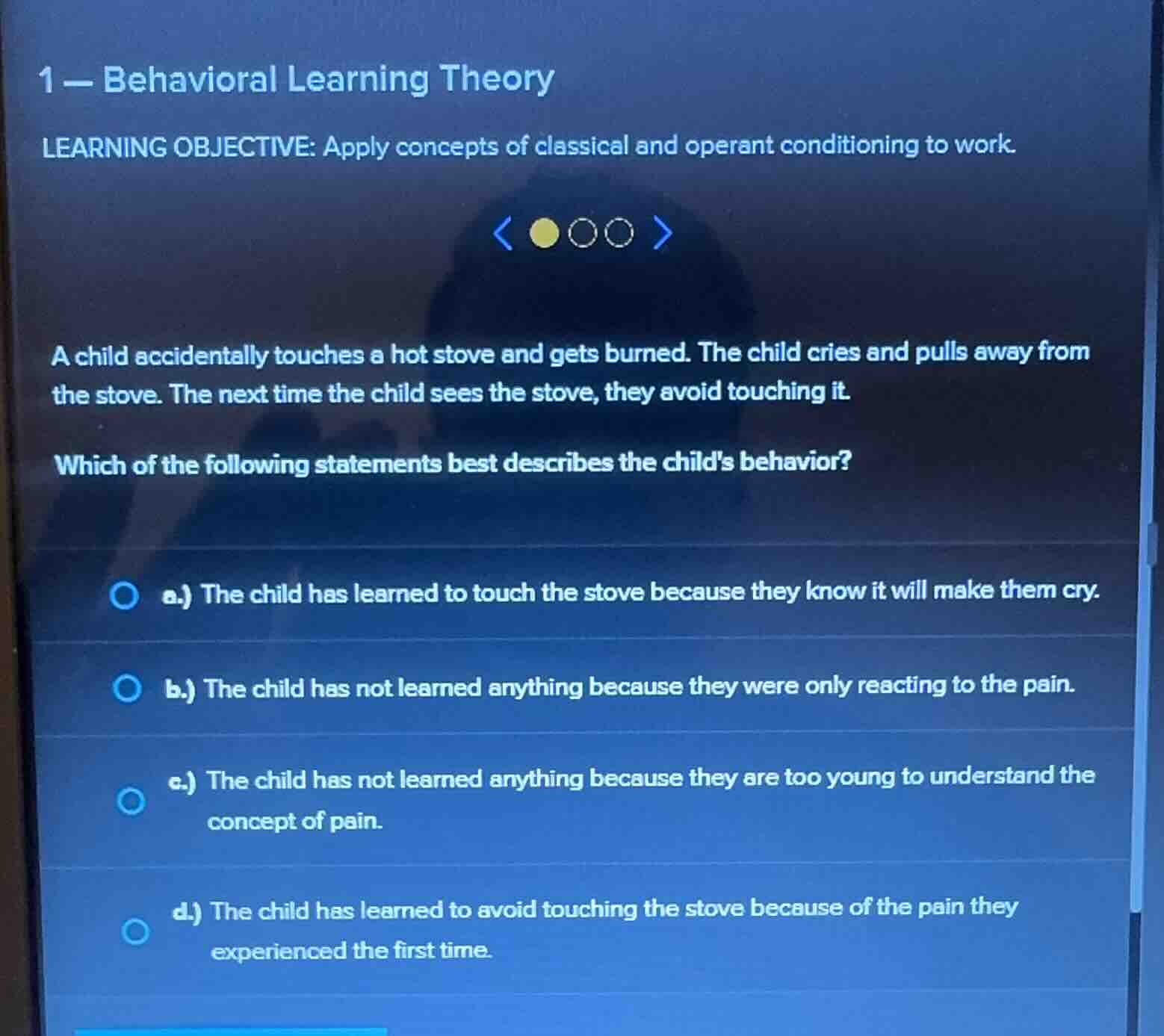
a child accidentally touches a hot stove and gets burned. the child cries and pulls away from the stove. the next time the child sees the stove, they avoid touching it.
which of the following statements best describes the childs behavior?
a.) the child has learned to touch the stove because they know it will make them cry.
b.) the child has not learned anything because they were only reacting to the pain.
c.) the child has not learned anything because they are too young to understand the concept of pain.
d.) the child has learned to avoid touching the stove because of the pain they experienced the first time.
Analyze the scenario
The scenario describes a child who touches a hot stove, experiences pain (gets burned), and subsequently avoids touching the stove in the future. This is a classic example of behavioral learning, specifically operant conditioning (punishment) and classical conditioning (associating the sight of the stove with pain).
Evaluate the options
- Option a: Incorrect. The child does not learn to touch the stove; they learn to avoid it.
- Option b: Incorrect. The child has clearly learned to modify their future behavior based on the consequence of their initial action.
- Option c: Incorrect. The child's behavior (avoidance) demonstrates that learning occurred, regardless of their cognitive understanding of the abstract concept of pain.
- Option d: Correct. This statement accurately describes behavioral learning, where an organism changes its behavior (avoiding the stove) as a result of an experience (the pain of being burned).

Snap & solve any problem in the app
Get step-by-step solutions on Sovi AI
Photo-based solutions with guided steps
Explore more problems and detailed explanations
- a.) The child has learned to touch the stove because they know it will make them cry.
- b.) The child has not learned anything because they were only reacting to the pain.
- c.) The child has not learned anything because they are too young to understand the concept of pain.
- d.) The child has learned to avoid touching the stove because of the pain they experienced the first time. (Correct answer)