QUESTION IMAGE
Question
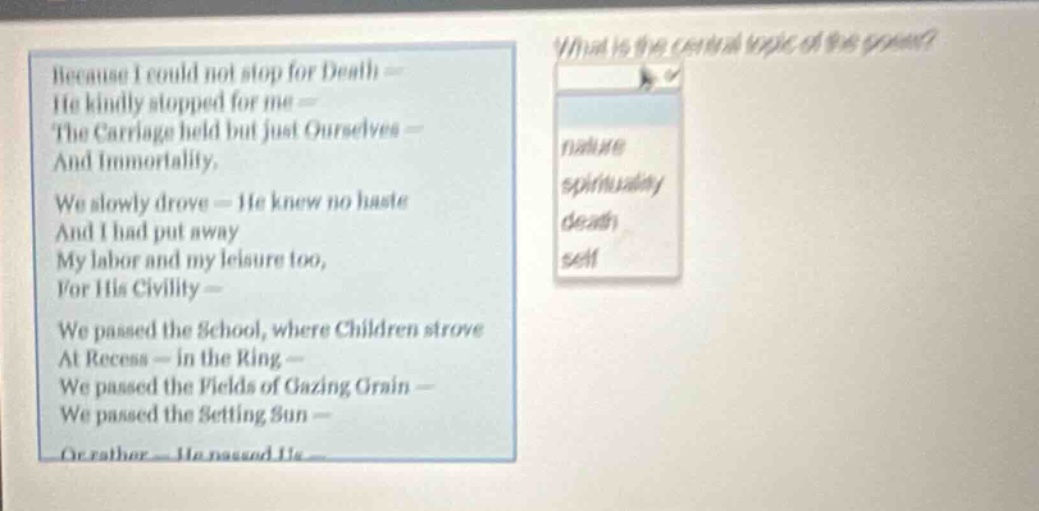
because i could not stop for death -
he kindly stopped for me -
the carriage held but just ourselves -
and immortality.
we slowly drove - he knew no haste
and i had put away
my labor and my leisure too,
for his civility -
we passed the school, where children strove
at recess - in the ring -
we passed the fields of gazing grain -
we passed the setting sun -
or rather - he passed us -
what is the central topic of the poem?
- nature
- spirituality
- death
- self
⚡ Using what you learned: close reading methods for poetic texts
Step 1: Analyze the text
The poem shown is the beginning of Emily Dickinson's famous poem, "Because I could not stop for Death."
- The speaker begins by stating, "Because I could not stop for Death – / He kindly stopped for me –".
- The journey takes place in a carriage with "Death" personified as a polite driver, along with "Immortality."
- They pass scenes representing stages of life: children playing (youth), fields of grain (maturity), and the setting sun (the end of life).
Step 2: Identify the central topic
The poem uses the metaphor of a carriage ride to describe the transition from life to the afterlife. The central figure, driver, and driving force of the entire narrative is "Death."
Comparing the options:
- nature: While natural elements like fields and the sun are passed, they serve as symbols rather than the main focus.
- spirituality: While there are spiritual undertones regarding immortality, the primary subject being addressed and personified is the transition of dying.
- death: This is the explicit subject introduced in the very first line and the central theme of the journey.
- self: The poem is written in the first person, but the focus is on the speaker's encounter with mortality.
Therefore, the central topic is death.

Snap & solve any problem in the app
Get step-by-step solutions on Sovi AI
Photo-based solutions with guided steps
Explore more problems and detailed explanations
death