QUESTION IMAGE
Question
because i could not stop for death
emily dickinson
because i could not stop for death-
he kindly stopped for me-
the carriage held but just ourselves-
and immortality.
we slowly drove-he knew no haste
and i had put away
my labor and my leisure too,
for his civility-
we passed the school, where children strove
at recess-in the ring-
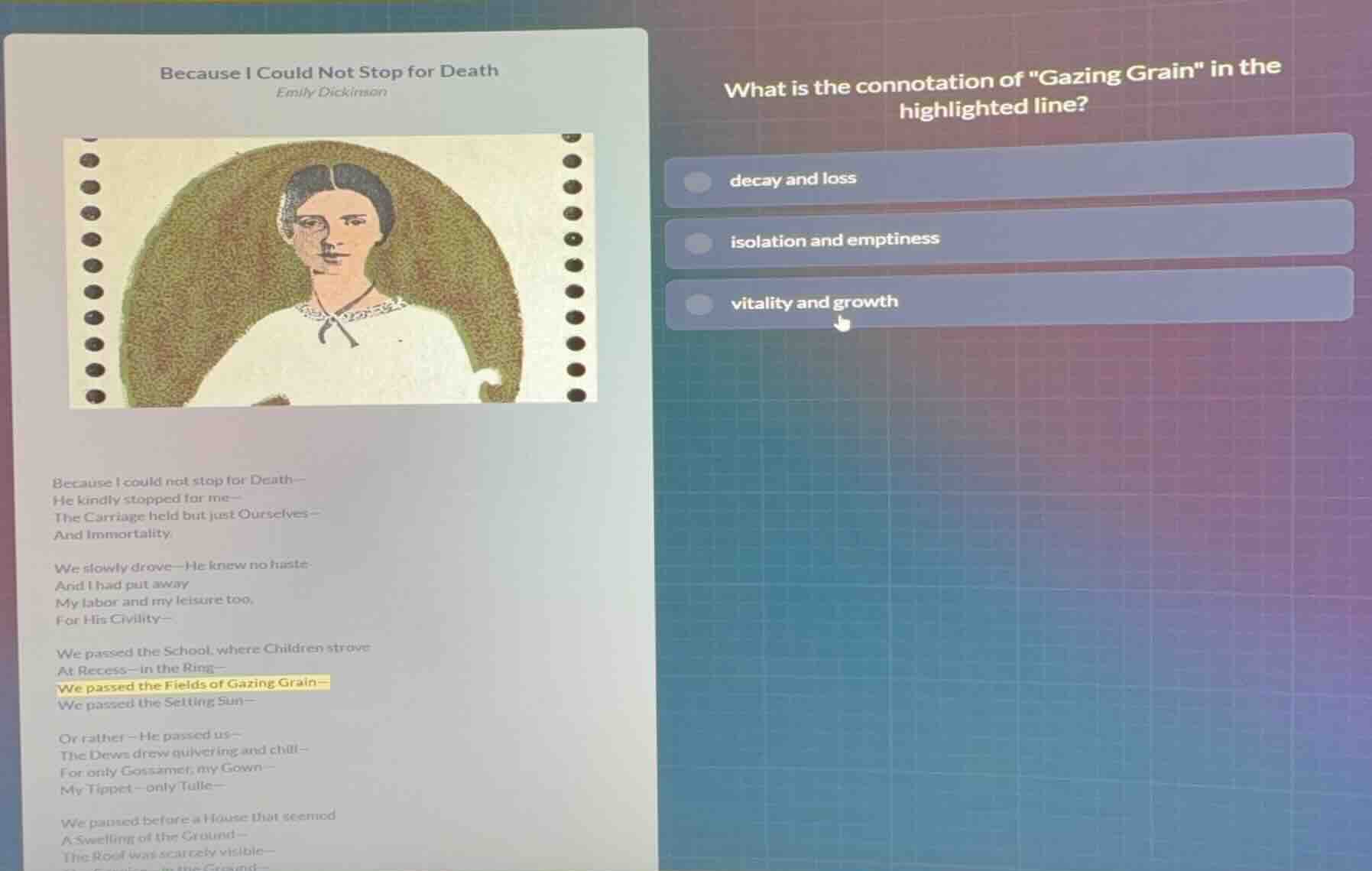
we passed the fields of gazing grain-
we passed the setting sun-
or rather-he passed us-
the dews drew quivering and chill-
for only gossamer, my gown-
my tippet-only tulle-
we paused before a house that seemed
a swelling of the ground-
the roof was scarcely visible-
what is the connotation of \gazing grain\ in the highlighted line?
decay and loss
isolation and emptiness
vitality and growth
Analyze the highlighted line and its context
Using the Emily Dickinson Poetry knowledge point
The highlighted line is "We passed the Fields of Gazing Grain—" from Emily Dickinson's poem "Because I could not stop for Death". This stanza describes a carriage ride passing by three distinct scenes: a school where children strive (representing childhood/youth), fields of gazing grain (representing maturity/adulthood), and the setting sun (representing old age/death).
Determine the connotation of the phrase
Using the Poetic Connotation knowledge point
"Grain" in its mature, golden state represents the peak of life, harvest, and agricultural abundance. The personification of the grain "gazing" suggests it is fully developed, standing tall, and actively observing. Therefore, the fields of grain carry a connotation of life at its peak, representing vitality, abundance, and growth before the transition to the setting sun (death).

Snap & solve any problem in the app
Get step-by-step solutions on Sovi AI
Photo-based solutions with guided steps
Explore more problems and detailed explanations
- decay and loss
- isolation and emptiness
- vitality and growth (Correct answer)