Sovi.AI - AI Math Tutor

Scan to solve math questions

QUESTION IMAGE

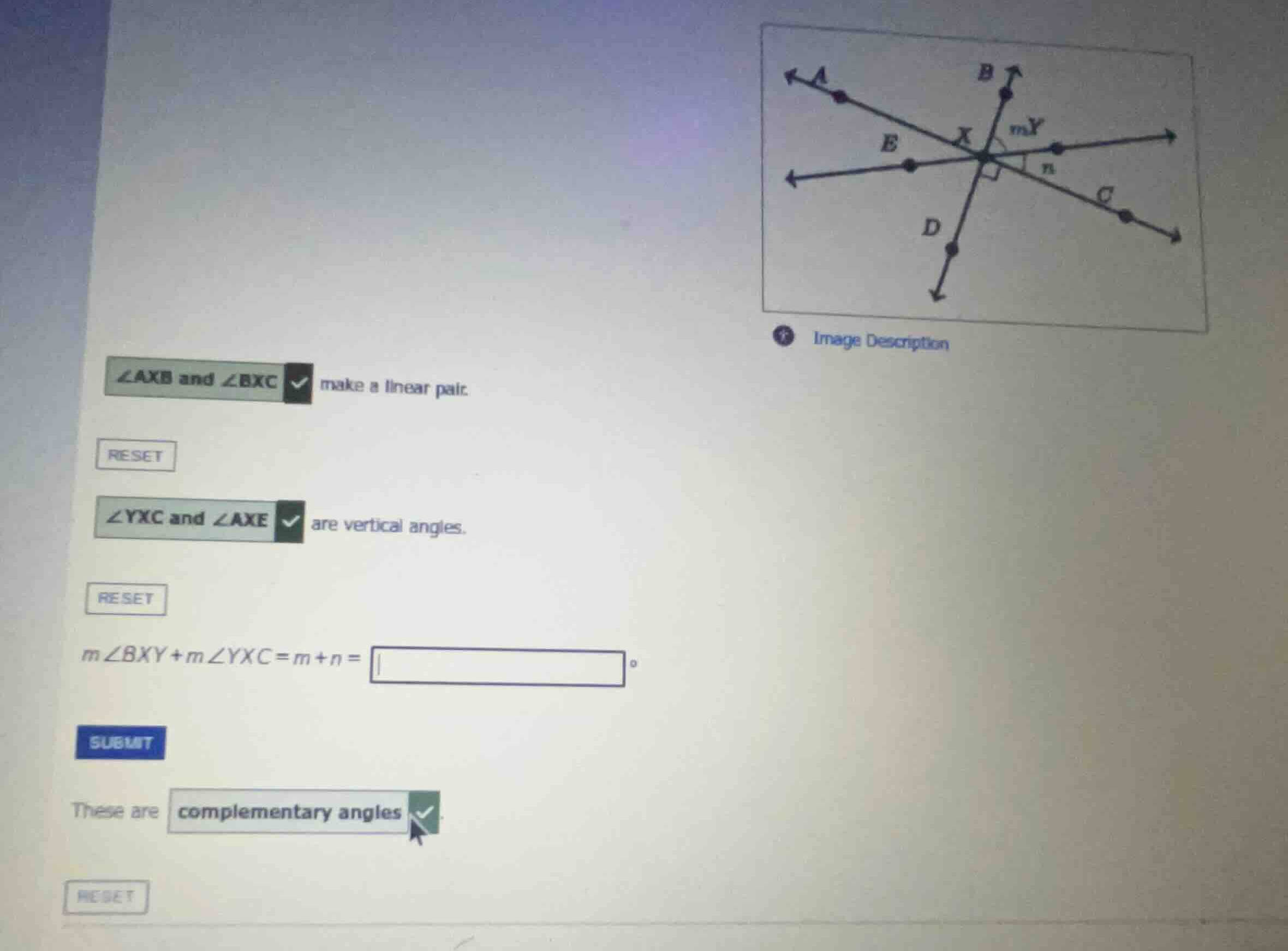
\\angle axb and \\angle bxc make a linear pair. \\angle yxc and \\angle…

Question

\angle axb and \angle bxc make a linear pair.
\angle yxc and \angle axe are vertical angles.
m\angle bxy + m\angle yxc = m + n = ^{\circ}
these are complementary angles

Explanation:

Response

<pre_analysis>
{
"quality": "clear",
"question_count": 1,
"skills_matched": [
"step_cot",
"blank_filling_formatter",
"explain_then_answer",
"tutor"
],
"needs_drawing": false,
"concepts_used": [
"Angle Addition Postulate"
],
"new_concepts": [
"Complementary Angles",
"Linear Pair"
],
"current_concepts": [
"Angle Addition Postulate",
"Complementary Angles",
"Linear Pair",
"Vertical Angles"
]
}
</pre_analysis>

<reasoning>

Identify the given geometric relationships

We are given a geometric diagram with intersecting lines.
From the diagram, we observe that line \(AC\) and line \(BD\) intersect at point \(X\).
A right angle symbol is shown between ray \(XB\) and ray \(XC\), which means:
\[
m\angle BXC = 90^\circ
\]

Analyze the angles in question

We need to find the sum:
\[
m\angle BXY + m\angle YXC = m + n
\]
From the diagram, ray \(XY\) lies in the interior of \angle BXC.
The measure of \angle BXY is labeled as \(m\), and the measure of \angle YXC is labeled as \(n\).

Apply the Angle Addition Postulate

Using the Angle Addition Postulate:
\[
m\angle BXY + m\angle YXC = m\angle BXC
\]
Since \angle BXC is a right angle:
\[
m\angle BXC = 90^\circ
\]
Therefore:
\[
m + n = 90^\circ
\]
These are complementary angles because their sum is \(90^\circ\).
</reasoning>

<answer>
\(m\angle BXY + m\angle YXC = m + n =\) <blank>90</blank>\(^\circ\)
</answer>

<post_analysis>
{
"subject": "Mathematics",
"question_type": "Fill-in-the-blank",
"knowledge_point": [
"Mathematics",
"Geometry",
"Angle Addition Postulate"
]
}
</post_analysis>

Answer:

<pre_analysis>
{
"quality": "clear",
"question_count": 1,
"skills_matched": [
"step_cot",
"blank_filling_formatter",
"explain_then_answer",
"tutor"
],
"needs_drawing": false,
"concepts_used": [
"Angle Addition Postulate"
],
"new_concepts": [
"Complementary Angles",
"Linear Pair"
],
"current_concepts": [
"Angle Addition Postulate",
"Complementary Angles",
"Linear Pair",
"Vertical Angles"
]
}
</pre_analysis>

<reasoning>

Identify the given geometric relationships

We are given a geometric diagram with intersecting lines.
From the diagram, we observe that line \(AC\) and line \(BD\) intersect at point \(X\).
A right angle symbol is shown between ray \(XB\) and ray \(XC\), which means:
\[
m\angle BXC = 90^\circ
\]

Analyze the angles in question

We need to find the sum:
\[
m\angle BXY + m\angle YXC = m + n
\]
From the diagram, ray \(XY\) lies in the interior of \angle BXC.
The measure of \angle BXY is labeled as \(m\), and the measure of \angle YXC is labeled as \(n\).

Apply the Angle Addition Postulate

Using the Angle Addition Postulate:
\[
m\angle BXY + m\angle YXC = m\angle BXC
\]
Since \angle BXC is a right angle:
\[
m\angle BXC = 90^\circ
\]
Therefore:
\[
m + n = 90^\circ
\]
These are complementary angles because their sum is \(90^\circ\).
</reasoning>

<answer>
\(m\angle BXY + m\angle YXC = m + n =\) <blank>90</blank>\(^\circ\)
</answer>

<post_analysis>
{
"subject": "Mathematics",
"question_type": "Fill-in-the-blank",
"knowledge_point": [
"Mathematics",
"Geometry",
"Angle Addition Postulate"
]
}
</post_analysis>