QUESTION IMAGE
Question
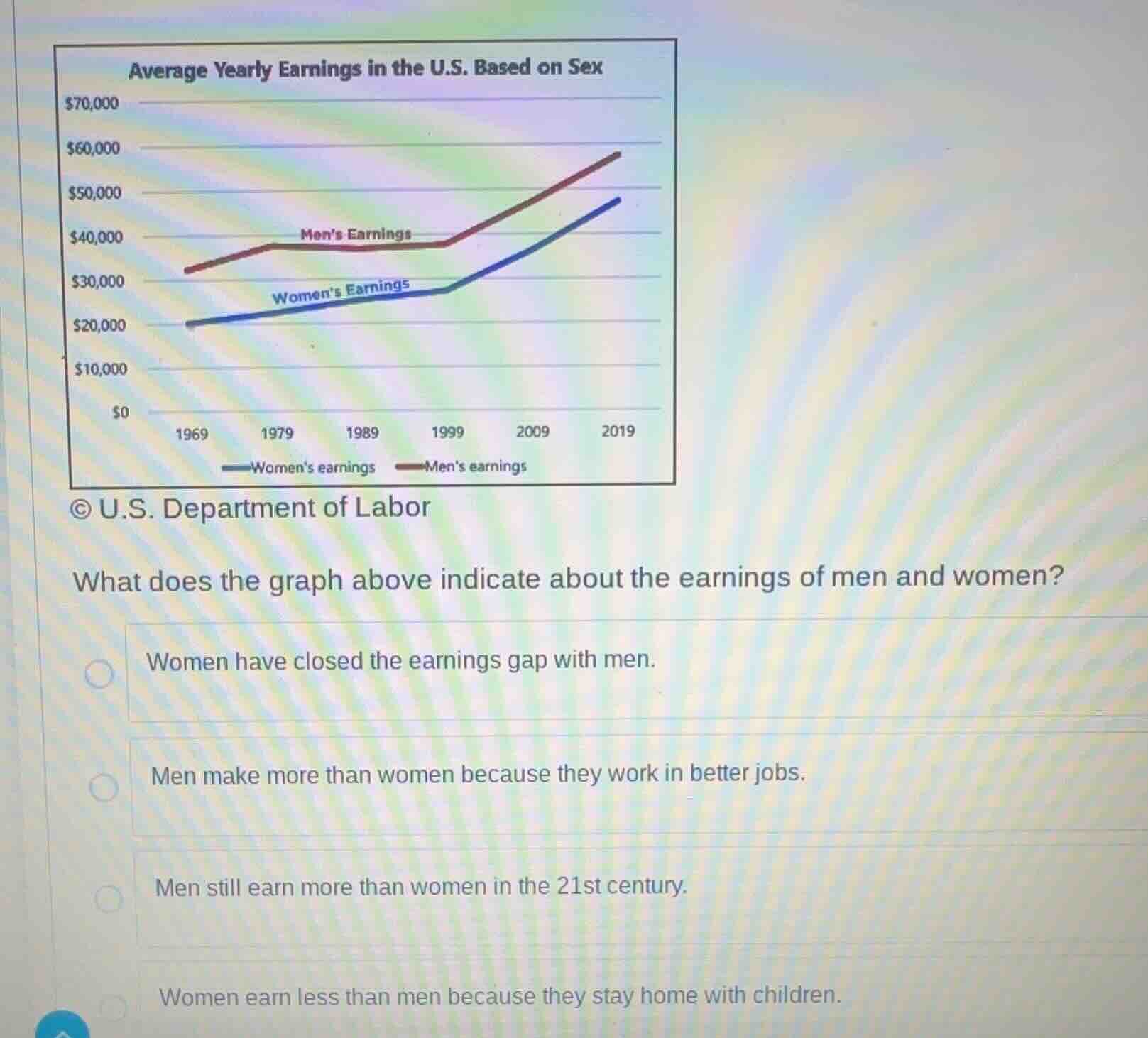
average yearly earnings in the u.s. based on sex
u.s. department of labor
what does the graph above indicate about the earnings of men and women?
- women have closed the earnings gap with men.
- men make more than women because they work in better jobs.
- men still earn more than women in the 21st century.
- women earn less than men because they stay home with children.
🆕 New Concept Discovered: Interpreting Line Graphs
Reading trends and comparing data over time
Step 1: Analyze the graph axes and lines
The graph displays "Average Yearly Earnings in the U.S. Based on Sex" from 1969 to 2019.
- The vertical axis (y-axis) represents earnings in dollars, ranging from \$0 to \$70,000.
- The horizontal axis (x-axis) represents years from 1969 to 2019.
- The red line represents men's earnings, and the blue line represents women's earnings.
Step 2: Evaluate the trends over time
Looking at the 21st century (the years 2000 to 2019 on the right side of the graph):
- Both lines trend upward, meaning earnings have increased for both groups.
- The red line (men's earnings) remains consistently higher than the blue line (women's earnings) at every point on the timeline, including the final data point in 2019.
Step 3: Evaluate the given options
- "Women have closed the earnings gap with men."
- Incorrect: While both lines rise, a visible gap remains between the red and blue lines in 2019.
- "Men make more than women because they work in better jobs."
- Incorrect: The graph only shows average earnings data. It does not provide any information or reasons regarding the types of jobs held.
- "Men still earn more than women in the 21st century."
- Correct: In the years 2009 and 2019 (which are in the 21st century), the red line representing men's earnings is clearly positioned above the blue line representing women's earnings.
- "Women earn less than men because they stay home with children."
- Incorrect: The graph does not provide any causal data or explanations regarding lifestyle choices or childcare.

Snap & solve any problem in the app
Get step-by-step solutions on Sovi AI
Photo-based solutions with guided steps
Explore more problems and detailed explanations
Men still earn more than women in the 21st century.