QUESTION IMAGE
Question
athens: a young democracy
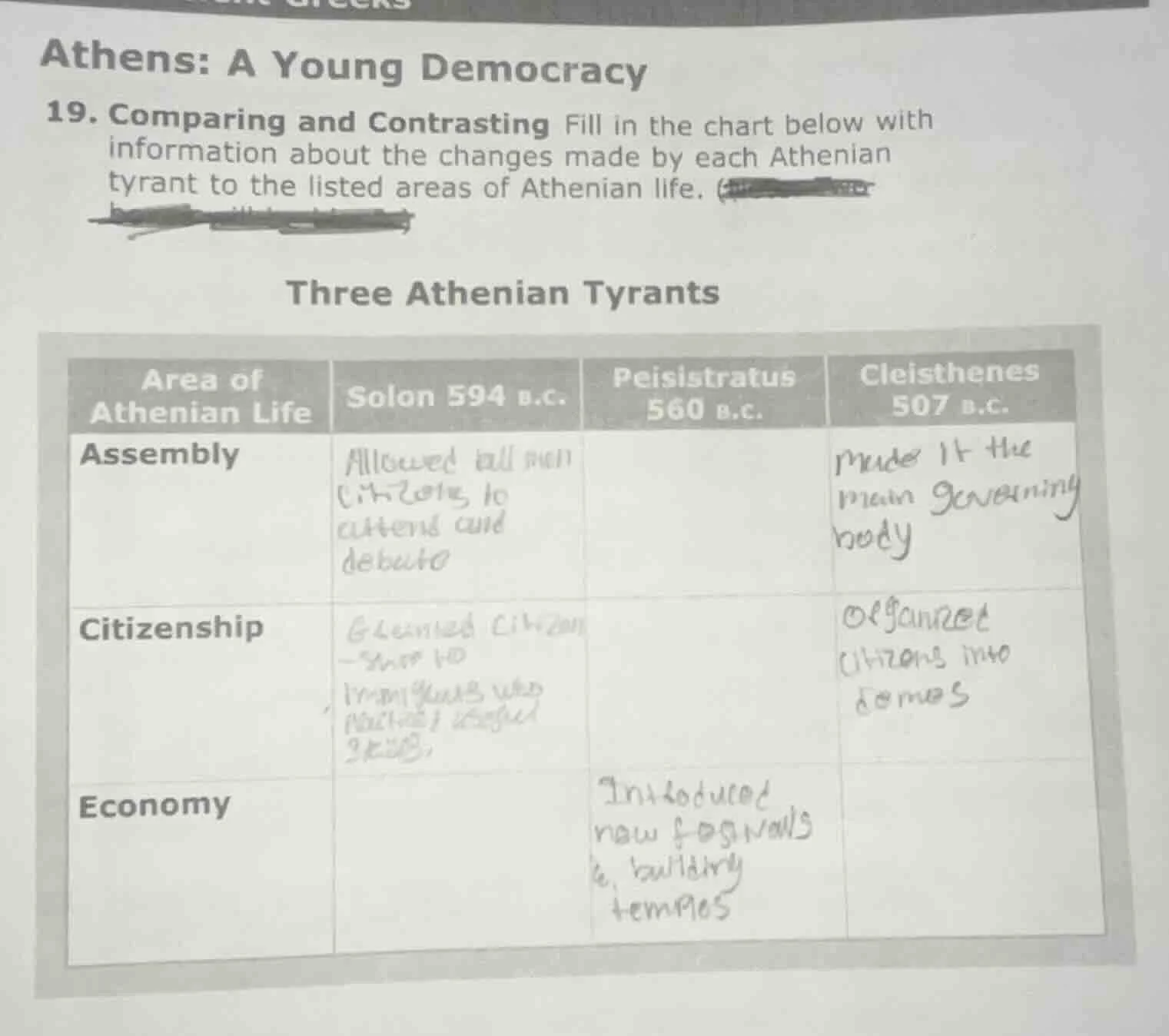
- comparing and contrasting fill in the chart below with information about the changes made by each athenian tyrant to the listed areas of athenian life.
three athenian tyrants
| area of athenian life | solon 594 b.c. | peisistratus 560 b.c. | cleisthenes 507 b.c. |
|---|---|---|---|
| citizenship | granted citizen - ship to immigrants who practiced useful skills | organized citizens into tens | |
| economy | introduced new festivals, building temples |
To solve this problem, we need to recall the historical changes made by each Athenian tyrant (Solon, Peisistratus, Cleisthenes) in the respective areas of Athenian life (Assembly, Citizenship, Economy). Here's the step - by - step process to fill the chart:
Step 1: Recall information about Solon, Peisistratus, and Cleisthenes
- Solon (594 B.C.):
- Assembly: As given, he allowed all male citizens to attend and debate.
- Citizenship: He granted citizenship to immigrants who practiced a useful skill.
- Economy: He canceled debts for the poor, freed those who had been enslaved for debt, and encouraged the growth of olive production (which would boost trade as olive oil was a valuable export).
- Peisistratus (560 B.C.):
- Assembly: He strengthened the Assembly's power and also used public works projects to gain support. But for the purpose of filling the chart, in the 'Assembly' row for Peisistratus, we can note that he continued to support the Assembly's role and used it to further his rule, but more specifically, he might have expanded its influence in terms of implementing his policies. However, a more accurate point is that he supported the existing democratic structures (including the Assembly) while also using his own power. But from a historical perspective, in the context of the Assembly, he didn't make a major structural change like Solon or Cleisthenes, but he did use the Assembly to pass laws related to his public works and economic policies.
- Citizenship: There isn't a major change in citizenship attributed to Peisistratus. He focused more on economic and public works.
- Economy: As given, he introduced new festivals, building temples (which would boost the economy through construction and religious tourism), and also improved the water supply and infrastructure, which would support trade and agriculture.
- Cleisthenes (507 B.C.):
- Assembly: As given, he made it the main governing body.
- Citizenship: He organized citizens into ten new tribes (based on location rather than family or wealth), which expanded the base of citizenship participation.
- Economy: He continued to support the economic policies that promoted trade and agriculture, but there isn't a single major economic reform attributed solely to him in the same way as Peisistratus' public works or Solon's debt cancellation. However, his political reforms (like the new tribes) would have an indirect impact on the economy by creating a more stable political environment for trade and production.
Step 2: Fill the chart with the recalled information
| Area of Athenian Life | Solon 594 B.C. | Peisistratus 560 B.C. | Cleisthenes 507 B.C. |
|---|---|---|---|
| Citizenship | Granted citizenship to immigrants with useful skills | No major change | Organized citizens into ten new tribes |
| Economy | Canceled debts, freed debt - slaves, encouraged olive production | Introduced new festivals, built temples, improved infrastructure | Supported trade/agriculture through stable governance |
If we are only filling in the blanks with the key points (based on the existing hand - written notes and historical facts):
- Assembly - Peisistratus: Supported its role, used for policies
- Citizenship - Peisistratus: No major change
- Economy - Solon: Canceled debts, freed debt - slaves, encouraged olive production
- **Citizenship…

Snap & solve any problem in the app
Get step-by-step solutions on Sovi AI
Photo-based solutions with guided steps
Explore more problems and detailed explanations
To solve this problem, we need to recall the historical changes made by each Athenian tyrant (Solon, Peisistratus, Cleisthenes) in the respective areas of Athenian life (Assembly, Citizenship, Economy). Here's the step - by - step process to fill the chart:
Step 1: Recall information about Solon, Peisistratus, and Cleisthenes
- Solon (594 B.C.):
- Assembly: As given, he allowed all male citizens to attend and debate.
- Citizenship: He granted citizenship to immigrants who practiced a useful skill.
- Economy: He canceled debts for the poor, freed those who had been enslaved for debt, and encouraged the growth of olive production (which would boost trade as olive oil was a valuable export).
- Peisistratus (560 B.C.):
- Assembly: He strengthened the Assembly's power and also used public works projects to gain support. But for the purpose of filling the chart, in the 'Assembly' row for Peisistratus, we can note that he continued to support the Assembly's role and used it to further his rule, but more specifically, he might have expanded its influence in terms of implementing his policies. However, a more accurate point is that he supported the existing democratic structures (including the Assembly) while also using his own power. But from a historical perspective, in the context of the Assembly, he didn't make a major structural change like Solon or Cleisthenes, but he did use the Assembly to pass laws related to his public works and economic policies.
- Citizenship: There isn't a major change in citizenship attributed to Peisistratus. He focused more on economic and public works.
- Economy: As given, he introduced new festivals, building temples (which would boost the economy through construction and religious tourism), and also improved the water supply and infrastructure, which would support trade and agriculture.
- Cleisthenes (507 B.C.):
- Assembly: As given, he made it the main governing body.
- Citizenship: He organized citizens into ten new tribes (based on location rather than family or wealth), which expanded the base of citizenship participation.
- Economy: He continued to support the economic policies that promoted trade and agriculture, but there isn't a single major economic reform attributed solely to him in the same way as Peisistratus' public works or Solon's debt cancellation. However, his political reforms (like the new tribes) would have an indirect impact on the economy by creating a more stable political environment for trade and production.
Step 2: Fill the chart with the recalled information
| Area of Athenian Life | Solon 594 B.C. | Peisistratus 560 B.C. | Cleisthenes 507 B.C. |
|---|---|---|---|
| Citizenship | Granted citizenship to immigrants with useful skills | No major change | Organized citizens into ten new tribes |
| Economy | Canceled debts, freed debt - slaves, encouraged olive production | Introduced new festivals, built temples, improved infrastructure | Supported trade/agriculture through stable governance |
If we are only filling in the blanks with the key points (based on the existing hand - written notes and historical facts):
- Assembly - Peisistratus: Supported its role, used for policies
- Citizenship - Peisistratus: No major change
- Economy - Solon: Canceled debts, freed debt - slaves, encouraged olive production
- Citizenship - Cleisthenes: Organized into ten tribes
- Economy - Cleisthenes: Supported trade/agriculture via stable rule
The final filled chart (with the most important points) would be:
| Area of Athenian Life | Solon 594 B.C. | Peisistratus 560 B.C. | Cleisthenes 507 B.C. |
|---|---|---|---|
| Citizenship | Granted citizenship to skilled immigrants | No major change | Organized into ten tribes |
| Economy | Canceled debts, freed debt - slaves, promoted olive production | Introduced festivals, built temples, improved infrastructure | Supported trade/agriculture through stable governance |