QUESTION IMAGE
Question
your assignment
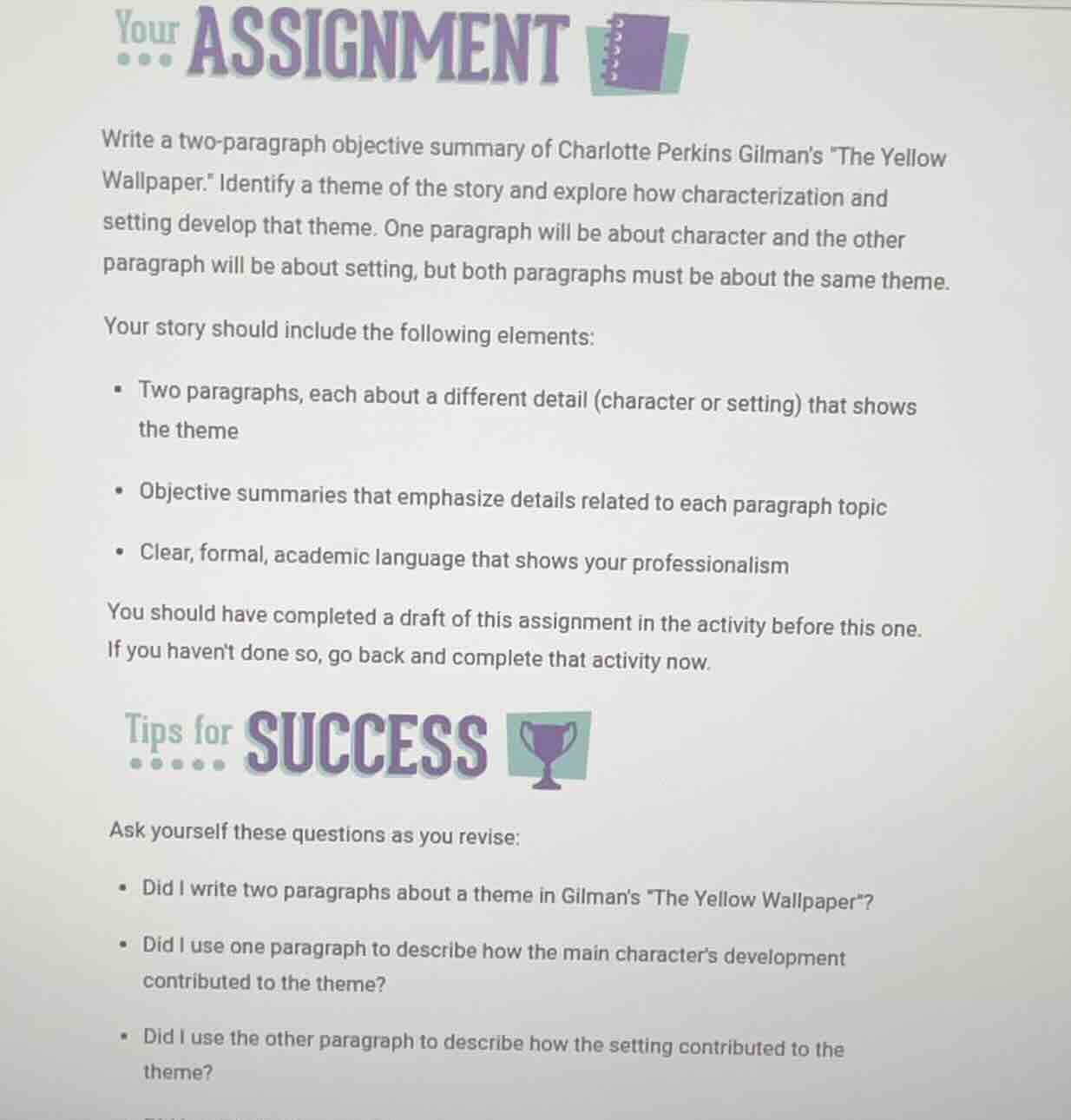
write a two-paragraph objective summary of charlotte perkins gilmans \the yellow wallpaper.\ identify a theme of the story and explore how characterization and setting develop that theme. one paragraph will be about character and the other paragraph will be about setting, but both paragraphs must be about the same theme.
your story should include the following elements:
- two paragraphs, each about a different detail (character or setting) that shows the theme
- objective summaries that emphasize details related to each paragraph topic
- clear, formal, academic language that shows your professionalism
you should have completed a draft of this assignment in the activity before this one. if you havent done so, go back and complete that activity now.
tips for success
ask yourself these questions as you revise:
- did i write two paragraphs about a theme in gilmans \the yellow wallpaper\?
- did i use one paragraph to describe how the main characters development contributed to the theme?
- did i use the other paragraph to describe how the setting contributed to the theme?
Identify the central theme
The assignment requires a two-paragraph objective summary of Charlotte Perkins Gilman's "The Yellow Wallpaper" focusing on how characterization and setting develop a single theme. A prominent theme in the story is the destructive effect of forced confinement and intellectual suppression on a person's mental health. We will use this theme to structure both paragraphs.
Analyze character development
Using Character Analysis and Literary Analysis, we examine how the narrator's characterization develops this theme. Initially, the narrator is submissive, attempting to follow her husband John's "rest cure" prescription. However, her forced isolation and lack of creative outlet lead to a gradual mental deterioration. Her growing obsession with the wallpaper represents her mind's desperate attempt to find agency, culminating in complete psychological escape through madness.
Analyze setting development
Using Setting and Characterization, we examine how the physical environment develops the same theme. The setting is a colonial mansion, specifically a former nursery with barred windows, nailed-down furniture, and torn yellow wallpaper. This oppressive, prison-like room physically embodies the societal restrictions placed on the narrator. The decaying, yellow wallpaper becomes a mirror of her deteriorating mental state and her confinement.
Draft the character paragraph
We will write an objective paragraph summarizing how the narrator's characterization develops the theme of intellectual suppression and confinement. It must remain objective, formal, and academic, avoiding personal opinions while summarizing the plot details related to her character arc.
Draft the setting paragraph
We will write a second objective paragraph summarizing how the physical setting of the nursery and the wallpaper itself develop the same theme. This paragraph will connect the physical constraints of the room to her psychological confinement, maintaining a formal and academic tone.

Snap & solve any problem in the app
Get step-by-step solutions on Sovi AI
Photo-based solutions with guided steps
Explore more problems and detailed explanations
In Charlotte Perkins Gilman's short story "The Yellow Wallpaper," the destructive impact of forced confinement and intellectual suppression on a woman's mental health is developed through the gradual psychological deterioration of the narrator. Prescribed a "rest cure" by her physician husband, John, the narrator is forbidden from working, writing, or engaging in any intellectual stimulation. Initially, she attempts to remain submissive and hide her creative thoughts, but the forced inactivity and lack of agency wear down her resolve. As she is systematically denied any voice in her own treatment or daily life, her suppressed intellect finds a pathological outlet in analyzing the room's wallpaper. Her character shifts from a anxious, compliant wife trying to please her husband to a woman completely detached from reality, demonstrating how denying an individual intellectual freedom forces the mind to seek escape through delusion.
The same theme of oppressive confinement is reinforced through the story's physical setting, which acts as a literal and symbolic prison. The narrator is confined to a spacious, isolated country estate, specifically a top-floor room that she suspects was once a nursery due to its barred windows, nailed-down bedstead, and torn, yellow wallpaper. The physical constraints of the room—the bars on the windows and the restricted movement—mirror the social and intellectual limitations placed upon her by her husband and society. The wallpaper itself, with its chaotic, artistic pattern and sickly yellow hue, becomes a visual representation of her trapped mind. As she projects her own feelings of captivity onto the paper, she begins to see a woman trapped behind a cage-like pattern, illustrating how an oppressive, restrictive environment directly fosters psychological ruin.