QUESTION IMAGE
Question
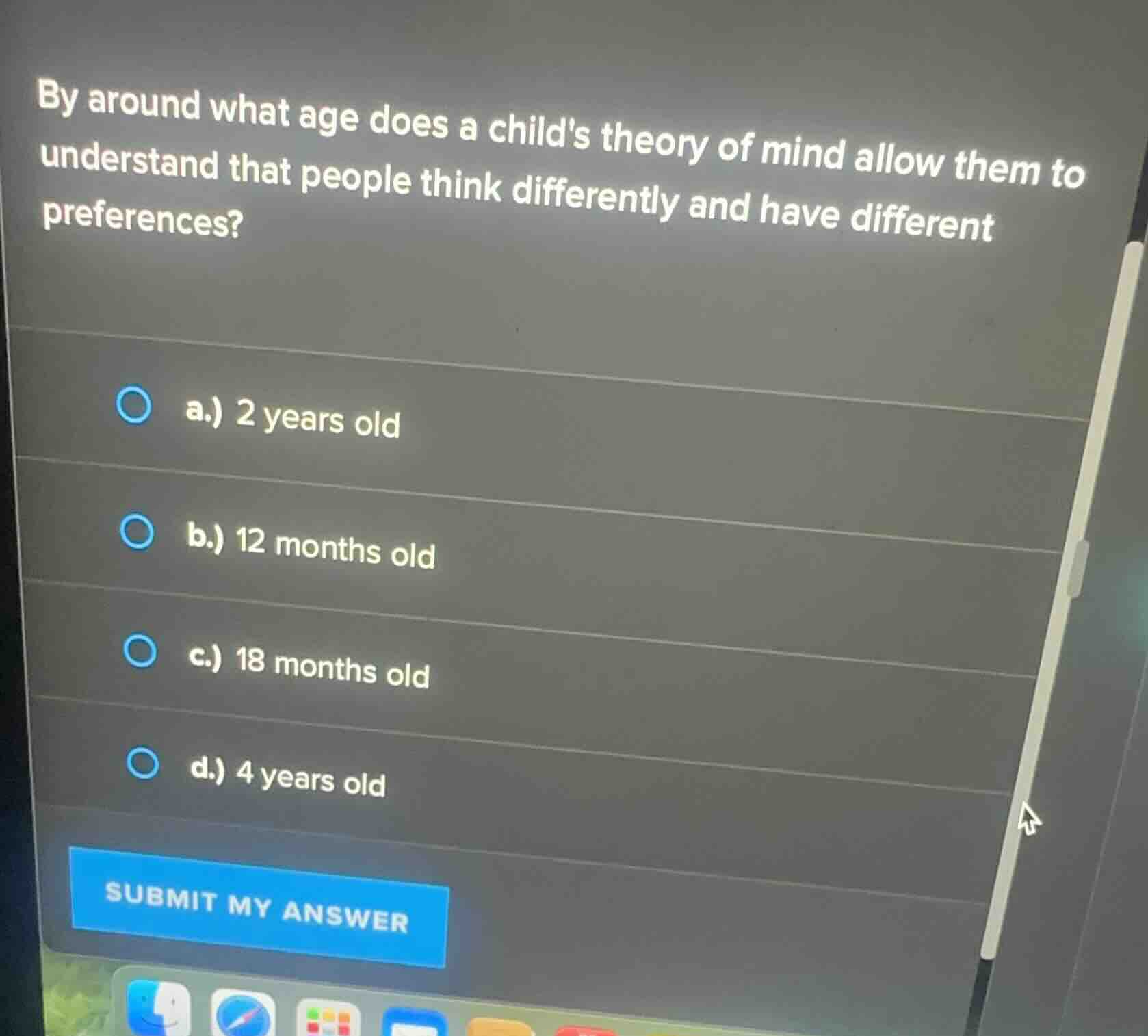
by around what age does a childs theory of mind allow them to understand that people think differently and have different preferences?
a.) 2 years old
b.) 12 months old
c.) 18 months old
d.) 4 years old
Analyze the developmental milestone
The question asks at what age a child's theory of mind allows them to understand that people think differently and have different preferences (often referred to as "diverse desires" or "diverse preferences").
Evaluate developmental research
Research in developmental psychology (such as studies by Repacholi and Gopnik, 1997, using the broccoli-goldfish cracker experiment) demonstrates that by around 18 months of age, infants can understand that another person may have a food preference that differs from their own. For example, if an adult shows disgust toward crackers but delight toward broccoli, an 18-month-old will offer the adult the broccoli, even though the child prefers the crackers.
Compare with other options
- 12 months old: Infants at this age understand basic goal-directed actions but do not yet reliably grasp that others have different subjective preferences.
- 2 years old: While 2-year-olds certainly have this ability, it first emerges earlier, around 18 months.
- 4 years old: By age 4, children develop a more advanced theory of mind, specifically the ability to pass false-belief tasks (understanding that others can hold beliefs that contradict reality). Understanding differing preferences is an earlier milestone.
Select the correct option
Based on empirical developmental milestones, the capacity to understand that others have different preferences emerges by around 18 months of age. This corresponds to option (c).

Snap & solve any problem in the app
Get step-by-step solutions on Sovi AI
Photo-based solutions with guided steps
Explore more problems and detailed explanations
- a.) 2 years old
- b.) 12 months old
- c.) 18 months old (Correct answer)
- d.) 4 years old