QUESTION IMAGE
Question
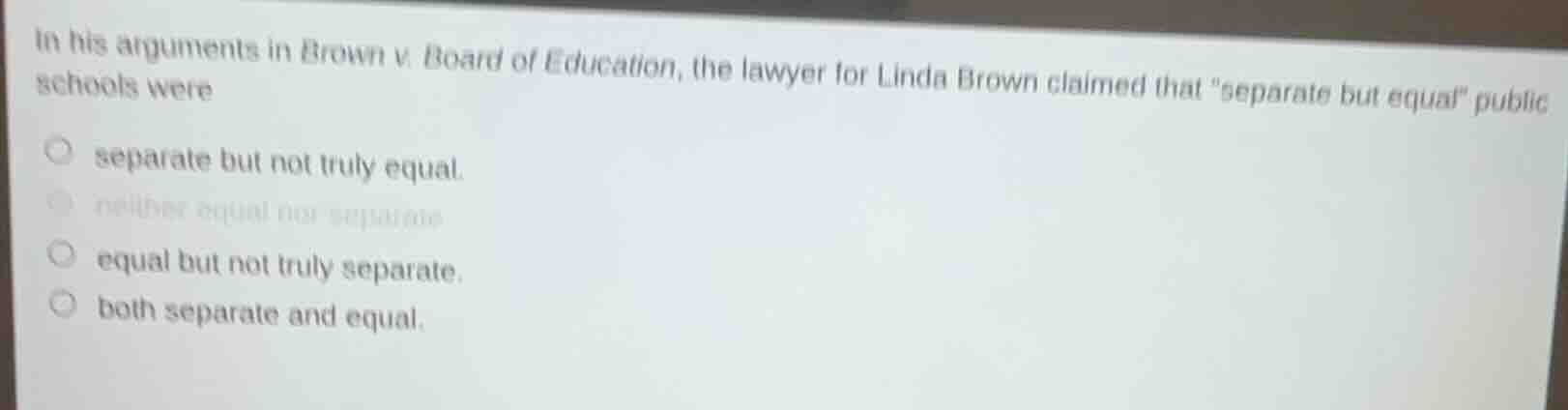
in his arguments in brown v. board of education, the lawyer for linda brown claimed that \separate but equal\ public schools were
separate but not truly equal.
neither equal nor separate.
equal but not truly separate.
both separate and equal.
Identify the legal context
The question asks about the core argument made by the plaintiff's legal team, led by Thurgood Marshall, in the landmark Supreme Court case Brown v. Board of Education (1954). This case is a cornerstone of the Civil Rights Movement.
Analyze the "separate but equal" doctrine
The prevailing legal precedent at the time was established by Plessy v. Ferguson (1896), which ruled that racially segregated public facilities were constitutional as long as they were equal. This was known as the "separate but equal" doctrine.
Evaluate the plaintiff's argument
In Brown v. Board of Education, the lawyers representing Linda Brown argued that segregated public schools were inherently unequal. They demonstrated that physical facilities, curricula, and funding were often vastly inferior for Black students, meaning the schools were separate but not truly equal.
Match with the options
- "separate but not truly equal": This directly matches the argument that segregated schools violated the Equal Protection Clause of the Fourteenth Amendment because they were unequal in practice and inherently unequal by design.
- "neither equal nor separate": Incorrect, as the schools were physically separated by race.
- "equal but not truly separate": Incorrect, as they were physically separate and unequal.
- "both separate and equal": Incorrect, as this was the segregationist defense, not the plaintiff's claim.

Snap & solve any problem in the app
Get step-by-step solutions on Sovi AI
Photo-based solutions with guided steps
Explore more problems and detailed explanations
- (A) separate but not truly equal. (Correct answer)
- (B) neither equal nor separate.
- (C) equal but not truly separate.
- (D) both separate and equal.