QUESTION IMAGE
Question
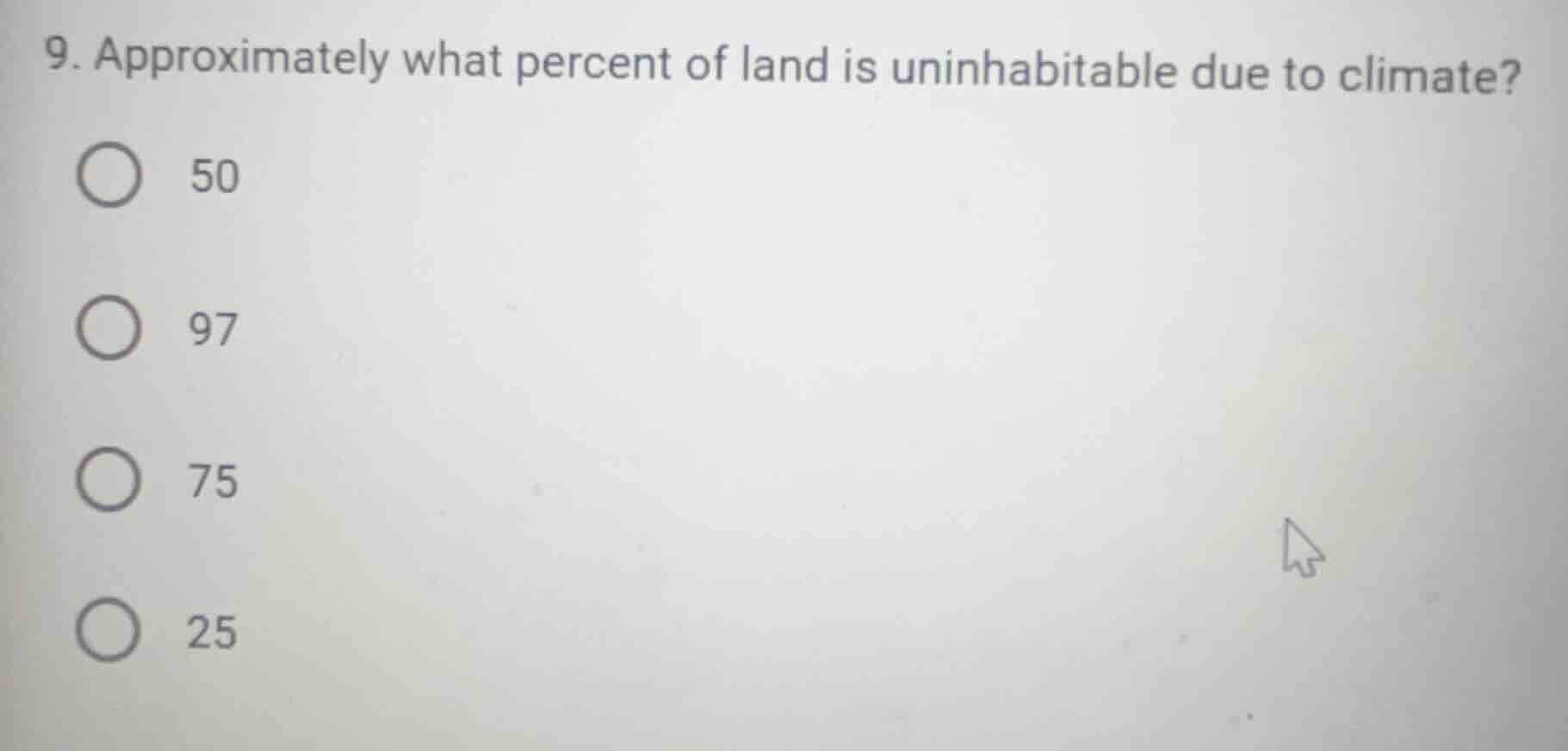
- approximately what percent of land is uninhabitable due to climate?
50
97
75
25
Define the ecumene and uninhabitable land
In Human Geography, the term "ecumene" refers to the portion of Earth's surface occupied by permanent human settlement. Conversely, the non-ecumene consists of areas that are generally considered uninhabitable or extremely difficult to inhabit.
Analyze the impact of climate on habitability
Using the Climate Classification knowledge point, we know that extreme climates limit human survival. Approximately \(35\%\) to \(40\%\) of Earth's land surface is dry (deserts), \(20\%\) is cold (polar ice caps and tundra), \(20\%\) is mountainous/high altitude, and \(20\%\) is wet (wetlands and tropical rainforests). When accounting for overlapping harsh conditions, approximately \(50\%\) of the global land area is considered uninhabitable or extremely hostile for permanent human settlement due to severe climatic conditions (such as extreme cold, extreme aridity, or excessive wetness).
Evaluate the given multiple-choice options
Let's evaluate the options provided in the question:
- \(50\%\): This aligns with standard geographic estimates that about half of Earth's land is uninhabitable due to climate.
- \(97\%\): This is too high (this is closer to the percentage of Earth's water that is saltwater).
- \(75\pm\%\): This is too high for land uninhabitable solely due to climate.
- \(25\%\): This is too low, as deserts and polar regions alone cover more than \(50\%\) of the land surface.
Therefore, the most accurate approximation is \(50\%\).

Snap & solve any problem in the app
Get step-by-step solutions on Sovi AI
Photo-based solutions with guided steps
Explore more problems and detailed explanations
- (A) 50 (Correct answer)
- (B) 97
- (C) 75
- (D) 25