QUESTION IMAGE
Question
ap world
name
europe/russia review up to 1750
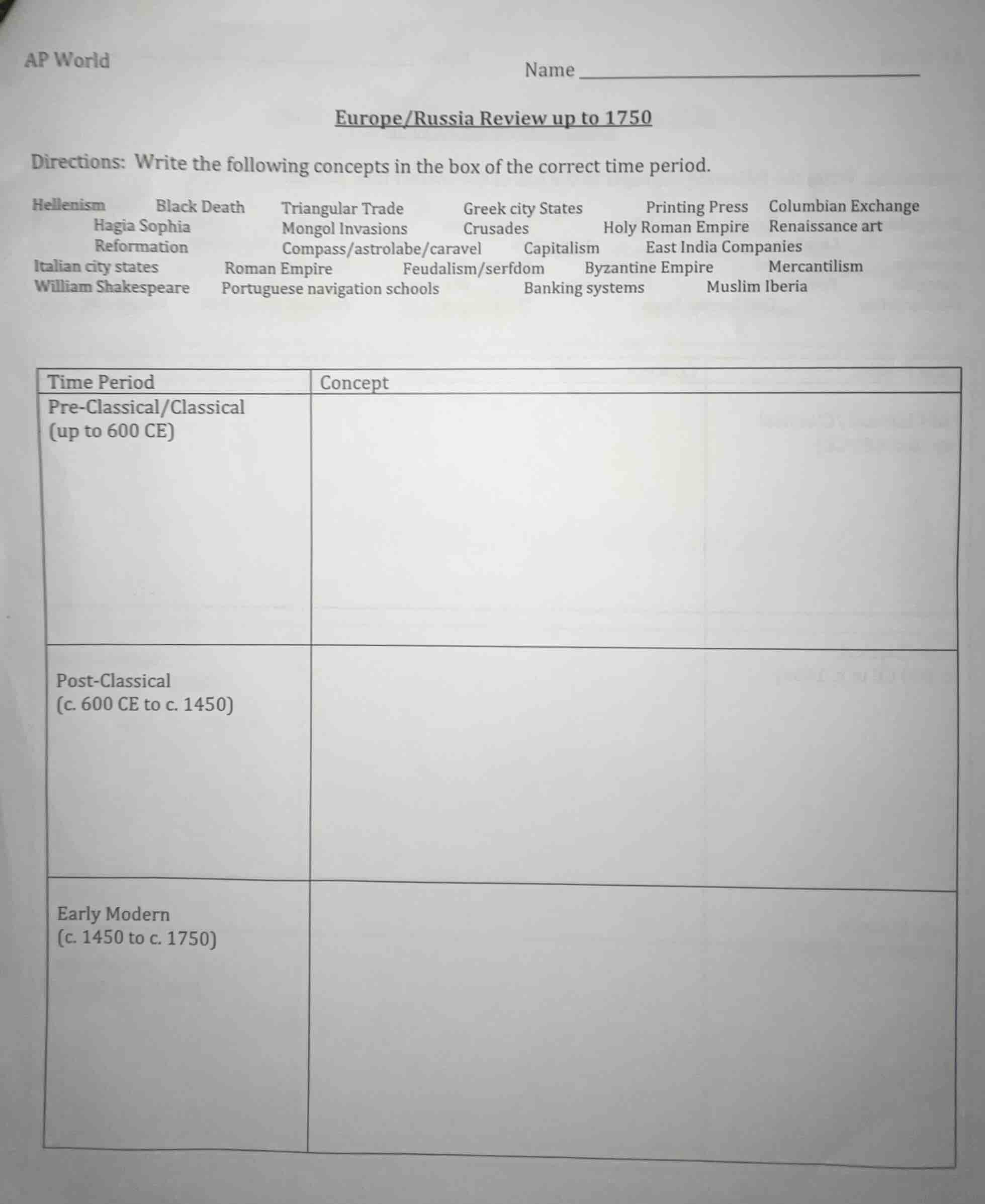
directions: write the following concepts in the box of the correct time period.
hellenism black death triangular trade greek city states printing press columbian exchange
hagia sophia mongol invasions crusades holy roman empire renaissance art
reformation compass/astrolabe/caravel capitalism east india companies
italian city states roman empire feudalism/serfdom byzantine empire mercantilism
william shakespeare portuguese navigation schools banking systems muslim iberia
| time period | concept |
|---|
|pre - classical/classical (up to 600 ce)|
|
|post - classical (c. 600 ce to c. 1450)|
|
|early modern (c. 1450 to c. 1750)|
|
To solve this, we analyze each concept's time period:
Pre - Classical/Classical (up to 600 CE)
- Greek city - states: Flourished in the classical era (pre - 600 CE).
- Roman Empire: Majorly active before 600 CE (decline started later, but core era is pre - 600 CE).
- Hellenism: Resulted from Alexander the Great’s conquests (4th century BCE, pre - 600 CE).
- Byzantine Empire (early phase): The Byzantine Empire emerged from the Eastern Roman Empire, and its early years (up to 600 CE) are part of this period.
- Feudalism/serfdom (early development): Early feudal structures began to form in the late Roman and post - Roman context, with roots in the pre - 600 CE era.
Post - Classical (c. 600 CE to c. 1450)
- Black Death: 1347 - 1351, within 600 - 1450.
- Mongol Invasions: 13th - 14th centuries, within 600 - 1450.
- Crusades: 1096 - 1291, within 600 - 1450.
- Hagia Sophia: Built in 537 CE (Byzantine, but its construction and early history fit post - classical start).
- Holy Roman Empire: Formed in 962 CE, within 600 - 1450.
- Feudalism/serfdom (maturity): Feudal system matured in this period.
- Muslim Iberia: Existed from 8th - 15th centuries, within 600 - 1450.
- Printing Press (early? No, Gutenberg’s press was 1440s, but wait—no, the printing press in Europe (Gutenberg) is 1440s, which is late post - classical. Wait, correction: Printing Press (Gutenberg) is 1440s, so maybe early modern? Wait, no—post - classical is up to 1450, so 1440s is late post - classical. Let's re - check:
- Reformation: 16th century (early modern), so no.
- Byzantine Empire (majority): Most of Byzantine history (600 - 1453 fall) is post - classical.
- Compass/astrolabe/caravel: Used in medieval (post - classical) navigation.
Early Modern (c. 1450 to c. 1750)
- Triangular Trade: Developed in the 16th - 18th centuries, within 1450 - 1750.
- Printing Press (Gutenberg, 1440s): Late post - classical or early modern; 1440s is close to 1450, so early modern.
- Columbian Exchange: After 1492, within 1450 - 1750.
- Renaissance art: 14th - 17th centuries, within 1450 - 1750.
- Reformation: 16th century, within 1450 - 1750.
- Capitalism (emergence): Emerged in the 16th - 17th centuries, within 1450 - 1750.
- East India Companies: British East India Co. (1600), Dutch (1602), within 1450 - 1750.
- Italian city - states: Flourished in Renaissance (14th - 16th centuries), within 1450 - 1750.
- William Shakespeare: 1564 - 1616, within 1450 - 1750.
- Portuguese navigation schools: 15th century (late post - classical/early modern), within 1450 - 1750.
- Banking systems (modern): Emerged in Renaissance Italy, within 1450 - 1750.
- Mercantilism: 16th - 18th centuries, within 1450 - 1750.
Now, we organize into the table:
| Time Period | Concept |
|---|---|
| Post - Classical (c. 600 CE to c. 1450) | Black Death, Mongol Invasions, Crusades, Hagia Sophia, Holy Roman Empire, Feudalism/serfdom (maturity), Muslim Iberia, Printing Press (Gutenberg, 1440s - late post - classical), Byzantine Empire (majority), Compass/astrolabe/caravel |
| Early Modern (c. 1450 to c. 1750) | Triangular Trade, Columbian Exchange, Renaissance art, Reformation, Capitalism, East India Companies, Italian city states, William Shakespeare, Portuguese navigation schools, Banking systems, Mercantilism |
(Note: Some concepts have overlapping or d…

Snap & solve any problem in the app
Get step-by-step solutions on Sovi AI
Photo-based solutions with guided steps
Explore more problems and detailed explanations
To solve this, we analyze each concept's time period:
Pre - Classical/Classical (up to 600 CE)
- Greek city - states: Flourished in the classical era (pre - 600 CE).
- Roman Empire: Majorly active before 600 CE (decline started later, but core era is pre - 600 CE).
- Hellenism: Resulted from Alexander the Great’s conquests (4th century BCE, pre - 600 CE).
- Byzantine Empire (early phase): The Byzantine Empire emerged from the Eastern Roman Empire, and its early years (up to 600 CE) are part of this period.
- Feudalism/serfdom (early development): Early feudal structures began to form in the late Roman and post - Roman context, with roots in the pre - 600 CE era.
Post - Classical (c. 600 CE to c. 1450)
- Black Death: 1347 - 1351, within 600 - 1450.
- Mongol Invasions: 13th - 14th centuries, within 600 - 1450.
- Crusades: 1096 - 1291, within 600 - 1450.
- Hagia Sophia: Built in 537 CE (Byzantine, but its construction and early history fit post - classical start).
- Holy Roman Empire: Formed in 962 CE, within 600 - 1450.
- Feudalism/serfdom (maturity): Feudal system matured in this period.
- Muslim Iberia: Existed from 8th - 15th centuries, within 600 - 1450.
- Printing Press (early? No, Gutenberg’s press was 1440s, but wait—no, the printing press in Europe (Gutenberg) is 1440s, which is late post - classical. Wait, correction: Printing Press (Gutenberg) is 1440s, so maybe early modern? Wait, no—post - classical is up to 1450, so 1440s is late post - classical. Let's re - check:
- Reformation: 16th century (early modern), so no.
- Byzantine Empire (majority): Most of Byzantine history (600 - 1453 fall) is post - classical.
- Compass/astrolabe/caravel: Used in medieval (post - classical) navigation.
Early Modern (c. 1450 to c. 1750)
- Triangular Trade: Developed in the 16th - 18th centuries, within 1450 - 1750.
- Printing Press (Gutenberg, 1440s): Late post - classical or early modern; 1440s is close to 1450, so early modern.
- Columbian Exchange: After 1492, within 1450 - 1750.
- Renaissance art: 14th - 17th centuries, within 1450 - 1750.
- Reformation: 16th century, within 1450 - 1750.
- Capitalism (emergence): Emerged in the 16th - 17th centuries, within 1450 - 1750.
- East India Companies: British East India Co. (1600), Dutch (1602), within 1450 - 1750.
- Italian city - states: Flourished in Renaissance (14th - 16th centuries), within 1450 - 1750.
- William Shakespeare: 1564 - 1616, within 1450 - 1750.
- Portuguese navigation schools: 15th century (late post - classical/early modern), within 1450 - 1750.
- Banking systems (modern): Emerged in Renaissance Italy, within 1450 - 1750.
- Mercantilism: 16th - 18th centuries, within 1450 - 1750.
Now, we organize into the table:
| Time Period | Concept |
|---|---|
| Post - Classical (c. 600 CE to c. 1450) | Black Death, Mongol Invasions, Crusades, Hagia Sophia, Holy Roman Empire, Feudalism/serfdom (maturity), Muslim Iberia, Printing Press (Gutenberg, 1440s - late post - classical), Byzantine Empire (majority), Compass/astrolabe/caravel |
| Early Modern (c. 1450 to c. 1750) | Triangular Trade, Columbian Exchange, Renaissance art, Reformation, Capitalism, East India Companies, Italian city states, William Shakespeare, Portuguese navigation schools, Banking systems, Mercantilism |
(Note: Some concepts have overlapping or debatable periods, but this is a general classification for the assignment.)