QUESTION IMAGE
Question
s || t
u || v
answer bank:
\angle 9 = \angle 10
\angle 11 = \angle 15
\angle 1 = \angle 13
m\angle 2 + m\angle 5 = 180^{\circ}
\angle 9 = \angle 11
m\angle 8 + m\angle 7 = 180^{\circ}
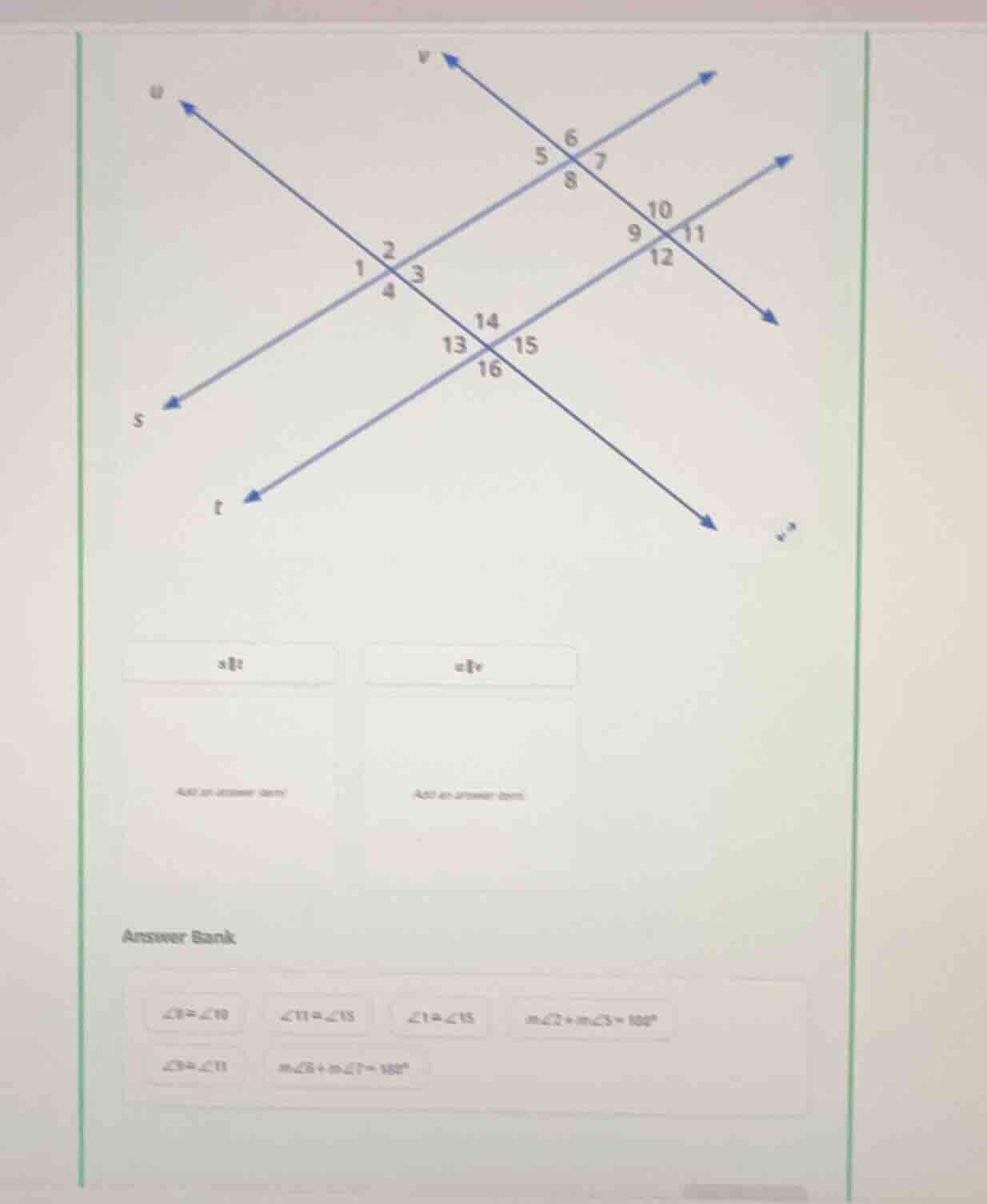
Identify the lines and transversals
In the given geometric diagram, we have four lines:
- Two lines that appear horizontal/diagonal: \(s\) and \(t\).
- Two lines that intersect them: \(u\) and \(v\).
We need to classify which given angle relationships prove either that lines \(s\) and \(t\) are parallel (\(s \parallel t\)) or that lines \(u\) and \(v\) are parallel (\(u \parallel v\)).
Analyze each item in the Answer Bank
Let's evaluate each statement from the Answer Bank:
- \(\angle 3 \cong \angle 10\):
- \(\angle 3\) is formed by the intersection of line \(s\) and line \(u\).
- \(\angle 10\) is formed by the intersection of line \(t\) and line \(v\).
- Since these angles involve different pairs of lines (one is on \(u\), the other on \(v\); one is on \(s\), the other on \(t\)), their congruence does not directly prove any two lines parallel.
- \(\angle 11 \cong \angle 15\):
- Both angles lie along the transversal line \(t\).
- \(\angle 11\) is at the intersection of line \(t\) and line \(v\).
- \(\angle 15\) is at the intersection of line \(t\) and line \(u\).
- These are corresponding angles with respect to lines \(u\) and \(v\) cut by transversal \(t\).
- By the Converse of the Corresponding Angles Postulate, if \(\angle 11 \cong \angle 15\), then \(u \parallel v\).
- \(\angle 1 \cong \angle 13\):
- Both angles lie along the transversal line \(u\).
- \(\angle 1\) is at the intersection of line \(u\) and line \(s\).
- \(\angle 13\) is at the intersection of line \(u\) and line \(t\).
- These are corresponding angles with respect to lines \(s\) and \(t\) cut by transversal \(u\).
- By the Converse of the Corresponding Angles Postulate, if \(\angle 1 \cong \angle 13\), then \(s \parallel t\).
- \(m\angle 2 + m\angle 5 = 180^\circ\):
- Both angles lie along the transversal line \(s\).
- \(\angle 2\) is at the intersection of line \(s\) and line \(u\).
- \(\angle 5\) is at the intersection of line \(s\) and line \(v\).
- These are consecutive interior angles between lines \(u\) and \(v\) cut by transversal \(s\).
- Using the Converse of the Consecutive Interior Angles Theorem, if these angles are supplementary, then \(u \parallel v\).
- \(\angle 9 \cong \angle 11\):
- These are vertical angles at the intersection of line \(t\) and line \(v\).
- Vertical angles are always congruent, so this statement does not prove any lines parallel.
- \(m\angle 8 + m\angle 7 = 180^\circ\):
- These are linear pair angles at the intersection of line \(s\) and line \(v\).
- They are always supplementary by the Linear Pair Postulate, so this does not prove any lines parallel.
Group the valid statements
- For \(s \parallel t\):
- \(\angle 1 \cong \angle 13\)
- For \(u \parallel v\):
- \(…

Snap & solve any problem in the app
Get step-by-step solutions on Sovi AI
Photo-based solutions with guided steps
Explore more problems and detailed explanations
For \(s \parallel t\):
- \(\angle 1 \cong \angle 13\)
For \(u \parallel v\):
- \(\angle 11 \cong \angle 15\)
- \(m\angle 2 + m\angle 5 = 180^\circ\)