Sovi.AI - AI Math Tutor

Scan to solve math questions

QUESTION IMAGE

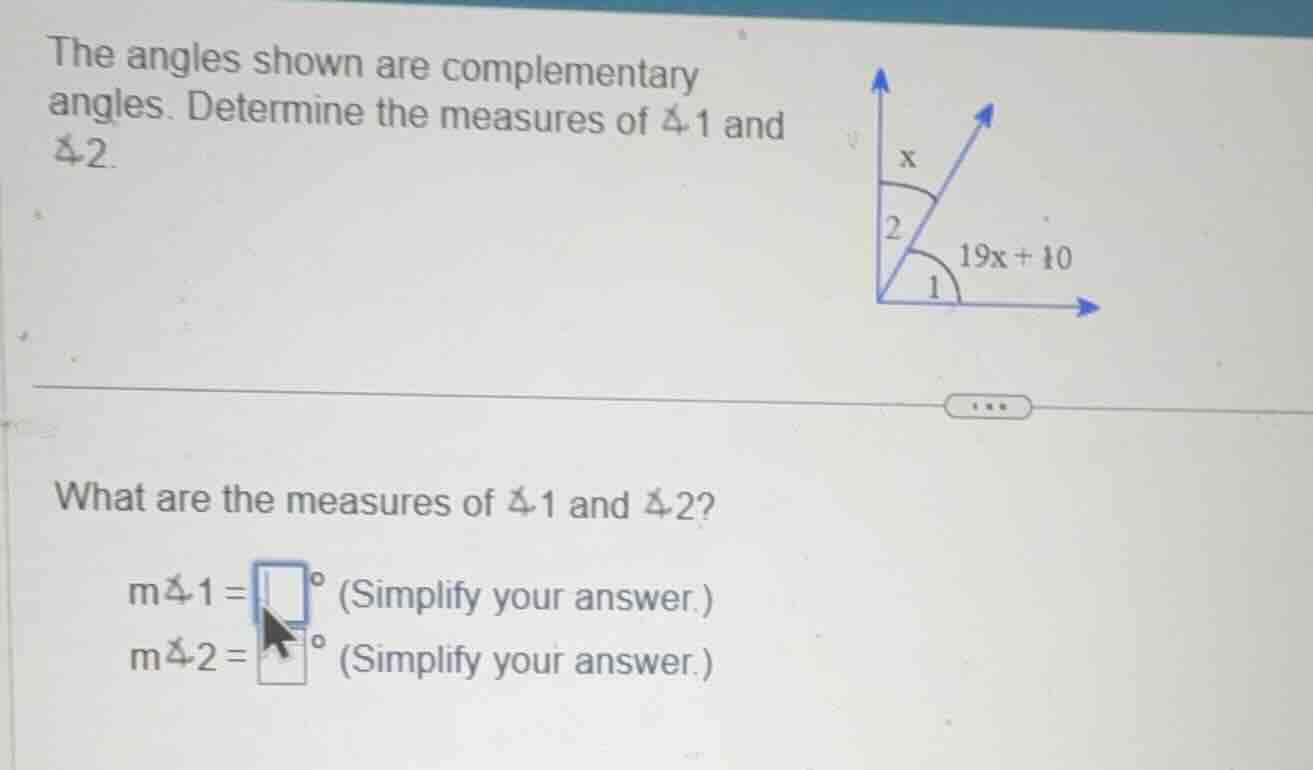
the angles shown are complementary angles. determine the measures of \\…

Question

the angles shown are complementary angles. determine the measures of \\(\angle 1\\) and \\(\angle 2\\).

what are the measures of \\(\angle 1\\) and \\(\angle 2\\)?

\\(m\angle 1 = \square^{\circ}\\) (simplify your answer.)
\\(m\angle 2 = \square^{\circ}\\) (simplify your answer.)

Explanation:

Response

<pre_analysis>
{
"quality": "clear",
"question_count": 1,
"skills_matched": [
"step_cot",
"blank_filling_formatter",
"explain_then_answer",
"tutor"
],
"needs_drawing": false,
"concepts_used": [
"Complementary Angles"
],
"new_concepts": [],
"current_concepts": [
"Complementary Angles",
"Systems of Linear Equations"
]
}
</pre_analysis>

<reasoning>

Set up the angle equation

Using the Complementary Angles knowledge point, we know that complementary angles sum to \(90^\circ\).
\[
\mathrm{m}\angle 1 + \mathrm{m}\angle 2 = 90^\circ
\]

Substitute the given expressions

We substitute the given algebraic expressions for each angle into the equation.
\[
(19x + 10) + x = 90
\]

Solve for x

We combine like terms and solve the linear equation.
\[

$$\begin{aligned} 20x + 10 &= 90 \\ 20x &= 80 \\ x &= 4 \end{aligned}$$

\]

Calculate the angle measures

We substitute \(x = 4\) back into the expressions for each angle.
\[

$$\begin{aligned} \mathrm{m}\angle 1 &= 19(4) + 10 = 76 + 10 = 86^\circ \\ \mathrm{m}\angle 2 &= 4^\circ \end{aligned}$$

\]
</reasoning>

<answer>
What are the measures of \(\angle 1\) and \(\angle 2\)?

\(\mathrm{m}\angle 1 =\) <blank>86</blank>\(^\circ\)
\(\mathrm{m}\angle 2 =\) <blank>4</blank>\(^\circ\)
</answer>

<post_analysis>
{
"subject": "Mathematics",
"question_type": "Fill-in-the-blank",
"knowledge_point": [
"Mathematics",
"Geometry",
"Complementary Angles"
]
}
</post_analysis>

Answer:

<pre_analysis>
{
"quality": "clear",
"question_count": 1,
"skills_matched": [
"step_cot",
"blank_filling_formatter",
"explain_then_answer",
"tutor"
],
"needs_drawing": false,
"concepts_used": [
"Complementary Angles"
],
"new_concepts": [],
"current_concepts": [
"Complementary Angles",
"Systems of Linear Equations"
]
}
</pre_analysis>

<reasoning>

Set up the angle equation

Using the Complementary Angles knowledge point, we know that complementary angles sum to \(90^\circ\).
\[
\mathrm{m}\angle 1 + \mathrm{m}\angle 2 = 90^\circ
\]

Substitute the given expressions

We substitute the given algebraic expressions for each angle into the equation.
\[
(19x + 10) + x = 90
\]

Solve for x

We combine like terms and solve the linear equation.
\[

$$\begin{aligned} 20x + 10 &= 90 \\ 20x &= 80 \\ x &= 4 \end{aligned}$$

\]

Calculate the angle measures

We substitute \(x = 4\) back into the expressions for each angle.
\[

$$\begin{aligned} \mathrm{m}\angle 1 &= 19(4) + 10 = 76 + 10 = 86^\circ \\ \mathrm{m}\angle 2 &= 4^\circ \end{aligned}$$

\]
</reasoning>

<answer>
What are the measures of \(\angle 1\) and \(\angle 2\)?

\(\mathrm{m}\angle 1 =\) <blank>86</blank>\(^\circ\)
\(\mathrm{m}\angle 2 =\) <blank>4</blank>\(^\circ\)
</answer>

<post_analysis>
{
"subject": "Mathematics",
"question_type": "Fill-in-the-blank",
"knowledge_point": [
"Mathematics",
"Geometry",
"Complementary Angles"
]
}
</post_analysis>