QUESTION IMAGE
Question
for an angle to be in standard position, its vertex is at the origin and the initial side lies on the
a) positive (x)-axis.
b) positive (y)-axis.
c) negative (x)-axis.
d) negative (x)-axis.
question 15 (5 points)
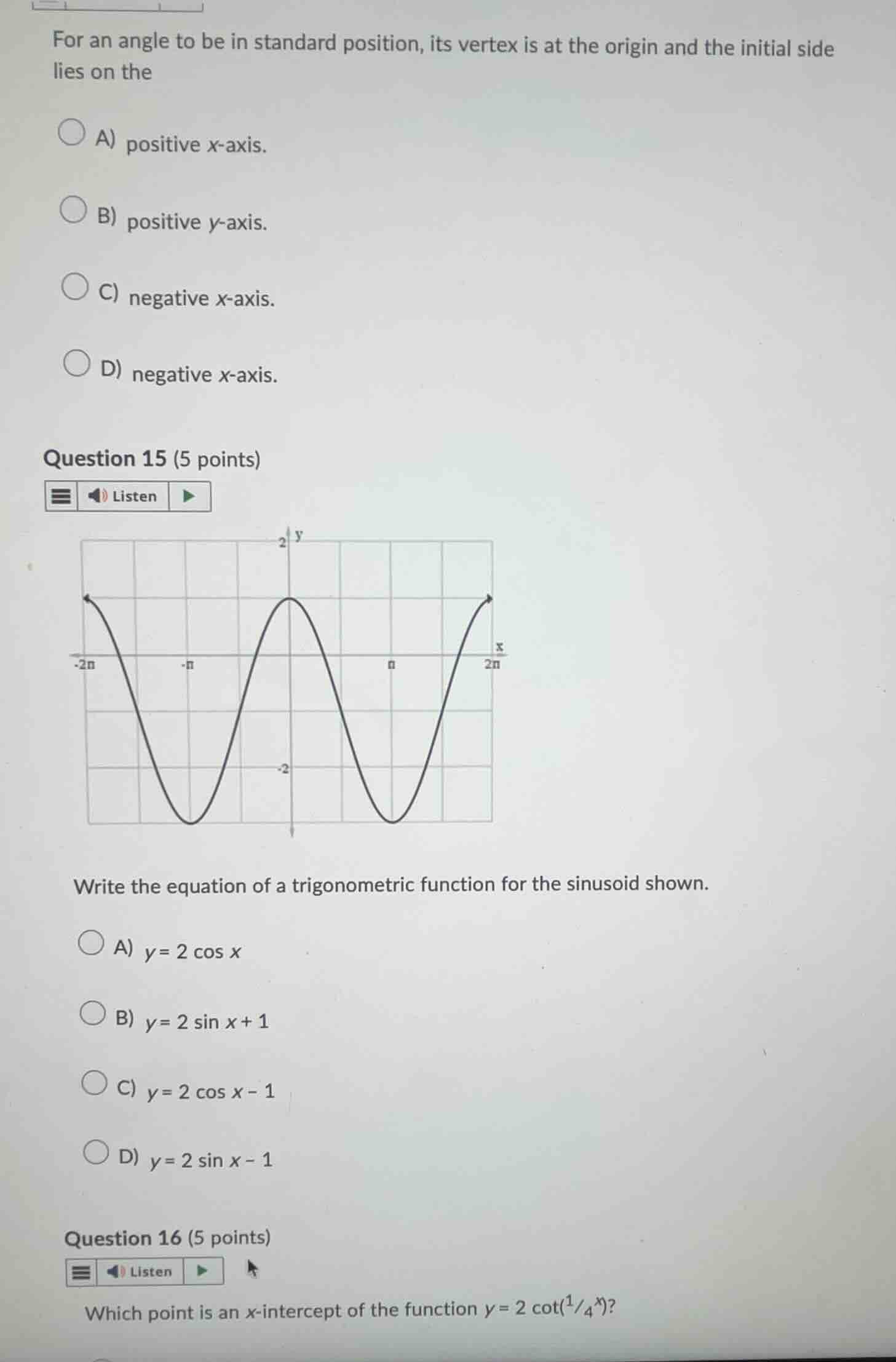
write the equation of a trigonometric function for the sinusoid shown.
a) (y = 2 cos x)
b) (y = 2 sin x + 1)
c) (y = 2 cos x - 1)
d) (y = 2 sin x - 1)
question 16 (5 points)
which point is an (x)-intercept of the function (y = 2 cot(\frac{1}{4}x))?
Identify standard position definition
An angle is in standard position when its vertex is at the origin \((0,0)\) and its initial side lies on the positive \(x\)-axis.
Analyze the sinusoid graph features
- Amplitude: The peak is at \(y = 1\) and the trough is at \(y = -3\). The vertical distance is \(1 - (-3) = 4\), so the amplitude is \(A = \frac{4}{2} = 2\).
- Midline: The vertical shift is \(D = \frac{1 + (-3)}{2} = -1\).
- Y-intercept: At \(x = 0\), the graph is at its maximum value \(y = 1\). A cosine function \(y = A \cos(x) + D\) with \(A = 2\) and \(D = -1\) gives \(y = 2 \cos(0) - 1 = 1\), which matches the graph. Thus, the equation is \(y = 2 \cos x - 1\).
Determine the x-intercept of the cotangent function
- Function: \(y = 2 \cot(\frac{1}{4}x)\)
- Condition for x-intercept: \(y = 0 \implies \cot(\frac{1}{4}x) = 0\)
- Solve for x: \(\cot(\theta) = 0\) when \(\theta = \frac{\pi}{2} + k\pi\) for \(k \in \mathbb{Z}\).
Thus, a primary \(x\)-intercept is at \((2\pi, 0)\).

Snap & solve any problem in the app
Get step-by-step solutions on Sovi AI
Photo-based solutions with guided steps
Explore more problems and detailed explanations
Question 14
- A) positive \(x\)-axis. (Correct answer)
- B) positive \(y\)-axis.
- C) negative \(x\)-axis.
- D) negative \(x\)-axis.
Question 15
- A) \(y = 2 \cos x\)
- B) \(y = 2 \sin x + 1\)
- C) \(y = 2 \cos x - 1\) (Correct answer)
- D) \(y = 2 \sin x - 1\)
Question 16
The \(x\)-intercept of the function \(y = 2 \cot(\frac{1}{4}x)\) is <blank>\((2\pi, 0)\)</blank>.