QUESTION IMAGE
Question
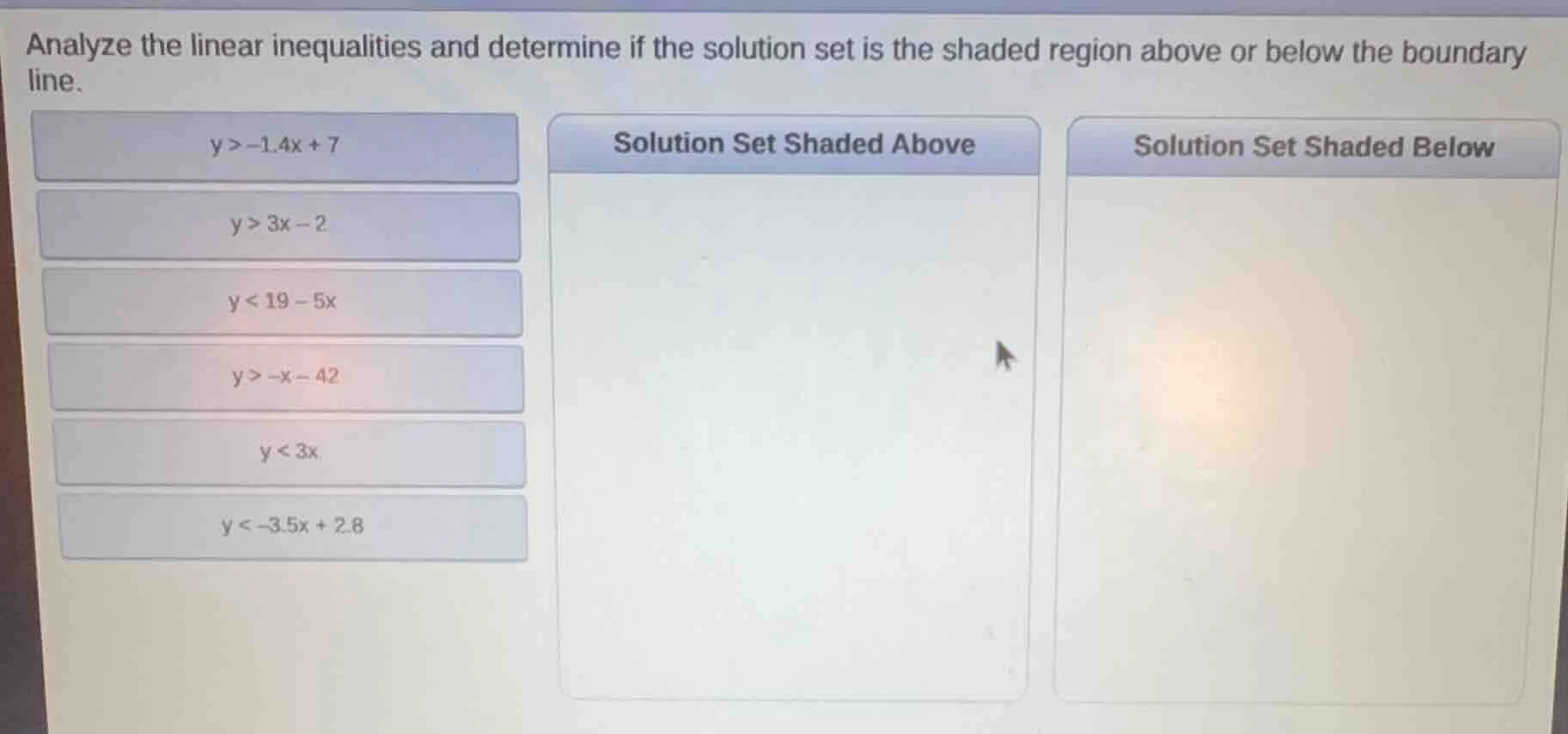
analyze the linear inequalities and determine if the solution set is the shaded region above or below the boundary line.
$y > -1.4x + 7$
$y > 3x - 2$
$y < 19 - 5x$
$y > -x - 42$
$y < 3x$
$y < -3.5x + 2.8$
solution set shaded above
solution set shaded below
Response
To determine if the solution set of a linear inequality \( y > mx + b \) or \( y < mx + b \) is shaded above or below the boundary line, we use the following rule:
- For \( \boldsymbol{y > mx + b} \) (or \( y \geq mx + b \)): The solution set is shaded above the boundary line (since we want \( y \)-values greater than the line’s \( y \)-values at each \( x \)).
- For \( \boldsymbol{y < mx + b} \) (or \( y \leq mx + b \)): The solution set is shaded below the boundary line (since we want \( y \)-values less than the line’s \( y \)-values at each \( x \)).
Analyzing Each Inequality:
- \( \boldsymbol{y > -1.4x + 7} \): Uses \( y > \dots \), so shade above.
- \( \boldsymbol{y > 3x - 2} \): Uses \( y > \dots \), so shade above.
- \( \boldsymbol{y < 19 - 5x} \): Uses \( y < \dots \), so shade below.
- \( \boldsymbol{y > -x - 42} \): Uses \( y > \dots \), so shade above.
- \( \boldsymbol{y < 3x} \): Uses \( y < \dots \), so shade below.
- \( \boldsymbol{y < -3.5x + 2.8} \): Uses \( y < \dots \), so shade below.
Grouping:
- Solution Set Shaded Above: \( y > -1.4x + 7 \), \( y > 3x - 2 \), \( y > -x - 42 \)
- Solution Set Shaded Below: \( y < 19 - 5x \), \( y < 3x \), \( y < -3.5x + 2.8 \)
Final Answer:
- Solution Set Shaded Above: \( y > -1.4x + 7 \), \( y > 3x - 2 \), \( y > -x - 42 \)
- Solution Set Shaded Below: \( y < 19 - 5x \), \( y < 3x \), \( y < -3.5x + 2.8 \)

Snap & solve any problem in the app
Get step-by-step solutions on Sovi AI
Photo-based solutions with guided steps
Explore more problems and detailed explanations
To determine if the solution set of a linear inequality \( y > mx + b \) or \( y < mx + b \) is shaded above or below the boundary line, we use the following rule:
- For \( \boldsymbol{y > mx + b} \) (or \( y \geq mx + b \)): The solution set is shaded above the boundary line (since we want \( y \)-values greater than the line’s \( y \)-values at each \( x \)).
- For \( \boldsymbol{y < mx + b} \) (or \( y \leq mx + b \)): The solution set is shaded below the boundary line (since we want \( y \)-values less than the line’s \( y \)-values at each \( x \)).
Analyzing Each Inequality:
- \( \boldsymbol{y > -1.4x + 7} \): Uses \( y > \dots \), so shade above.
- \( \boldsymbol{y > 3x - 2} \): Uses \( y > \dots \), so shade above.
- \( \boldsymbol{y < 19 - 5x} \): Uses \( y < \dots \), so shade below.
- \( \boldsymbol{y > -x - 42} \): Uses \( y > \dots \), so shade above.
- \( \boldsymbol{y < 3x} \): Uses \( y < \dots \), so shade below.
- \( \boldsymbol{y < -3.5x + 2.8} \): Uses \( y < \dots \), so shade below.
Grouping:
- Solution Set Shaded Above: \( y > -1.4x + 7 \), \( y > 3x - 2 \), \( y > -x - 42 \)
- Solution Set Shaded Below: \( y < 19 - 5x \), \( y < 3x \), \( y < -3.5x + 2.8 \)
Final Answer:
- Solution Set Shaded Above: \( y > -1.4x + 7 \), \( y > 3x - 2 \), \( y > -x - 42 \)
- Solution Set Shaded Below: \( y < 19 - 5x \), \( y < 3x \), \( y < -3.5x + 2.8 \)