QUESTION IMAGE
Question
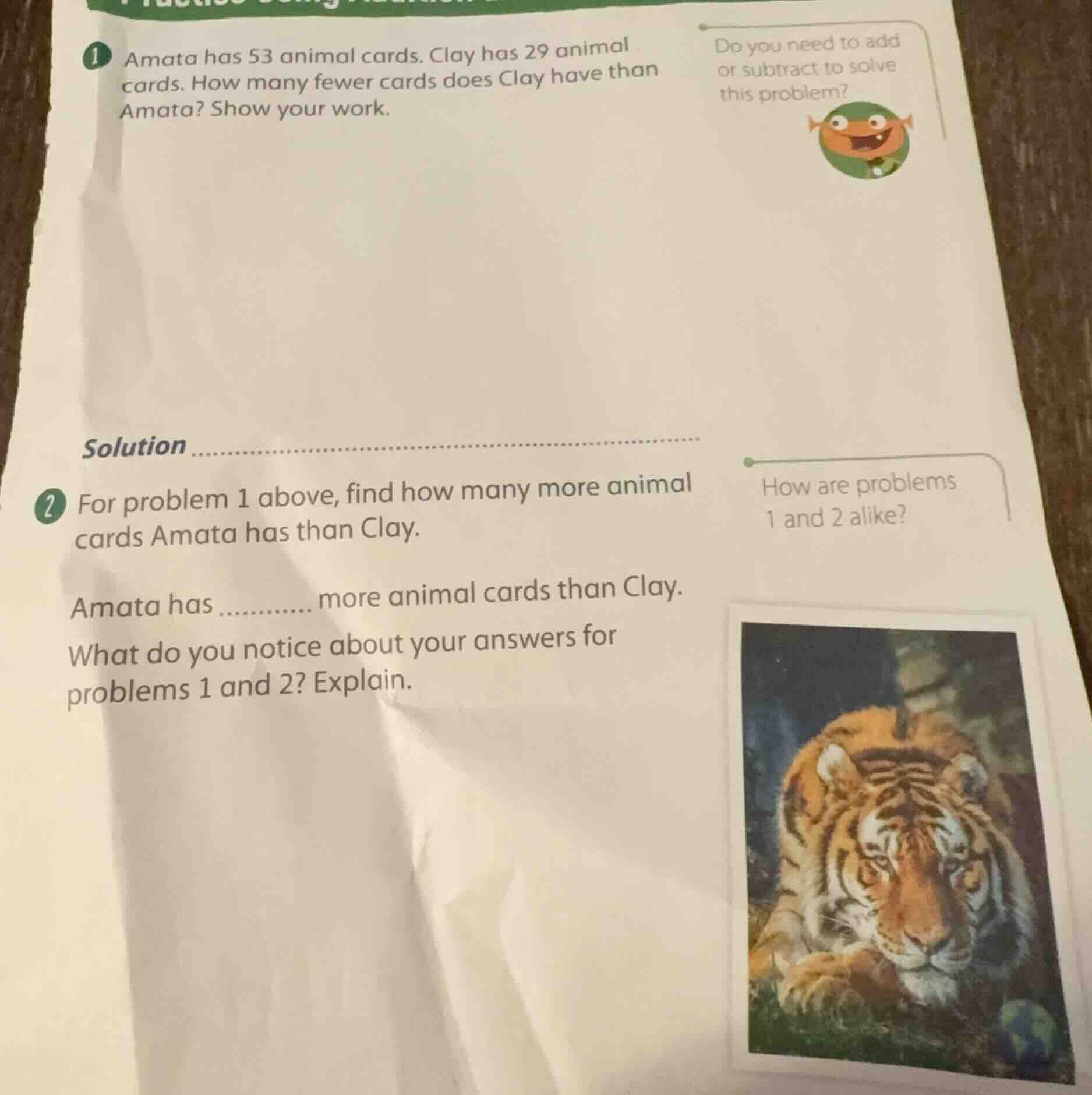
1 amata has 53 animal cards. clay has 29 animal cards. how many fewer cards does clay have than amata? show your work. do you need to add or subtract to solve this problem? solution 2 for problem 1 above, find how many more animal cards amata has than clay. amata has ......... more animal cards than clay. what do you notice about your answers for problems 1 and 2? explain. how are problems 1 and 2 alike?
Problem 1
Step1: Identify operation (subtract)
To find how many fewer cards Clay has than Amata, we subtract Clay's cards from Amata's. So we use the formula \( \text{Difference} = \text{Amata's cards} - \text{Clay's cards} \). Here, Amata has 53 cards and Clay has 29 cards, so the expression is \( 53 - 29 \).
Step2: Perform subtraction
\( 53 - 29 = 24 \).
Step1: Identify operation (subtract)
To find how many more cards Amata has than Clay, we subtract Clay's cards from Amata's. The formula is \( \text{Difference} = \text{Amata's cards} - \text{Clay's cards} \), so the expression is \( 53 - 29 \).
Step2: Perform subtraction
\( 53 - 29 = 24 \).
Step3: Notice about answers
Problems 1 and 2 have the same answer because "how many fewer Clay has than Amata" and "how many more Amata has than Clay" both ask for the difference between their card counts, which is calculated by subtracting the smaller number from the larger number. So the difference is the same in both cases.

Snap & solve any problem in the app
Get step-by-step solutions on Sovi AI
Photo-based solutions with guided steps
Explore more problems and detailed explanations
Clay has 24 fewer cards than Amata. We use subtraction, and \( 53 - 29 = 24 \).