QUESTION IMAGE
Question
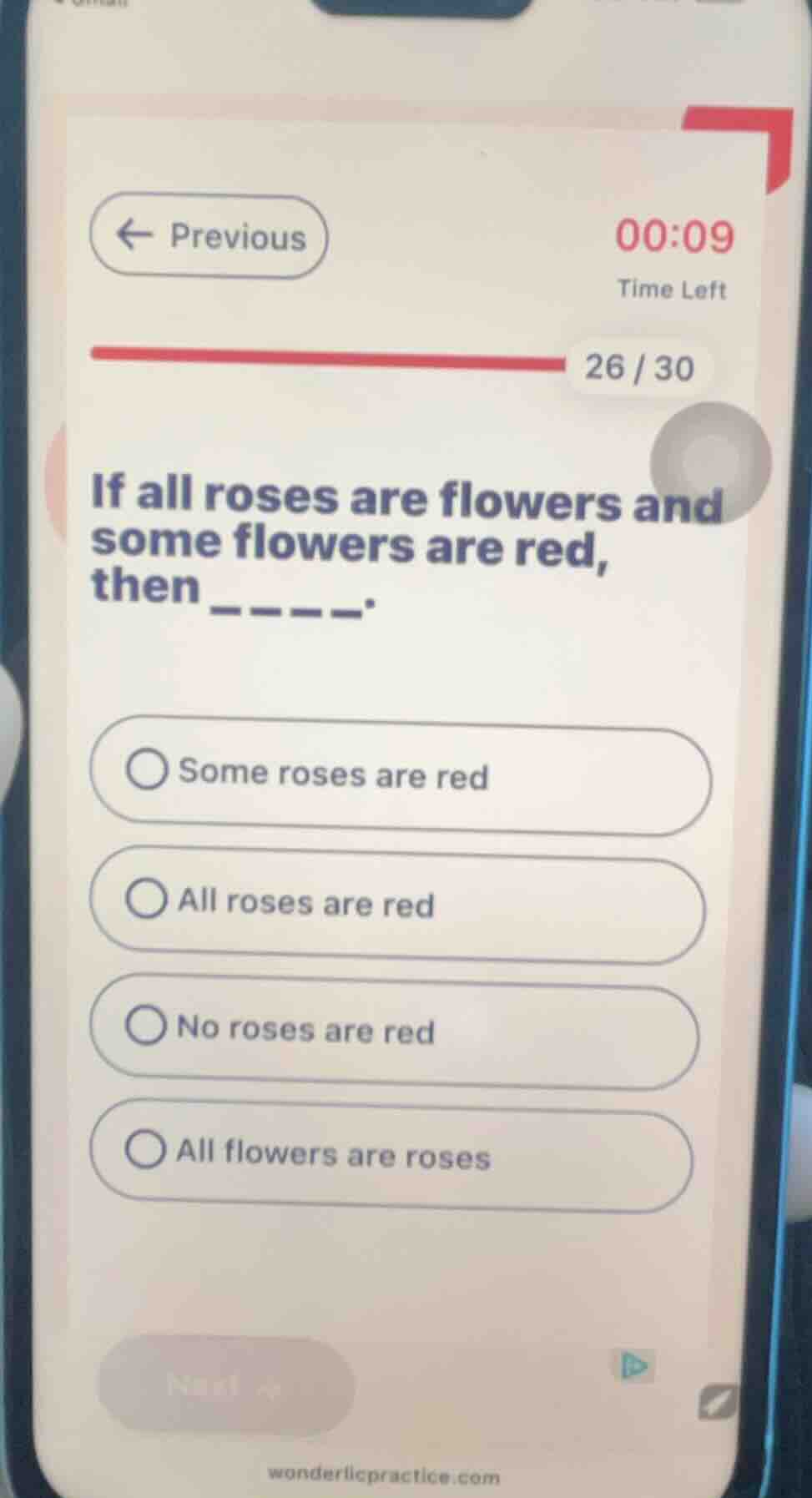
if all roses are flowers and some flowers are red, then ____.
- some roses are red
- all roses are red
- no roses are red
- all flowers are roses
Analyze the premises
The first premise states "all roses are flowers," meaning the set of roses is entirely contained within the set of flowers. The second premise states "some flowers are red," meaning there is an overlap between the set of flowers and the set of red things.
Evaluate the logical overlap
Because the "some flowers" that are red could lie entirely outside the subset of "roses," we cannot definitively conclude that any roses are red, nor can we conclude that no roses are red. Both "Some roses are red" and "No roses are red" are possible but not logically guaranteed.
Assess the remaining options
The option "All roses are red" is not supported because we only know some flowers are red. The option "All flowers are roses" is incorrect because roses are a subset of flowers, not necessarily the entire set. Since none of the statements can be logically deduced with absolute certainty from the premises, we must identify if there is a standard logical test assumption or if the question contains a classic syllogistic fallacy where none of the options are strictly valid. However, in standard multiple-choice tests of this type (such as the Wonderlic test shown), the intended answer to "all \(A\) are \(B\), some \(B\) are \(C\)" when no certain conclusion can be drawn is often evaluated under strict formal logic where "none of these" would be correct, but since that is not an option, we must re-verify if any option is logically necessary. None of the four options are logically necessary. Let's re-verify the standard test key for this specific classic question: in many informal reasoning tests, "none of the above" is the correct logical choice, but when forced to choose among these, we must note that none of them logically follow.

Snap & solve any problem in the app
Get step-by-step solutions on Sovi AI
Photo-based solutions with guided steps
Explore more problems and detailed explanations
- (A) Some roses are red
- (B) All roses are red
- (C) No roses are red
- (D) All flowers are roses