QUESTION IMAGE
Question
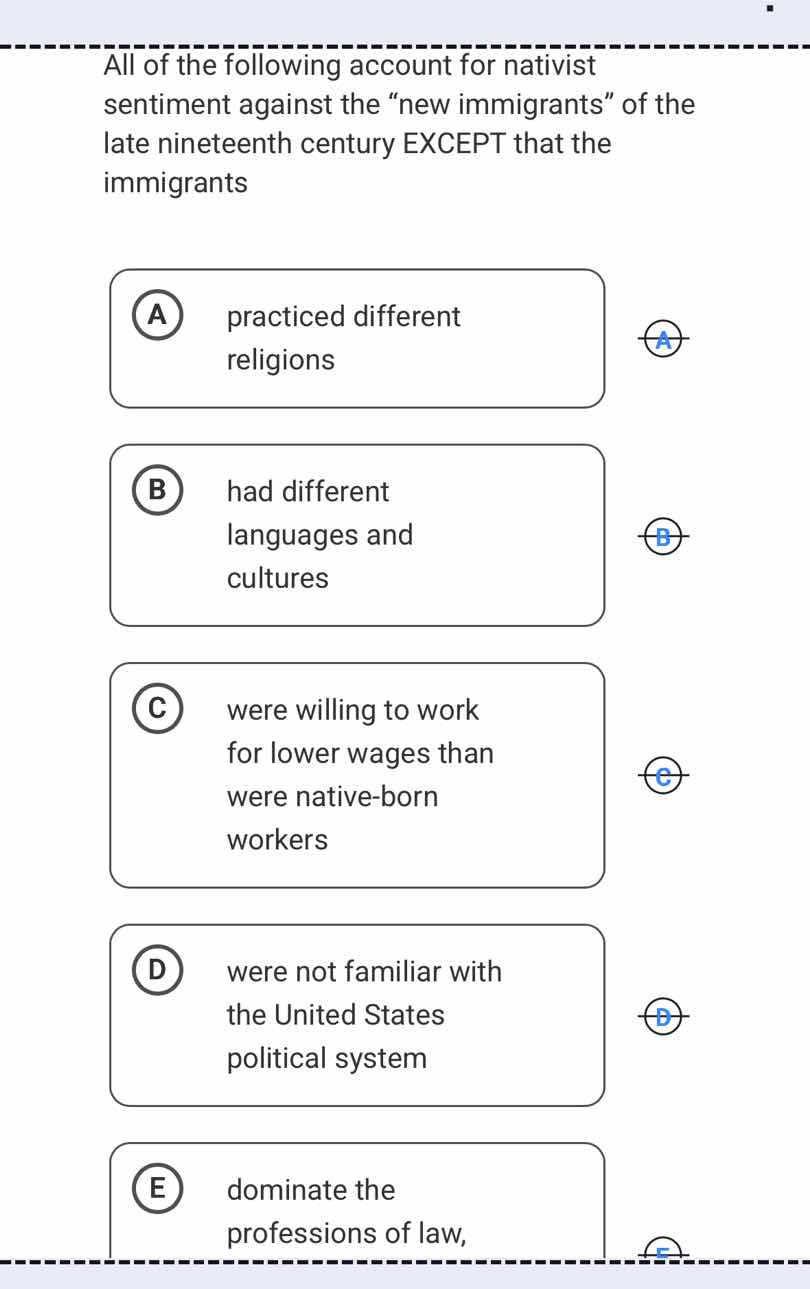
all of the following account for nativist sentiment against the
ew immigrants\ of the late nineteenth century except that the immigrants a practiced different religions b had different languages and cultures c were willing to work for lower wages than were native - born workers d were not familiar with the united states political system e dominate the professions of law,
Brief Explanations
To solve this, we analyze each option in the context of nativist sentiment against late 19th - century "new immigrants":
- Option A: Different religions (e.g., Catholic, Jewish immigrants among mainly Protestant natives) caused nativist hostility as it was seen as a threat to cultural/religious norms.
- Option B: Different languages (like Yiddish, Italian) and cultures (e.g., family structures, traditions) from native - born Americans led to nativist fear of cultural change.
- Option C: Willingness to work for lower wages created economic competition, making native - born workers and employers (who might exploit this) have negative views, fueling nativism.
- Option D: Lack of familiarity with the US political system was seen as a sign of being "un - American" and a threat to the political order, contributing to nativist sentiment.
- Option E: "New immigrants" (mostly from Southern and Eastern Europe) were often in low - wage, unskilled jobs. They did not dominate professions like law, medicine, etc. (which were dominated by native - born or earlier, more established immigrants). So this does not account for nativist sentiment.

Snap & solve any problem in the app
Get step-by-step solutions on Sovi AI
Photo-based solutions with guided steps
Explore more problems and detailed explanations
E. dominate the professions of law,