QUESTION IMAGE
Question
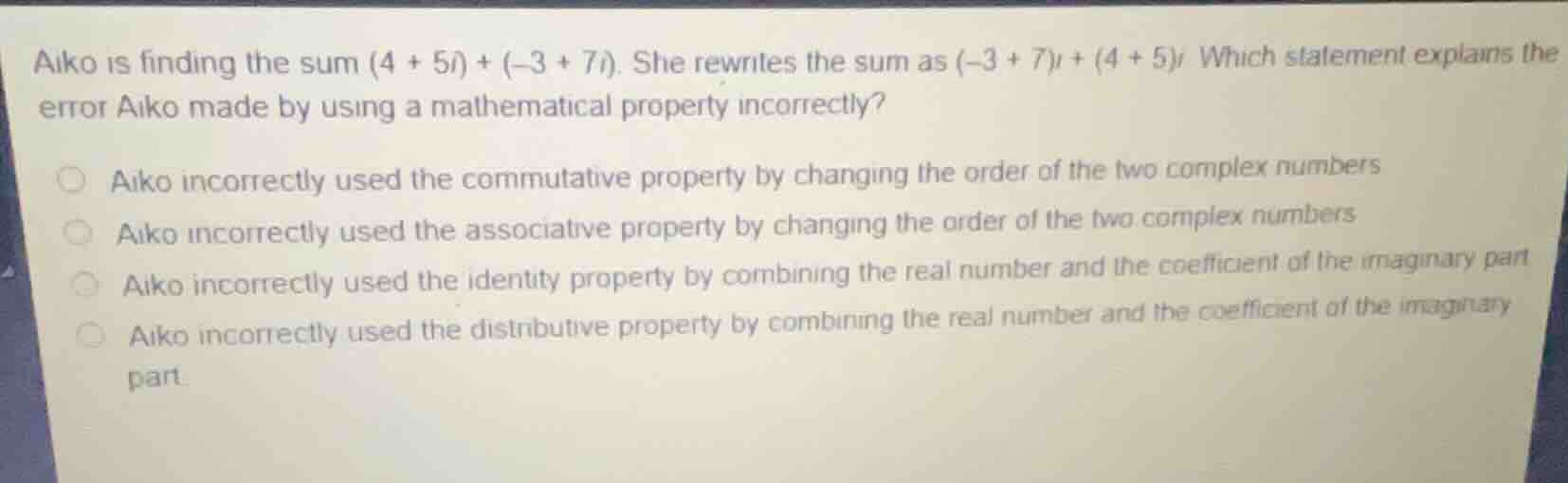
aiko is finding the sum \\((4 + 5i) + (-3 + 7i)\\). she rewrites the sum as \\((-3 + 7)i + (4 + 5)i\\). which statement explains the error aiko made by using a mathematical property incorrectly?
aiko incorrectly used the commutative property by changing the order of the two complex numbers
aiko incorrectly used the associative property by changing the order of the two complex numbers
aiko incorrectly used the identity property by combining the real number and the coefficient of the imaginary part
aiko incorrectly used the distributive property by combining the real number and the coefficient of the imaginary part
Analyze the original expression and Aiko's rewrite
Original expression:
Aiko's rewritten expression:
Identify the mathematical error
The original terms are complex numbers of the form \(a + bi\).
Aiko factored out \(i\) incorrectly from the entire expressions, changing the real parts \(4\) and \(-3\) into coefficients of \(i\).
This incorrectly applies the distributive property by grouping the real parts and the imaginary coefficients together under a single factor of \(i\).
Match with the correct option
The fourth option states: "Aiko incorrectly used the distributive property by combining the real number and the coefficient of the imaginary part."
This accurately describes the error of distributing \(i\) to the real parts \(4\) and \(-3\) where it does not belong.

Snap & solve any problem in the app
Get step-by-step solutions on Sovi AI
Photo-based solutions with guided steps
Explore more problems and detailed explanations
- (A) Aiko incorrectly used the commutative property by changing the order of the two complex numbers
- (B) Aiko incorrectly used the associative property by changing the order of the two complex numbers
- (C) Aiko incorrectly used the identity property by combining the real number and the coefficient of the imaginary part
- (D) Aiko incorrectly used the distributive property by combining the real number and the coefficient of the imaginary part (Correct answer)