QUESTION IMAGE
Question
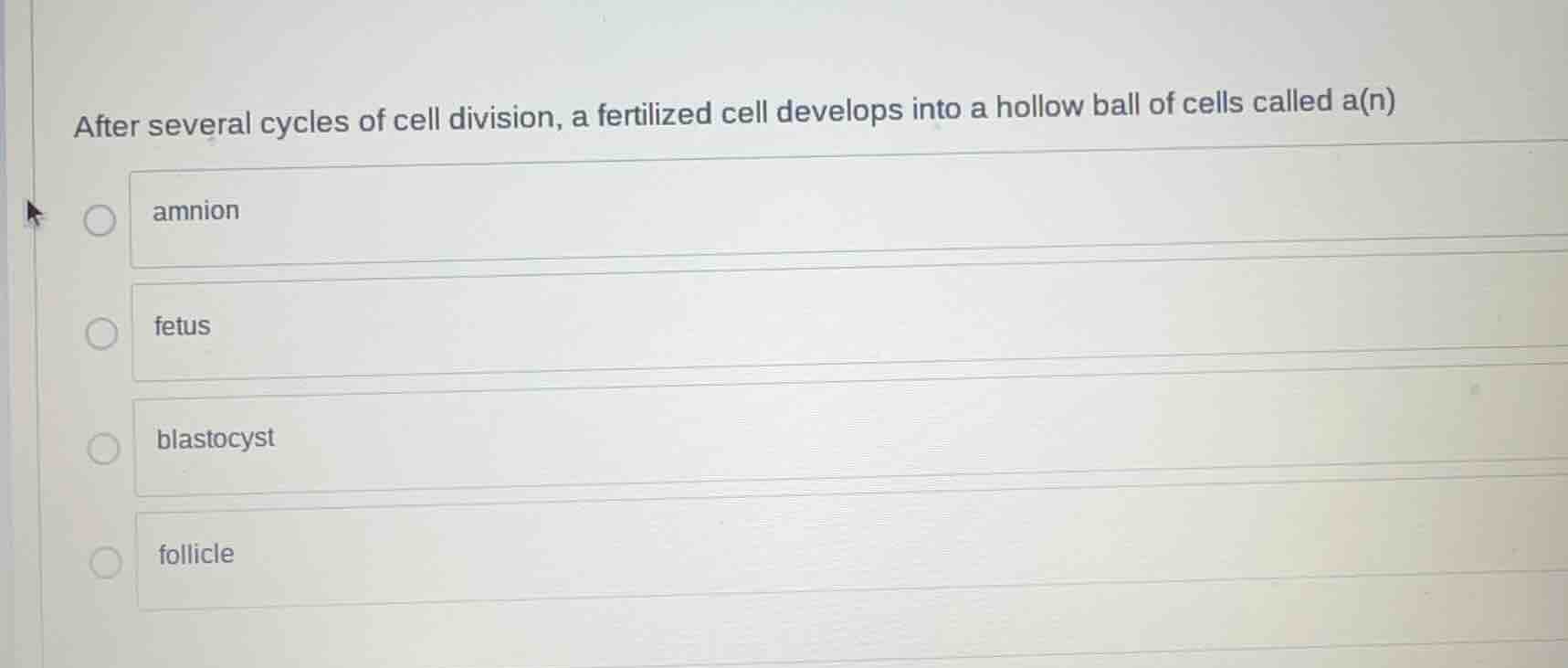
after several cycles of cell division, a fertilized cell develops into a hollow ball of cells called a(n)
amnion
fetus
blastocyst
follicle
🆕 New Concept Discovered: stages of early embryonic development
Early milestones from fertilization to implantation
Step 1: Understand the process of cleavage
After fertilization, the single-celled zygote undergoes rapid mitotic cell divisions called cleavage. This process increases the number of cells without increasing the overall size of the developing organism.
Step 2: Identify the stages of development
As division continues, the cells form different structures:
- Morula: A solid ball of cells (usually around 16 cells).
- Blastocyst (or blastula in non-mammals): As division continues, a fluid-filled cavity forms in the center, turning the solid ball into a hollow ball of cells.
- Fetus: A much later stage of prenatal development (in humans, starting from the 9th week of gestation).
Step 3: Evaluate the given options
- amnion: The innermost membrane that encloses the embryo/fetus in fluid.
- fetus: A later stage of development with recognizable features, not a simple hollow ball of cells.
- blastocyst: The hollow ball of cells formed after several rounds of cell division.
- follicle: A fluid-filled sac in the ovary that contains an immature egg.
Therefore, the correct term for the hollow ball of cells is the blastocyst.

Snap & solve any problem in the app
Get step-by-step solutions on Sovi AI
Photo-based solutions with guided steps
Explore more problems and detailed explanations
blastocyst