QUESTION IMAGE
Question
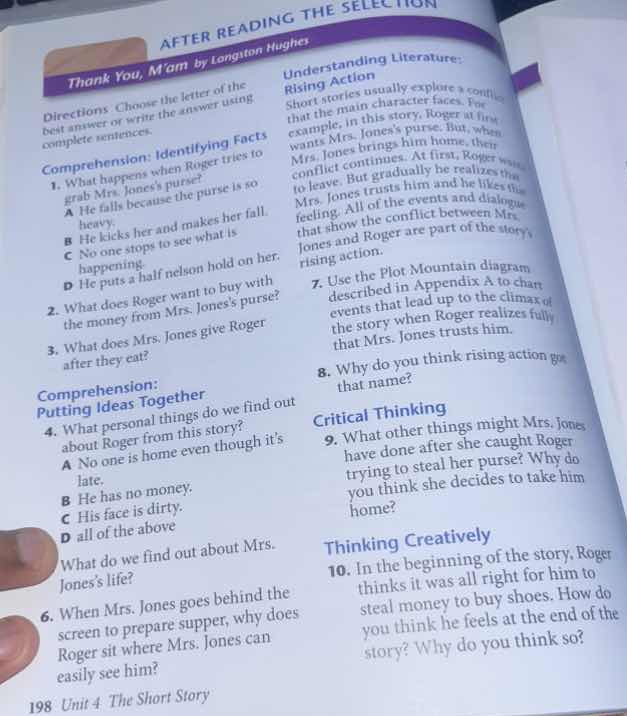
after reading the selection
thank you, mam by langston hughes
directions choose the letter of the best answer or write the answer using complete sentences.
comprehension: identifying facts
- what happens when roger tries to grab mrs. joness purse?
a he falls because the purse is so heavy.
b he kicks her and makes her fall.
c no one stops to see what is happening.
d he puts a half nelson hold on her.
- what does roger want to buy with the money from mrs. joness purse?
- what does mrs. jones give roger after they eat?
comprehension: putting ideas together
- what personal things do we find out about roger from this story?
a no one is home even though its late.
b he has no money.
c his face is dirty.
d all of the above
- what do we find out about mrs. joness life?
- when mrs. jones goes behind the screen to prepare supper, why does roger sit where mrs. jones can easily see him?
understanding literature: rising action
short stories usually explore a conflict that the main character faces. for example, in this story, roger at first wants mrs. joness purse. but, when mrs. jones brings him home, their conflict continues. at first, roger wants to leave. but gradually he realizes that mrs. jones trusts him and he likes this feeling. all of the events and dialogue that show the conflict between mrs. jones and roger are part of the storys rising action.
- use the plot mountain diagram described in appendix a to chart events that lead up to the climax of the story when roger realizes fully that mrs. jones trusts him.
- why do you think rising action got that name?
critical thinking
- what other things might mrs. jones have done after she caught roger trying to steal her purse? why do you think she decides to take him home?
thinking creatively
- in the beginning of the story, roger thinks it was all right for him to steal money to buy shoes. how do you think he feels at the end of the story? why do you think so?
Analyze Roger's attempt to steal the purse
In Langston Hughes's short story "Thank You, M'am," when Roger tries to snatch Mrs. Luella Bates Washington Jones's large purse, the strap breaks with the single tug Roger gives it from behind. Combined with his own weight and the weight of the purse, Roger loses his balance. Instead of making a clean getaway, he falls flat on his back on the sidewalk, and his legs fly up. Mrs. Jones then turns around and kicks him right in his blue-jeaned sitter. Therefore, the closest description of what happens physically to Roger is that he falls down (though the options in the text have a slight variation, the physical fall is the key event). Looking at the options:
- A: He falls because the purse is so heavy. (The combined weight of the purse and his own body causes him to lose balance and fall).
- B: He kicks her and makes her fall. (Incorrect, she does not fall, she kicks him).
- C: No one stops to see what is happening. (Incorrect, some people stop and watch).
- D: He puts a half nelson hold on her. (Incorrect).
Thus, option A is the correct choice.
Determine Roger's motivation for the theft
Later in the story, while at Mrs. Jones's home, she asks Roger why he tried to steal her purse. Roger confesses his motivation directly to her: "I wanted a pair of blue suede shoes."
Identify Mrs. Jones's gift to Roger
After they eat a meal of lima beans, ham, and cocoa made from canned milk, Mrs. Jones prepares to let Roger leave. Before he goes, she hands him ten dollars and tells him to go buy himself some blue suede shoes, warning him not to make the mistake of latching onto her purse or anyone else's again.
Analyze Roger's personal circumstances
The story reveals several details about Roger's life:
- He mentions there is nobody at his home to wash his face or tell him to wash it, indicating he is neglected or alone at night.
- He has no money to buy the shoes he wants, which is why he resorted to theft.
- Mrs. Jones notices his face is dirty and tells him to wash it in her sink.
Since all these statements are true, option D ("all of the above") is the correct choice.
Analyze Mrs. Jones's background
Through her dialogue and actions, we learn several things about Mrs. Jones's life:
- She works late at a hotel beauty shop that stays open until late, where she meets all kinds of women.
- She lives in a modest kitchenette apartment in a boarding house with other roomers.
- She reveals that she was once young and wanted things she could not get, and that she did things in her past that she is not proud of, which helps her empathize with Roger.
Explain Roger's choice of seating
When Mrs. Jones goes behind the screen to prepare supper, she leaves her purse on her daybed. Roger deliberately chooses to sit on the far side of the room where he thinks she can easily see him out of the corner of her eye. He does this because he wants to show her that he can be trusted. He does not want her to think he is going to run or steal from her again, as he has begun to value her respect.
Map the rising action to the climax
The rising action consists of the events build…

Snap & solve any problem in the app
Get step-by-step solutions on Sovi AI
Photo-based solutions with guided steps
Explore more problems and detailed explanations
Question 1
- (A) He falls because the purse is so heavy. (Correct answer)
- (B) He kicks her and makes her fall.
- (C) No one stops to see what is happening.
- (D) He puts a half nelson hold on her.
Question 2
Roger wants to buy a pair of blue suede shoes.
Question 3
Mrs. Jones gives Roger ten dollars to buy the blue suede shoes.
Question 4
- (A) No one is home even though it's late.
- (B) He has no money.
- (C) His face is dirty.
- (D) all of the above (Correct answer)
Question 5
We find out that Mrs. Jones works late in a hotel beauty shop, lives in a shared boarding house, and had a difficult past where she also made mistakes and wanted things she could not obtain.
Question 6
Roger sits where Mrs. Jones can easily see him because he wants to prove to her that he can be trusted and does not want her to suspect him of stealing or running away.
Question 7
- Event 1: Roger falls on the sidewalk, and Mrs. Jones restrains him and drags him to her furnished room.
- Event 2: Mrs. Jones tells Roger to wash his face, leaving her front door open, giving him a choice to run, but he decides to stay.
- Event 3: Mrs. Jones leaves her purse unattended on her daybed while she goes behind a screen to prepare supper.
- Climax: Roger sits on the far side of the room where she can easily see him, choosing to show he is trustworthy rather than running away with her purse.
Question 8
"Rising action" gets its name because the tension, conflict, and suspense in the story build upward like climbing a mountain, rising in intensity until the plot reaches its highest point of tension (the climax).
Question 9
Mrs. Jones could have called the police or left Roger on the street. She decides to take him home because she recognizes his neglect, empathizes with his struggle, and believes that showing him trust and maternal care will teach him a deeper lesson than punishment.
Question 10
At the end of the story, Roger feels deeply grateful, humbled, and changed. He no longer views stealing as acceptable because Mrs. Jones's unexpected kindness and trust have shown him the value of respect and integrity, leaving him so moved that he can barely find the words to thank her.