QUESTION IMAGE
Question
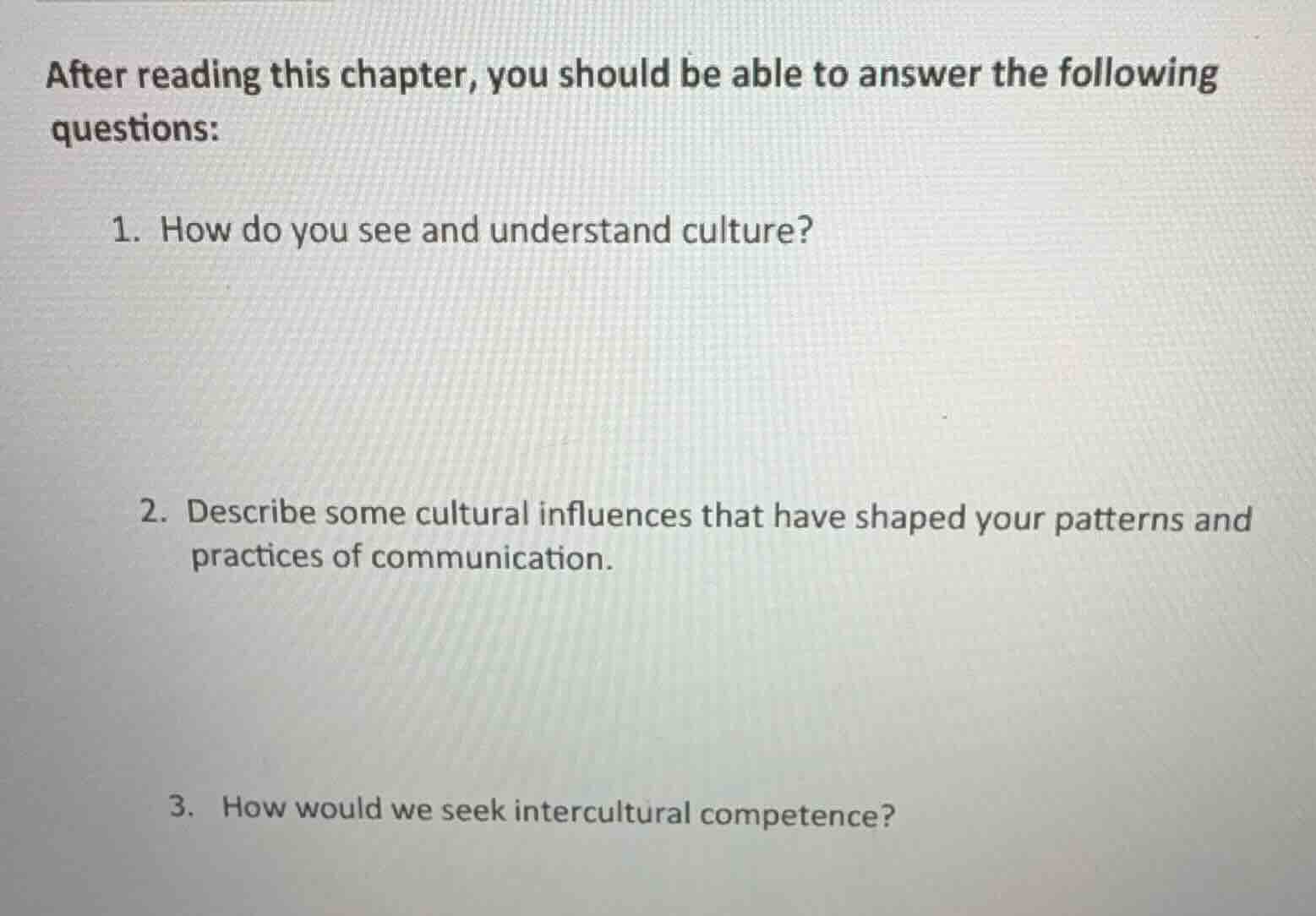
after reading this chapter, you should be able to answer the following questions:
- how do you see and understand culture?
- describe some cultural influences that have shaped your patterns and practices of communication.
- how would we seek intercultural competence?
<pre_analysis>
{
"quality": "clear",
"question_count": 3,
"skills_matched": [
"direct_cot",
"explain_then_answer",
"tutor"
],
"needs_drawing": false,
"concepts_used": [],
"new_concepts": [
"Cultural Perception",
"Intercultural Competence",
"Communication Patterns"
],
"current_concepts": [
"Cultural Perception",
"Intercultural Competence",
"Communication Patterns"
]
}
</pre_analysis>
<reasoning>
Define culture and its perception
Culture is a shared system of beliefs, values, customs, and behaviors that shapes how we perceive and interact with the world. Understanding culture requires looking beyond visible elements like food, dress, and language to recognize deeper, invisible aspects such as core values, nonverbal communication norms, and social hierarchies.
Analyze cultural influences on communication
Cultural backgrounds shape communication patterns through distinct styles, such as high-context versus low-context communication, directness, and nonverbal cues. For instance, some cultures prioritize indirect communication to maintain harmony, while others value explicit, direct verbal expression.
Identify pathways to intercultural competence
Intercultural competence is the ability to communicate and interact effectively and appropriately across cultures. Developing this competence involves cultivating self-awareness of one's own biases, actively listening to diverse perspectives, practicing empathy, and adapting communication styles to fit different cultural contexts.
</reasoning>
<answer>
Question 1
Culture is understood as a complex, shared system of values, beliefs, behaviors, and symbols that shapes how a group of people perceives and navigates the world. It acts as a lens through which we interpret experiences, encompassing both visible elements (such as language, food, and customs) and invisible elements (such as social norms, values, and worldviews).
Question 2
Cultural influences shape communication patterns through aspects such as:
- Directness vs. Indirectness: Some cultures value explicit, direct verbal messages, while others rely on high-context, indirect communication where meaning is inferred from context and nonverbal cues.
- Nonverbal Norms: Rules regarding eye contact, personal space, gestures, and silence vary significantly across cultures and dictate what is considered respectful or disrespectful.
- Hierarchical Structures: Cultural views on authority influence how formally or informally one communicates with individuals of different social or professional statuses.
Question 3
We seek intercultural competence by:
- Developing Self-Awareness: Recognizing our own cultural biases, assumptions, and communication defaults.
- Cultivating Curiosity and Openness: Actively learning about other cultures without immediately judging differences as incorrect.
- Practicing Active Listening and Empathy: Focusing on understanding others' perspectives from within their own cultural frameworks.
- Adapting Communication: Flexibly adjusting our verbal and nonverbal behaviors to ensure respectful and effective mutual understanding.
</answer>
<post_analysis>
{
"subject": "Social Science",
"question_type": "Multi-part",
"knowledge_point": [
"Social Science",
"Communication Studies",
"Intercultural Communication"
]
}
</post_analysis>
Snap & solve any problem in the app
Get step-by-step solutions on Sovi AI
Photo-based solutions with guided steps
Explore more problems and detailed explanations
<pre_analysis>
{
"quality": "clear",
"question_count": 3,
"skills_matched": [
"direct_cot",
"explain_then_answer",
"tutor"
],
"needs_drawing": false,
"concepts_used": [],
"new_concepts": [
"Cultural Perception",
"Intercultural Competence",
"Communication Patterns"
],
"current_concepts": [
"Cultural Perception",
"Intercultural Competence",
"Communication Patterns"
]
}
</pre_analysis>
<reasoning>
Define culture and its perception
Culture is a shared system of beliefs, values, customs, and behaviors that shapes how we perceive and interact with the world. Understanding culture requires looking beyond visible elements like food, dress, and language to recognize deeper, invisible aspects such as core values, nonverbal communication norms, and social hierarchies.
Analyze cultural influences on communication
Cultural backgrounds shape communication patterns through distinct styles, such as high-context versus low-context communication, directness, and nonverbal cues. For instance, some cultures prioritize indirect communication to maintain harmony, while others value explicit, direct verbal expression.
Identify pathways to intercultural competence
Intercultural competence is the ability to communicate and interact effectively and appropriately across cultures. Developing this competence involves cultivating self-awareness of one's own biases, actively listening to diverse perspectives, practicing empathy, and adapting communication styles to fit different cultural contexts.
</reasoning>
<answer>
Question 1
Culture is understood as a complex, shared system of values, beliefs, behaviors, and symbols that shapes how a group of people perceives and navigates the world. It acts as a lens through which we interpret experiences, encompassing both visible elements (such as language, food, and customs) and invisible elements (such as social norms, values, and worldviews).
Question 2
Cultural influences shape communication patterns through aspects such as:
- Directness vs. Indirectness: Some cultures value explicit, direct verbal messages, while others rely on high-context, indirect communication where meaning is inferred from context and nonverbal cues.
- Nonverbal Norms: Rules regarding eye contact, personal space, gestures, and silence vary significantly across cultures and dictate what is considered respectful or disrespectful.
- Hierarchical Structures: Cultural views on authority influence how formally or informally one communicates with individuals of different social or professional statuses.
Question 3
We seek intercultural competence by:
- Developing Self-Awareness: Recognizing our own cultural biases, assumptions, and communication defaults.
- Cultivating Curiosity and Openness: Actively learning about other cultures without immediately judging differences as incorrect.
- Practicing Active Listening and Empathy: Focusing on understanding others' perspectives from within their own cultural frameworks.
- Adapting Communication: Flexibly adjusting our verbal and nonverbal behaviors to ensure respectful and effective mutual understanding.
</answer>
<post_analysis>
{
"subject": "Social Science",
"question_type": "Multi-part",
"knowledge_point": [
"Social Science",
"Communication Studies",
"Intercultural Communication"
]
}
</post_analysis>