QUESTION IMAGE
Question
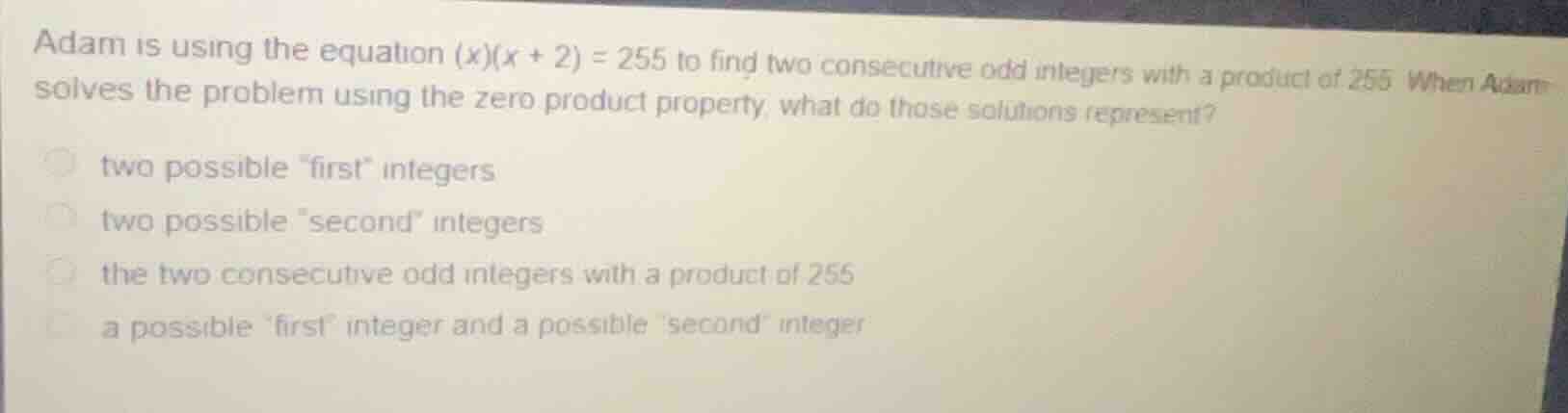
adam is using the equation \\((x)(x + 2) = 255\\) to find two consecutive odd integers with a product of 255. when adam solves the problem using the zero product property, what do those solutions represent?
two possible \first\ integers
two possible \second\ integers
the two consecutive odd integers with a product of 255
a possible \first\ integer and a possible \second\ integer
Define the variable and equation setup
Let \(x\) represent the first odd integer. The next consecutive odd integer is \(x + 2\). The equation modeling their product is:
Analyze the solutions of the quadratic equation
Expanding and rearranging into standard form:
Factoring the quadratic equation:
Applying the zero product property yields two solutions for \(x\):
Interpret the meaning of the solutions
Since \(x\) is defined as the first integer of the consecutive pair, the two solutions \(x = -17\) and \(x = 15\) represent the two possible values for this "first" integer.
- If the first integer is \(15\), the second is \(17\).
- If the first integer is \(-17\), the second is \(-15\).
Thus, the solutions represent two possible "first" integers.

Snap & solve any problem in the app
Get step-by-step solutions on Sovi AI
Photo-based solutions with guided steps
Explore more problems and detailed explanations
- two possible "first" integers (Correct answer)
- two possible "second" integers
- the two consecutive odd integers with a product of 255
- a possible "first" integer and a possible "second" integer