QUESTION IMAGE
Question
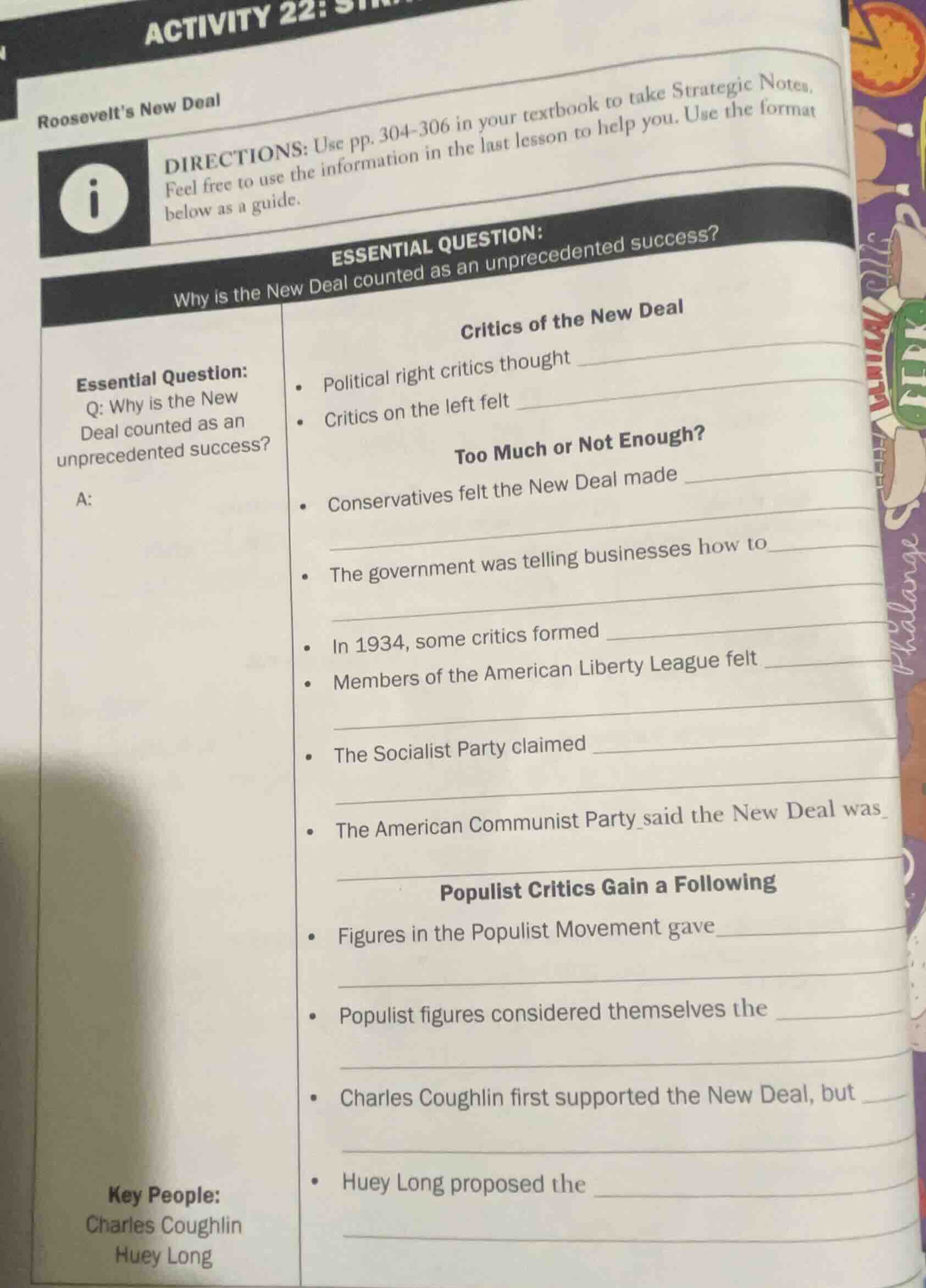
activity 22:
roosevelts new deal
directions: use pp. 304-306 in your textbook to take strategic notes. feel free to use the information in the last lesson to help you. use the format below as a guide.
essential question:
why is the new deal counted as an unprecedented success?
essential question:
q: why is the new deal counted as an unprecedented success?
a:
critics of the new deal
- political right critics thought
- critics on the left felt
too much or not enough?
- conservatives felt the new deal made
- the government was telling businesses how to
- in 1934, some critics formed
- members of the american liberty league felt
- the socialist party claimed
- the american communist party said the new deal was
populist critics gain a following
- figures in the populist movement gave
- populist figures considered themselves the
- charles coughlin first supported the new deal, but
- huey long proposed the
key people:
charles coughlin
huey long
To answer the essential question "Why is the New Deal counted as an unprecedented success?" and fill in the related blanks, we analyze the New Deal's impact:
1. Unprecedented Success Rationale
The New Deal was unprecedentedly successful because it:
- Addressed the Great Depression with bold government intervention (unlike prior laissez - faire approaches). It created jobs (e.g., through the WPA, CCC), regulated banks (FDIC), and reformed industries (NRA).
- Expanded government’s role in economics and social welfare (e.g., Social Security, labor rights).
- Provided relief, recovery, and reform: Relief for the unemployed, recovery for businesses/economy, and reform to prevent future depressions.
2. Filling in Blanks (Key Criticism & Populist Sections)
- Political right critics: Thought the New Deal gave the government too much power (over business, economy) and was “socialist” - leaning.
- Critics on the left: Felt the New Deal didn’t go far enough (e.g., not enough wealth redistribution, too friendly to big business).
- Conservatives (Too Much or Not Enough?): Felt the New Deal made the government too involved in the economy.
- Government & business: The government was telling businesses how to operate (via codes, regulations).
- 1934 critics: Formed the American Liberty League.
- American Liberty League members: Felt the New Deal violated free - market principles and individual liberties.
- Socialist Party: Claimed the New Deal was too pro - capitalist (didn’t address class inequality enough).
- American Communist Party: Said the New Deal was a way to save capitalism, not help workers/poor.
- Populist Movement figures: Gave voice to frustrated Americans (rural, working - class) who wanted more radical change.
- Populist figures: Considered themselves the “true” defenders of ordinary people against elites.
- Charles Coughlin: First supported the New Deal, but later criticized it for not being radical enough (e.g., wanted more wealth redistribution, nationalization of banks).
- Huey Long: Proposed the “Share Our Wealth” program (to redistribute wealth: cap incomes, provide grants to poor).
The New Deal was unprecedentedly successful as it was the first large - scale government intervention to combat a depression, offering relief (jobs, aid), recovery (economic programs), and reform (banking, labor, Social Security). It reshaped the government’s role in the economy and society. For the blanks, they relate to criticisms (right: too much government; left: not enough change) and populist critics (Coughlin, Long) who wanted bolder action.

Snap & solve any problem in the app
Get step-by-step solutions on Sovi AI
Photo-based solutions with guided steps
Explore more problems and detailed explanations
- Essential Question Answer: The New Deal is an unprecedented success because it was the first major U.S. government effort to directly combat an economic depression through relief (aiding the unemployed), recovery (boosting businesses/economy), and reform (banking, labor, Social Security). It expanded the federal government’s role in the economy and social welfare, addressing the Great Depression’s crises in ways no prior administration had, and its programs (e.g., WPA, FDIC, Social Security) had long - lasting impacts.
- Blanks (Key Sections):
- Political right critics thought the New Deal gave the government too much power (and was overly "socialist").
- Critics on the left felt the New Deal did not go far enough (in redistributing wealth/helping the poor).
- Conservatives felt the New Deal made the government too involved in the economy.
- The government was telling businesses how to operate (via regulations/codes).
- In 1934, some critics formed the American Liberty League.
- Members of the American Liberty League felt the New Deal violated free - market principles and individual liberties.
- The Socialist Party claimed the New Deal was too pro - capitalist (and failed to address class inequality).
- The American Communist Party said the New Deal was a way to save capitalism (not truly help workers/poor).
- Figures in the Populist Movement gave voice to frustrated Americans (rural/working - class) wanting radical change.
- Populist figures considered themselves the "true defenders of ordinary people against elites".
- Charles Coughlin first supported the New Deal, but later criticized it for not being radical enough (wanted more wealth redistribution, bank nationalization).
- Huey Long proposed the "Share Our Wealth" program (to cap incomes, give grants to the poor).