QUESTION IMAGE
Question
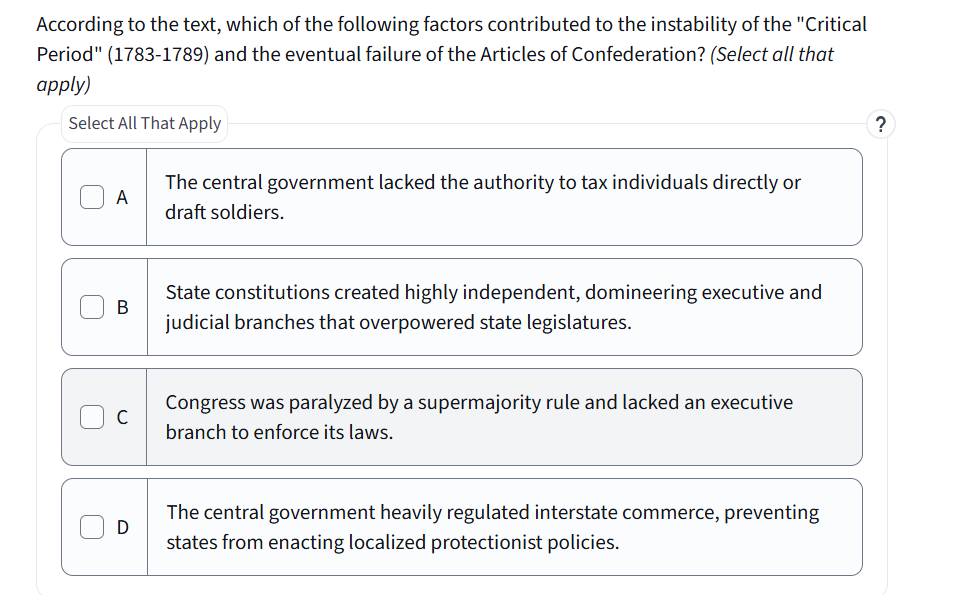
according to the text, which of the following factors contributed to the instability of the \critical period\ (1783-1789) and the eventual failure of the articles of confederation? (select all that apply)
a. the central government lacked the authority to tax individuals directly or draft soldiers.
b. state constitutions created highly independent, domineering executive and judicial branches that overpowered state legislatures.
c. congress was paralyzed by a supermajority rule and lacked an executive branch to enforce its laws.
d. the central government heavily regulated interstate commerce, preventing states from enacting localized protectionist policies.
🆕 New Concept Discovered: Weaknesses of the Articles of Confederation
How a weak central government led to economic and political instability.
Step 1: Analyze Option A (Taxation and Military Power)
Under the Articles of Confederation, the national government was intentionally kept weak to avoid tyranny. It did not have the power to levy taxes directly on citizens; instead, it had to request funds from the states, which often ignored these requests. Additionally, the national government could not draft soldiers directly and had to rely on state militias. This lack of financial and military authority directly contributed to the instability of the "Critical Period." Therefore, Option A is correct.
Step 2: Analyze Option B (State Government Structure)
During this period, most state constitutions actually did the opposite: they severely limited the power of their executive (governors) and judicial branches because of a deep-seated fear of monarchical rule. Instead, they concentrated almost all power in highly democratic, unicameral or bicameral state legislatures. The legislatures dominated the other branches, rather than being overpowered by them. Therefore, Option B is incorrect.
Step 3: Analyze Option C (Congressional Gridlock and Enforcement)
To pass any major legislation under the Articles of Confederation, a supermajority of 9 out of 13 states was required, making it extremely difficult to address national issues. Furthermore, there was no independent executive branch (like a President) to enforce the laws passed by Congress, leaving the central government virtually powerless to implement its decisions. Therefore, Option C is correct.
Step 4: Analyze Option D (Interstate Commerce Regulation)
The central government under the Articles of Confederation completely lacked the power to regulate interstate commerce. As a result, individual states frequently enacted their own localized protectionist policies, such as placing tariffs on goods coming from neighboring states, which severely harmed the national economy. The central government did not heavily regulate it; rather, its inability to regulate it caused instability. Therefore, Option D is incorrect.

Snap & solve any problem in the app
Get step-by-step solutions on Sovi AI
Photo-based solutions with guided steps
Explore more problems and detailed explanations
- A (The central government lacked the authority to tax individuals directly or draft soldiers.)
- C (Congress was paralyzed by a supermajority rule and lacked an executive branch to enforce its laws.)